
Early in my son’s discernment process, one of the biggest shocks was related to something very concrete, not spiritual.
About 2 weeks after my son first told me he thought God was calling him to the priesthood, I attended a women’s retreat that had been planned for several months.
In God’s perfect timing, it was exactly what I needed to get away and spend time in prayer and reflection to sort out my feelings, confusing thoughts and my imagination running wild.
At that time, I was struggling with the objection: “He is too young”.
It wasn’t the idea of discerning a vocation, just not right now. He hasn’t even been out in the world yet to see what else is out there. I didn’t want him to rush headlong on a whim or idealized fantasy and then feel trapped with a decision he made when he was so young. Remember, this was 2 weeks in, so it is easy now to pick out my misconceptions about discernment.
Arriving at the retreat a little late, I was looking for my assigned room, when I spotted a young man with a cassock and collar up ahead.
“Excuse me, Father, can you tell me where Tannery Hall is?”
When he turned around, the shock almost knocked me over. This young man looked about 16 years old! He graciously showed me where to go and helped me with my luggage. At this point, I was reeling. A few hours later I found out that this was a 19 year old seminarian who had just finished his first year in college seminary. He was helping the priest leading the retreat.
Now in my Catholic playbook, if you are wearing a cassock and a white collar, you are a priest. I know I haven’t been around a lot of seminarians in my life, but I thought this was a pretty stable concept. When did this happen? When did seminarians start dressing like priests?
One of the traditions for new seminarians is something called “Cassock Day”. This is when the new men have their 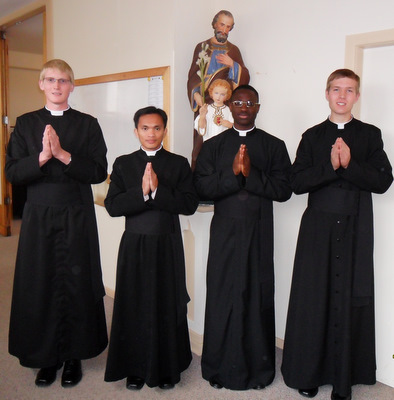 cassocks blessed and are now allowed to wear them for specific functions in seminary; sort of a rite of passage.
Cassock Day last year was the first time I ever saw my son dressed like a priest in a cassock and collar. My very first thought was that it looked like he was dressed up for Halloween. The clothing was in such a juxtaposition to the son I knew. But he was so happy and proud, I couldn’t help but be happy for him.
All this back story is leading up to a posting on Seminarian Casual, the blog for St Charles Seminary in Philadelphia, about Cassock Day this year. It describes the history and significance of the cassock. Once you read it, you will understand why seminarians wear the cassock proudly.
The Cassock: Sign of Love
- Posted on September 19, 2015
- by Matthew Richardson
- in Current Events, Seminary Life
This weekend here at St. Charles is the annual “Cassock Day” celebration for every new man. Cassocks are the black, button-down robes that seminarians and priests, wear for liturgical functions. On Saturday, our cassocks will be blessed and we will be allowed to wear them for the first time since entering the seminary.
As a new man, I wanted to find out many things about the Roman Cassock in preparation for this day. There are many interesting facts that I found about the cassock, such as the normal cassock has thirty-three buttons symbolizing the Earthly life of Christ. Or that the five buttons on either side of the sleeves symbolize the five wounds of Christ. But the most interesting fact that I found was that the cassock was once worn by highly esteemed soldiers riding to the battlegrounds of war. The new soldiers would ride after them, recognizing the garments in which they had on.
We, no matter what denomination, are being thrown into battlegrounds between good and evil every day. The sad truth is that most of us choose not to follow the “esteemed soldiers,” but rather try to lead ourselves with no aid. We abandon our brothers and sisters and end up being berated by the enemy. But, lucky for us, those “esteemed soldiers” never turn their backs on us. When they see us turning away, they find us and remind us that there is a battle to be won, a battle for Christ and His love!
The cassock is not just a cloth priests, deacons, or seminarians wear “just for the heck of it”, but it is a sign. It is a sign of Christ’s love for the world. It is a sign of “esteemed soldiers” who try to lead all to victory. Gustave Flaubert, a famous French author, once said, “The true poet for me is a priest. As soon as he dons the cassock, he must leave his family.”
The priest, or seminarian, must leave his family for the sake of protecting and leading God’s children. He symbolically accepts this task by putting on the cassock. He is now an “esteemed soldier” for Christ and His Church.
Now all of us seminarians, whether new men or old men, are not worthy to receive or to even wear the cassock. To think of all the men who have worn it before is quite literally feeling like a midget in a giant’s footprint! But whether we feel like this or not, it is a symbol of Christ in the world in which we are all called to share, especially those discerning the possibility of priesthood.
The cassock, out of everything it is, is a pure sign of love. And that, for all of us, should give us a motive for praying for our priests, bishops, and pope. We should pray constantly for our “esteemed soldiers” and pray that one day these warriors for Christ and His Church may lead many into His Kingdom.
You are all in our thoughts and prayers, but I also hope we are in yours. We need good people of God, and you need holy seminarians that can discern if we can fully take on the cassock, a sign of love.
Please know that the authors of this blog pray daily for parents of discerning sons and daughter to find understanding and peace.


 Since you are reading this blog, you might be interested in following a blog where seminarians and faculty post regularly. “Seminarian Casual” is the blog on the website for St Charles Borromeo Seminary in Philadelphia. FYI: This is where Pope Frances will be staying when he comes to Philadelphia for the World Meeting of Families (WMF). I expect we will see more posts from an insider’s perspective on these events, including hanging out with Pope Frances.
 unusual for young guys to follow football. But when I read this post, I was astonished at the level of detail on the history, stats and current status of teams in the NFL divided by division. This level of detail has to come from a deep and ongoing passion for keeping up with everything from player trades to injuries to coaching strategies. I am sure there are obscure points of significance not in this post, which the author would be happy to discuss over a cold beer.
 Their major in college may be Philosophy or Theology in graduate school, but you can bet these guys can argue the merits of the offensive strategies of the Philadelphia Eagles with the same passion as the classic works of St.Thomas Aquinas.

 er to marry my husband. Did I see this as a sacrifice? No! I wanted to do it. I did it happily, whole heartedly, joyfully. Did I understand the full implications of those vows? At the time, I thought I did. But of course as the saying goes, you have to say “I do” every day, even when you don’t want to, even when it is hard to love. Did I fully know what that meant? No, no one does on your wedding day









 to a point outside of a seminary environment. Inside, there are significant opportunities and advantages to help him come to an understanding of whether or not he is called to priesthood. The advantages of seminary described here can help you understand that going to seminary may be the next right step. Those who do not take this next step may spend the rest of their life wondering if they were called to be a priest. No one wants their son to live with a lifetime of questions and regret.
 privileged to experience. You can think of it as coaching in order to determine what God wants you to do with your life and become a better person. The environment at seminary is conducive to this discernment by having the time and resources available in a structured, positive environment. Every year, seminarians come to the decision, with the assistance of their spiritual director that they are not called to be a priest and decide to leave the seminary. Some refer to this as “discerning out.” When they leave may have more to do with finishing the semester to finish academic credit than anything else.
 and drink alcohol in moderation if over 21 years old. They aren’t roaming the halls singing Gregorian chant. They do have mass every day and pray the liturgy of the
  hours together and have curfews. Faculty take note if someone is not in class and they look into it. You can’t hide in seminary. Even as his mother, I am not allowed in my son’s room if he needs something from home.
 confidentiality, parents have absolutely no right to knowledge about the
 Seminarian Parents