God In All Things

Taken from Wikipedia, provided by Piotr Bodzek, MDIt’s been a rough couple of weeks at our house.  Cathy already hit the highlights of when things started to go south.  There’s more to the story, though, and I think it’s worth sharing.

The trip to the ER followed a week of belly pain and the onset of a fever.  In short order they recorded my vitals, poked and prodded my abdomen, gave me an IV and ran me through a CT scanner.  Everyone was caring and efficient and shortly after the scan one of my nurses said, “It’s appendicitis.  If there’s a surgeon available we’ll operate tonight.  If not, we’ll admit you and operate in the morning.”

Oh.  Okay.

Mystery solved, I guessed.  The health team was clearly feeling some urgency, but nobody seemed to be panicking.  I took that as a good sign.

Sometime around midnight a doctor came into the room, introduced himself, and started talking about the procedure.

“I take it you’re the surgeon?” I asked.

“Yes,” he laughed.  “I forgot to mention that.”

He ran through what was going to happen and said he’d see me in the OR.  On the way out, he said, “They found a tumor in your bladder.  You’ll need to see a urologist about that in the next week or two.”

Oh?  Not okay.

My father died in 2011 of a type of bladder cancer.  Hearing that I had a tumor was somewhat alarming.  (Although I have to admit that my feeling of alarm may have been attenuated a bit by the morphine they’d pushed through my IV.)

When they let me go mid-morning on Monday, the discharge instructions included a reminder to contact a urologist as quickly as possible.  The night before the surgeon had provided some referrals on the back of his business card.  Both of us were exhausted having only gotten a couple of hours’ sleep the night before, so we didn’t even think about the card again until Tuesday.

We researched the providers, selected one, and made an on-line request for an appointment.  By Wednesday we’d had no reply, so I called the Urology Clinic and they said they could get me in late on Thursday — the day before the holiday weekend.

The urologist we chose is an enthusiastic young doctor who had already reviewed the CT images by the time we got to the clinic.  He outlined the various scenarios from worst (metastasized cancer that would require extensive, aggressive treatment) to the best (low-grade non-invasive cancer).  Then he had us go to his procedure room so he could check the tumor visually.

“That’s a classic smoking-gun cancer,” he said when it showed up on the screen.  He snapped a couple of reference images and told me he had an opening on his surgical schedule for Monday morning.

Another Monday, another surgery.  (Cathy has asked me to try to break myself of the habit of having surgery on Monday mornings.)

I was in the OR less than an hour and when I emerged from the anesthetic, the urologist told me that it was a low-grade cancer with a very small footprint and that it hadn’t invaded the bladder wall.  Under the circumstances, it was the best of all possible outcomes.

The pathology report (my healthcare provider has a web portal through which I can access my own medical records) officially declares the tumor as “low-grade non-invasive” and notes that it is “negative for involvement of muscularis propria”.  Confirmation that it was the best of all possible outcomes.

In less than two weeks I went from thinking I was healthy to having had two surgeries and an official cancer diagnosis.

Increasingly, I find myself drawn to Ignatian Spirituality with its finely balanced integration of the practical and the spiritual.  In particular, I appreciate how the Ignatian approach encourages us to find God in all things.

I find myself looking back over the past two weeks to see threads of Grace woven through the experience.  Certainly the brightest of the threads is the tumor diagnosis itself.  Had it not been for the appendicitis (unusual in a man my age) there would have been no reason for me to have an abdominal CT.  I was completely asymptomatic for the cancer, so it might have been years before we found it.

Another moment of Grace was receiving the sacrament of Anointing of the Sick between the Masses last Sunday.  Our pastor is on vacation and the recently-ordained Fr. Christopher Gray is filling in.  Fr. Gray performed the long form of the sacrament and it was a beautiful and moving interlude in the midst of all of everything else that was going on.  The reading for the rite was Matthew 11:25 – 30, the same as the Gospel for the Masses last weekend.

Fr. Gray noted that we should take that a sign of providence and I smiled.  I think, perhaps, he thought I wasn’t taking him seriously, but it was quite the opposite.  I did see that as a sign; yet another in the long line of signs of Grace.  (Fr. Gray also noted that I had now received six of the seven sacraments and only lacked Holy Orders to make it a full house.)

The Grace came me through the event itself and its marvelous timing; through my wife’s care and resiliency in getting me to and from the hospital and appointments and standing beside me the whole time; through our friend Amy who urged us to go to the ER; through the care provided by the many different professionals I’ve interacted with in the last couple of weeks; and through the support and prayers of my friends, family and community.

God truly is in all things and these past two weeks I’ve had the privilege of getting a glimpse of some of the unexpected places that reveal God’s presence.

The Iron Pen

P6292084Last Sunday was a day of contrasts.  As you already know from Cathy’s post, it ended with a trip to the ER that resulted in early-morning surgery is a nearly deserted hospital.  Definitely not the day we had planned.

The day had started on a considerably brighter note.

Cathy was at St. Rose, registering students for the upcoming (and first ever for our parish) VBS.  I was at home, puttering about on the computer.  The phone rang, signaling a call from Ian.  After we’d exchanged “good mornings” he said, “I was awakened by a very strange call.”

“Oh?”

“Apparently I’m the honorable mention in the Iron Pen contest.”

The Wasatch Iron Pen Literary Marathon is sponsored by the Community Writing Center in Salt Lake.  It is timed to coincide with the Utah Arts Festival.  The contest rules are fairly straightforward.  Prospective contestants register in advance.  On Friday night at 6:00 p.m., the contestants assemble at the Community Writing Center office and they are given a prompt for their writing.  They have twenty-four hours to conceive, execute and submit some piece of literature which relates to the prompt.  The categories include fiction, non-fiction and poetry and there are youth and adult divisions.  The completed texts are submitted on Saturday and judged by a panel of Ph.D. candidates recruited from the writing program at the University of Utah.

Ian is a talented writer who has done well in NaNoWriMo and is developing a good voice.  He’s entered the Iron Pen before, but never been able to find his place among the winners.  Nonetheless, he persists and entered again this year.

Friday night, just after getting the prompt, he called for a quick brainstorming session.

“What’s the prompt?” I asked.

A woodcut of Monument Valley by Everett Ruess,” he said.

Everett Ruess is a somewhat romantic figure who travelled the southwest writing and creating art until he vanished into the canyons.  Ian had already dug up a bit of information about Ruess on the web and we kicked around a few ideas about how Monument Valley has become the visual icon of the west for many people and what Ruess might have made of that; what the people and land were like in that part of the country, and what really might have happened to Ruess.  I went off with my wife and mother to see Jersey Boys and Ian set to work.

When we talked on Saturday he outlined what he had written and seemed satisfied with it, so he whipped up the mandatory cover page and turned it in.

All of which brings us back to Sunday morning when he called.  Not only was he the runner up in the fiction category, there was to be a reading of all of the winning entries (by the winners) that afternoon at two.  For entering he got a ticket to get into the Arts Festival that afternoon and he had two guest tickets.

I called Cathy, she arranged for someone to cover registration at the last Mass of the day and we made out way down to meet Ian, take in some of the festival, and see his reading.

As parents, we are very proud.

From a literary point of view, Ian’s story is a lovely piece of character work that gives a strong sense of who Ruess was as a person.

After the reading, we all went out to dinner to celebrate.  Which was when my stomach ache really started to get bad and you know the rest.  If the day had to end in the hospital, I’m grateful for the interlude with family before then.  I love watching Ian develop his writing and it’s nice to see him get some affirmation.  (And the bag of swag he got was pretty cool too!)

The winning entries will be posted on the web at some future point.  When that happens, I’ll provide a link.

— Dad

A Book Report

CBC_thumbnailEvan has gone back to DC and will shortly be headed out on a retreat.  Before he left we had a conversation about the contents of this blog.  One of his brother novices pointed out that — from the parent’s perspective — there’s stuff to write about at the beginning of seminary and stuff to write about at the end.  In between are classes and seminars and apostolates and service.  Maybe not the most riveting content.

There’s some truth to that, but I expect we’ll have a few interesting tidbits to pass along in the coming year.  And, this blog is as much about us s it is about the seminary experience.  We, too, are living through our faith journey which is a continual conversion experience.

The nice thing about conversion is that it’s an experience we all get to share with one another.  And that brings me to the topic of this post; a brief report on a great book about a personal conversion.

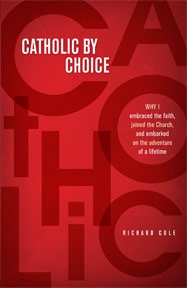
Catholic by Choice: Why I embraced the faith, joined the Church and embarked on the adventure of a lifetime is Richard Cole’s memoir the journey that brought him into the Catholic church.  Cole brings his poet’s sensibility to a personal saga which he describes as “…a love story about conversion and the honeymoon of faith.”

Evan met Richard while on his apostolate in Austin and gifted me with an autographed copy of the book for my fiftieth birthday.  As a convert myself, the subject matter drew me in and the beautiful, vivid language held me to the end.

Cole opens the book with a trip he took to a monastery for the purpose of rest and relaxation.  What he found, though, was a spiritual director.  She tells him, “You are being created, very deliberately, at God’s own pace. It’s like being pregnant or cooking.  If the soup takes three hours to make, you can’t rush it.  Just wait.  And while you’re waiting, you have to trust.  You can’t presume to know what God is doing.  That’s not faith; it’s a false security.  You simply have to have faith.”  Like a kid in an adventure story who discovers a fragment of a pirate’s treasure map, Cole began his search.  Along the way, he flashes back to his younger years, his struggle with alcoholism, and his desire to be significant.  Nothing he turned to seemed to satisfy his hunger, until he began to discover Christ.

His wife had been raised Catholic and had parted company with the church, so they sought compromise solutions by joining other communities.  Even as they attended an Episcopalian parish, Richard also went to daily Mass.  He read the Bible daily, hoping to find some answer and he prayed and encountered Jesus.

It really is a story of an inch-by-inch conversion.  Cole tried to be good enough for God.  A recurring theme in the book is his need to have the “right” answers and to be seen as the smart one — an impulse I’m entirely too familiar with in myself.  In the end, though, he has to let go and enter fully into relationship with God.

Near the end of the book returns to the monastery for another retreat and is frustrated that he can’t seem to figure out why he’s there and what God wants from him.  His spiritual director gives him some good advice.  “Don’t’ analyze.  Think about what’s happened to you this weekend, but don’t analyze it.  You don’t evaluate a loving relationship.  You’re simple there with the beloved.”

Cole’s honesty throughout the book is engaging and there’s nothing I can write here that will truly do it justice.  So, I won’t try.  I’ll end with one more quick quote and a relevant video.

Cole has joined the RCIA program at his parish and tells of a classmate who approaches the task of conversion like a doctoral candidates on the fast track.  She attacks the problem of faith with books and a copy of Ignatius’ Spiritual Exercises.  She asks the RCIA director for the best way to pray as if there is a universal answer that will fit all people in all situations.

The director answers; “Dance with God.  Don’t read or study.  Just try dancing, literally dancing with the Lord.”

I think that might be what the producers of the BBC series Rev had in mind when they wrote this into the series:

— Dad

Gloria, Grace & the Temple of the Forbidden Eye

100_2708-001

Evan is in the middle of a two week vacation.

(Aside: Yes, the novices and students get vacation time every year.  With the Paulist Assembly complete, they were all free to knock off for a couple weeks and travel.)

It’s been a busy couple of weeks for him; he traveled with us to Disneyland and was attending a wedding between two of his good friends from college.

The Disneyland trip was a gift from my mother who wanted to spend some of her money on a multigenerational family trip with all of the grandkids and her one great-grandchild.

Evan arrived in Utah on Friday and we all took off for California on Saturday morning.  The trip went brilliantly.  Cathy, Evan and I attended Mass on Saturday night at Holy Family Cathedral.  On Sunday, we hit the park hard, taking in as much of it as we could.

That evening, something extraordinary happened.

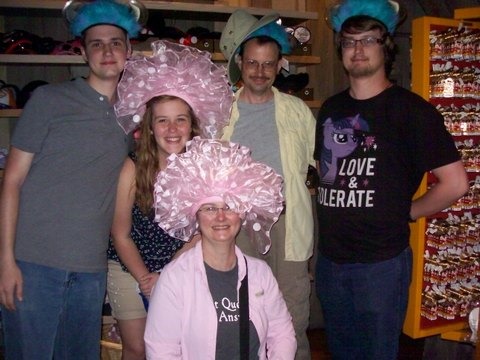
100_0598My niece (who had never been to the park before) asked to stop in at a gift shop to purchase a Minnie Mouse tank top.  As she was checking out, we struck up a conversation with Gloria, the helpful cast member behind the counter.  My niece commented on a tutu hat that someone outside was wearing and Gloria seized the opportunity to show us where the hats were stocked.  She decked out Cathy and our niece with the tutu hats and got the boys and I to wear Sully hats while we all posed for a picture.  It was one of those silly-but-fun moments that so endears the park to Cathy and I.

Then something remarkable happened.

Gloria asked about our visit and how long we were staying and then she said, “Stay right here.  I have a surprise for you.”

Oh?  She vanished into the back for a few minutes and I started to wonder if she had gone for security to deal with an excessively exuberant family.  She reappeared, handed Cathy a slip of yellow paper and said, “This works just like a Fastpass for the Indiana Jones ride.  Enjoy!”

We stammered a thanks, hurried out the shop and across to the Indiana Jones queue.  We had wanted to ride it a second time that day — my niece declared it one of her favorite rides — but at that point the wait was approaching 60 minutes.  At the end of a long day on the park, that seemed a little bit too long to stand in line.

Gloria’s generous gift got us to the head of line and on the ride in no time.

All of which actually got me thinking about the sacraments and grace.

You see, I think Gloria’s gift to us makes a pretty good object lesson on the sacraments.

Let me start with a couple of definitions and I’ll see if I can make my case.

In the summary of the section on the sacraments, the Catechism states:

(1131) The sacraments are efficacious signs of grace, instituted by Christ and entrusted to the Church, by which divine life is dispensed to us. the visible rites by which the sacraments are celebrated signify and make present the graces proper to each sacrament. They bear fruit in those who receive them with the required dispositions.

Which calls back to the Catechism’s definition of grace:

(1996) Our justification comes from the grace of God. Grace is favor, the free and undeserved help that God gives us to respond to his call to become children of God, adoptive sons, partakers of the divine nature and of eternal life.

(1997) Grace is a participation in the life of God. It introduces us into the intimacy of Trinitarian life: by Baptism the Christian participates in the grace of Christ, the Head of his Body. As an “adopted son” he can henceforth call God “Father,” in union with the only Son. He receives the life of the Spirit who breathes charity into him and who forms the Church.

(1998) This vocation to eternal life is supernatural. It depends entirely on God’s gratuitous initiative, for he alone can reveal and give himself. It surpasses the power of human intellect and will, as that of every other creature.

Go back and take a look at that phrase buried in the middle of 1996 — free and undeserved help.

The gift that Gloria gave us was freely given and undeserved.  There were thousands of people on the park that day and we were no more deserving of special treatment than anyone else.  In all honesty, I’ve no idea why Gloria picked us to be recipients of her generosity.

Which is the same paradox every person faces when confronted with God’s grace.  Why should God choose me?  Why am I granted the gift of faith when others aren’t? It is — as they say — a mystery.  The only thing we can really control is our response to the gift.

And that brings me to the sacramental parallel.

Gloria’s gift was embodied in a piece of paper.  It bore Cathy’s name, the name of the ride, and a few other points of data.  On it’s own, the paper was unremarkable; just another of the thousands of forms that corporations generate.  It became personally powerful to us when we accepted it and used it for its intended purpose.  More than a mere slip of paper, it moved us to the head of the line.  We had to claim the reward by being in the right place and ready to act.

In the same way, church affirms that the sacraments are a mechanism of conferring God’s grace.

(1127) Celebrated worthily in faith, the sacraments confer the grace that they signify. They are efficacious because in them Christ himself is at work: it is he who baptizes, he who acts in his sacraments in order to communicate the grace that each sacrament signifies. the Father always hears the prayer of his Son’s Church which, in the epiclesis of each sacrament, expresses her faith in the power of the Spirit. As fire transforms into itself everything it touches, so the Holy Spirit transforms into the divine life whatever is subjected to his power.

(1128) This is the meaning of the Church’s affirmation that the sacraments act ex opere operato (literally: “by the very fact of the action’s being performed”), i.e., by virtue of the saving work of Christ, accomplished once for all. It follows that “the sacrament is not wrought by the righteousness of either the celebrant or the recipient, but by the power of God.” From the moment that a sacrament is celebrated in accordance with the intention of the Church, the power of Christ and his Spirit acts in and through it, independently of the personal holiness of the minister. Nevertheless, the fruits of the sacraments also depend on the disposition of the one who receives them.

(1129) The Church affirms that for believers the sacraments of the New Covenant are necessary for salvation. “Sacramental grace” is the grace of the Holy Spirit, given by Christ and proper to each sacrament. the Spirit heals and transforms those who receive him by conforming them to the Son of God. the fruit of the sacramental life is that the Spirit of adoption makes the faithful partakers in the divine nature by uniting them in a living union with the only Son, the Savior.

Like the slip of paper (only in a much deeper and more meaningful way) the sacraments give physical and visible form to the grace of God.  The sacrament flows from the power of God who can act through the sacrament regardless of the righteousness of those involved.  At the same time, the fruits of the sacrament — whether or not there is a some individual outcome — depend on the “disposition of the one who receives them.”

Just like Gloria’s gift to us, the sacraments are valid regardless of our actions.  Yet, for the sacrament to yield some sort of fruit in us, we must be properly disposed to make use of the grace it imparts.

Finally, the gift was a reminder that you never know how much of an impact you might have on other people.  Gloria’s generosity certainly made this a memorable vacation for us.

— Dad

Path to the Priesthood

Saturday, May 24, 2014 saw the addition of a new priest to the Paulist ranks.  “Jimmy” Hsu, having completed his formation period was ordained by Bishop Joe Vasquez of Austin, Texas.
If you dig into the archives of the Paulist Fathers’ website, you can trace Jimmy’s formation.

It starts with an article from August 2009 detailing the Mass at which Jimmy marked the transition from novice to student by making his first promises to the community.  In part, the article says:

For Yao “Jimmy” Hsu, the novitiate year was a chance to experience St. Paul, the legacy of faith left by Paulist founder Servant of God Father Isaac T. Hecker and being part of a community.

“[Making first promises] is the first formal step to being part of the Paulist community, but is another small step in the road ahead,” he said.

Fast-forwarding to September of 2013 brings us to Jimmy’s final promises, payment for service (one penny) and ordination as a transitional deacon.

Jimmy Hsu, CSP, took his final steps toward the priesthood by pledging a lifetime of service with the Paulist Fathers before his Paulist brothers, family and friends Sept. 6 in the chapel of St. Paul’s College in Washington, D.C. The next morning, Mr. Hsu was ordained to the diaconate in the Crypt Church of the Basilica of the National Shrine of the Immaculate Conception by Most Rev. Barry C. Knestout, auxiliary bishop of Washington, D.C.

After one year of ordained service as a deacon, and update on the Paulist Fathers’ website reflects on Jimmy’s journey and his impending ordination.

Encouraged by family and friends, Deacon Hsu was inspired by the example of the Paulists he met at the University Catholic Center while earning a philosophy degree at the University of Texas at Austin.

“My family has always been supportive of whatever I do, and they are proud of my decision [to become a priest],” Deacon Hsu said. “And the Paulists have been there to help me process my experiences in formation and become part of the community.”

The big moment came on May 24, 2014 when Jimmy Hsu was ordained.

“You will be consecrated to Christ in a very special way,” said Bishop Joe S. Vasquez of the Diocese of Austin, Texas – Deacon Hsu’s home diocese – who presided over the ordination.

“Impart to everyone the word of God you have received with such joy,” the bishop said, “so that by your example you will build up the house that is God’s Church.”

One of the things that has impressed us the most about the Paulists is the strong sense of community.  (I suspect the same is true of most orders.)  Evan has become part of a larger family and considers Jimmy a brother.

We extend our congratulations to the newly ordained Reverend Jimmy Hsu and pray that God blesses his ministry.

— Dad

Still the Father

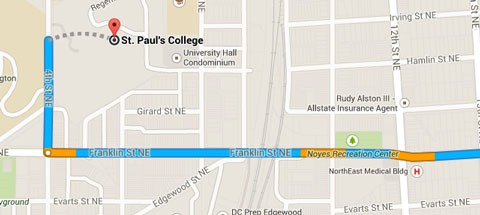
DC_Map

Last Sunday I was sitting at the computer when my phone rang.

It was Evan.  Unusual for him to call on a Sunday.

“Hi,” I said.  “What’s up?”

“I need an exit.”

“Huh?”

“I’m lost in DC and need help getting back to the college.”

“Ah…where are you?”

“Ummm…Ord and…hang on…there’s a cross street coming up…4th.”

“Okay…stand by…”  I called up Google maps and felt a little like an air traffic controller in one of those disaster movies.  Here I was, thousands of miles away, guiding Evan in with my voice.  “Got you.  Tell me the next cross street.”

“Okay.  Here is comes…45the Place.”

“Bingo.  You’re headed west.”  I asked Google for directions to St. Paul’s college and it obligingly tossed up a cheerful blue line tracing a path across the city.”

“Okay.  I can guide you in from here.”

So I stayed on the line, giving directions, tweaking the route when real-world road conditions didn’t match my tidy-bird’s eye view, and easing Evan back home.  While he drove, he filled me in on just how he’d come to be in an unfamiliar part of the city.

As part of his training, he is encouraged to attend other churches.  In his novice year he’s attended services in churches where English is never spoken, he’s taken some of his classmates to a Mormon ward meeting, and he’s developed a particular fondness for the spirituality of the Eastern Rite churches.  This past Sunday he went to a Ruthenian church.  Like many of the Easter Rite churches, it is considered to be in full communion with Rome.  The rites are different, though, from those you’d find in the average Roman Catholic church in the U.S.

Evan enjoyed his visit, but got turned around on the way out and needed a little help finding his way.

Which reminded me that — even a continent away — I’m still the Dad.

Both of my sons still seek my advice on matters small and large.  (They don’t always take my advice — that’s the beauty of asking for advice.  Just because somebody gives it to you, you don’t have to accept it.)  While he was an undergraduate, Evan frequently asked me to review his papers and make suggestions as I saw fit.  Ian has sought my advice on school projects, his novels and various job situations.  And, at various times, I’ve served as their personal OnStar.

(Aside: I don’t blame Evan for getting lost.  Out here where Evan grew up, the cities are laid out in nice, square grids.  Addresses tend to be things like 550 East 300 South.  If you know the city and the E/W and N/S coordinates, it’s almost impossible to get lost.  Especially if you know that the Wasatch Mountain range lies to the east.  If your destination is to the east, drive toward the mountains.  South?  Keep the mountains on your left side.  By contrast, the roads of Washington DC appear to have been laid out after a night of heavy drinking by contractors who were unclear on the concept of “the shortest distance between two points.”  Of course, that could just be my western bias.)

All of which got me thinking about my relationship with God.  You know, God the Father?

(To be clear — and to avoid giving offense — I’m not suggesting that I’m God or even particularly God-like.  The situation just gave me pause to think.)

When we call out to God for help, it’s usually because we’re lost somewhere.  We’ve gotten stuck or confused or overwhelmed and need to find a way back home.  And God is still the Father.  Still there.  Waiting to give us guidance and advice.

Even though I don’t follow that advice as often (or as closely) as I should, I still find the fact of God’s presence comforting.

— Dad

P.S.

For a more elegant exploration of this idea, I suggest you click over to the Ignatian Spirituality blog.

Back from the Desert

There’s a delightful bit in Pixar’s “Up” in which Russell (the eternally optimistic scout) is trying to assemble a tent.

Tents are hard!

The scene ends with the tent sailing over the rain-soaked horizon with Russell dejectedly declaring, “Tents are hard.”

A few years back Cathy and I adopted that as a family meme during Lent.  Whenever our Lenten sacrifices seemed particularly difficult, we’d look at each other and say, “Lent is hard.”

This Lent turned out to be unexpectedly difficult.  Not that I’m complaining, mind you.  It just wasn’t the Lent we anticipated.  But, I guess, that might have been the point.

Of course we were busy with the formation classes we were teaching and the Catechist Formation course we were taking.  For me, spring is always a busy time at work as we wrap up one fiscal year and plan for the next.

That was expected.

Cathy’s accident on St. Patrick’s Day was something of a surprise.

She fell and broke her right arm.

Too much merriment?  Nope.  She was at work and tripped on the sidewalk while crossing between two buildings.  She’d been holding an empty box and had her hand curled under.  When she fell, she landed on the back of her right wrist.  I’m not medically trained, but if I understood the doctor, the official diagnosis was that she “crunched the bone up, but good.”

Good enough, anyway.  The next day she had surgery to put in a T-shaped bit of titanium and seven screws.  (Oddly, when you compare broken arm stories with people, they want to know exactly how many screws you got.  Perhaps there’s some secret club you can join when you have enough screws in your bones.)

She was out of work for the better part of two months.  She’s had casts and braces and physical therapy appointments and doctor’s visits. Her medical clearance was granted this past Wednesday and she’s pleased to be back on the job — even if she’s discovering some unexpected limitations.  (Who knew staplers required so much force to operate?)

Cathy was a trooper and did well.  Still, we had to shift some of the household responsibilities and some things had to go by the wayside (including the blog) while we sorted things out.

Evan’ sojourn in Austin was spirit-filled and he came back with a better idea of how parish life looks from the priest’s point of view.  He also had a chance to visit old friends, new friends and distant relatives whilst in the weeks leading up to Easter.

And, as part of my Lent, I designed a new website.

It felt, in many ways, like a sojourn in the desert.  Not what we had expected; and more harsh than we anticipated.

There’s power in the desert imagery, though.  Cathy and I love the desert wastelands of southern Utah; the intimidating rock formations, deep canyons, and surprisingly stubborn life.  The desert is a hard place, but that hardness makes the life there all the more sweet.  Like grace born of suffering.

Easter was lovely, though.  The Vigil Mass was beautiful and moving as always.  Cathy has been restored and life is settling back into something resembling routine.  In the end, it was worth the journey, but I think the phrase “Lent is hard” may mean something a bit different to us from now on.

— Dad

Closing Doors, Opening Grace

doorsOne of the comments we hear most often when we tell people about Evan’s discernment is, “That’s quite a commitment.”

Yep.  Sure is.

I’ve got to admit, though, that I often have a less-than-charitable (much less) reaction.

Marriage is quite a commitment, too.  The Church makes this clear in the Catechism when it notes:

Thus the marriage bond has been established by God himself in such a way that a marriage concluded and consummated between baptized persons can never be dissolved. This bond, which results from the free human act of the spouses and their consummation of the marriage, is a reality, henceforth irrevocable, and gives rise to a covenant guaranteed by God’s fidelity. The Church does not have the power to contravene this disposition of divine wisdom.

The phrases “can never be dissolved” and “henceforth irrevocable” don’t leave much room for interpretation.  Marriage — properly considered — is a life-long commitment.

I’m not arguing that the religious life is easier than — or even equivalent to — marriage.  Both states have their challenges and blessings.  God’s grace is all that gets any of us through either of them.

What really bothers me about that comment, though, is the modern notion that commitment is a bad thing and maybe he ought to keep his options open.  I don’t think that’s the way God intended things to work and the research backs me up.

I stumbled over this study while preparing a presentation called “Hacking Your Happiness to be more Relaxed, Resilient, and Resourceful.”  The premise of the presentation is that there are simple things we can do to “hack” our own emotional states for the better.  One of the simplest is making choices.

Behaviorist and research Dan Ariely conducted research on making choices using materials you probably have around the house — undergraduates from MIT and a door simulation program that pays real cash awards.  Okay, you probably don’t have those things around your house, so I’ll just give you the lowdown from a New York Times article.

In the M.I.T. experiments, the students should have known better. They played a computer game that paid real cash to look for money behind three doors on the screen. After they opened a door by clicking on it, each subsequent click earned a little money, with the sum varying each time.

As each player went through the 100 allotted clicks, he could switch rooms to search for higher payoffs, but each switch used up a click to open the new door. The best strategy was to quickly check out the three rooms and settle in the one with the highest rewards.

Even after students got the hang of the game by practicing it, they were flummoxed when a new visual feature was introduced. If they stayed out of any room, its door would start shrinking and eventually disappear.

They should have ignored those disappearing doors, but the students couldn’t. They wasted so many clicks rushing back to reopen doors that their earnings dropped 15 percent. Even when the penalties for switching grew stiffer — besides losing a click, the players had to pay a cash fee — the students kept losing money by frantically keeping all their doors open.

Ariely explains the phenomenon this way:

“Closing a door on an option is experienced as a loss, and people are willing to pay a price to avoid the emotion of loss,” Dr. Ariely says. In the experiment, the price was easy to measure in lost cash. In life, the costs are less obvious — wasted time, missed opportunities. If you are afraid to drop any project at the office, you pay for it at home.

“We may work more hours at our jobs,” Dr. Ariely writes in his book, “without realizing that the childhood of our sons and daughters is slipping away. Sometimes these doors close too slowly for us to see them vanishing.”

It’s that sense of loss, I think, that people are expressing when they talk about the commitment inherent in pursuing a vocation.  And, there’s truth in that.  Choosing a life built on promises does limit your options.  But, as Ariely demonstrated in his experiment, we can experience greater rewards by committing to a choice.  In the final analysis, making a choice and moving ahead in God’s grace is the path to satisfaction.

— Dad

BONUS:

A lovely post over at the Happy Catholic blog captures the truth of this better than I did.  Read it here.

BONUS BONUS:

Watch Dan himself explain his research.

Life’s full of tough little choices, isn’t it?

Newsiness

A quick post with a couple of updates from St. Paul’s college.  If you’re looking for deep insights today, wander on over to the Catholic channel on Patheos.com.  Today’s post is just a metaphorical postcard from DC.

First up, this past weekend the college held a “Come and See” weekend retreat for men contemplating a vocation.  Evan reports that it went well.  If I understood him correctly, there were about fifteen men in attendance.  I pray that in calling those whom He will, God invites many new members to join the Paulist community.

The other news is that Evan will be travelling to Austin, Texas later this week to serve his Lenten Apostolate at St. Austin Catholic parish.  As part of the novice year, the novices spend Lent working in a Paulist parish.  This gives them a taste of pastoral work away from the rarified air of the seminary.  While he’s there, Evan will be giving a presentation on (I think) food and spirituality.

Have I mentioned that Evan is a great cook?  This past week when the snow was thick on the ground and folks couldn’t get in to prepare meals, he was called on to fix the evening meal.  He made kebabs with a strawberry sauce.  He says they were good and well received…and promised to make them for us on his next visit.

We’re looking forward to hearing about his adventures in Austin and are already grateful to the priests and parish there who will be part of his formation.

— Dad

Coffee, Catechism and a Black Apron

P2020473

Our oldest son, Ian, works as a Starbucks barista and trained as a Coffee Master.

“Coffee Master?” you ask. “What’s that?”

Coffee Masters are the Starbucks equivalent of the geniuses in the Apple Stores.  They’re the ones who know exactly what makes a blonde roast different from a dark roast and why sun dried Sumatra tastes so much better than it’s more mundane cousins.  They’re distinguished from other Starbucks partners with a black apron.  The Starbucks Melody blog explains it this way:

If you are a customer, and you have a question about coffee, look for the Starbucks baristas in black aprons:  They can talk to you about the four fundamentals of great coffee (water, proportion, grind, freshness), or if you want a low acidity coffee, a black apron Starbucks barista might steer you in the direction of Italian Roast, or if you want to try something fun and new as an espresso shot, again the barista can help answer those questions.  (The new Yirgacheffe works beautifully as a shot of espresso!).

Earning the apron was no easy task and, along the way, Ian taught me a lot about coffee.  I learned (for example) that coffee is the world’s second most traded commodity.  (Oil takes the top spot.)  I also learned to identify the various component flavors of individual blends and to articulate what I like and dislike about each.

P2020471As part of the training, Ian hosted a series of coffee tastings in his store.  These involved selecting and pairing different coffees with different foods to explore the ways in which flavors interact and strengthen one another.  In one surprising match, Ian paired a blonde roast (which I find a bit bitter) with some smoked gouda.  To my delighted, the cheese smoothed out the coffee and improved the flavor of both.

I’ve also learned to sound a bit snobbish when I say (in all sincerity) that the new Ethiopia blend has a smooth flavor that lingers on the back of the the tongue and has a chocolaty aftertaste.

I bring all of this up for three reasons;

1) I’m proud of Ian and how hard he worked to earn this distinction

2) It reminds me that the created world is good and God meant for us to enjoy it

3) There’s a link between this and the importance of catechesis

Really.

I’ve been a fan of coffee for since I took up the habit in college more than a quarter century ago.  And, for most of that time, I drank whatever was available.  I’d occasionally say something like, “That was a good cup of coffee.”  Except, I only said that because it tasted good to me.

I had no real understanding of coffee.  No appreciation for what it took to go from raw coffee cherries (they’re not really beans, I learned) to the dark liquid in my cup.  The language to describe the coffee in any meaningful way — to be able to communicate with others what I was experiencing — was beyond me.

Once I started to learn, though, a whole new universe of appreciation opened up for me.  The coffee hadn’t changed, I had.

I think the same is true for catechesis.  Cathy and I have been taking a catechist preparation course this year based on the Echoes of Faith series.  At the start, I assumed that teaching religious education was more-or-less like teaching any other subject.  It was about getting the students to understand the content.  They needed to be able to answer the questions appropriately and demonstrate some knowledge of the material.

As the class goes on, I’m rethinking that.  Certainly the knowledge is important.  Understanding is the basis of appreciation.  More importantly, though, my students need to have the experience that comes of out that knowledge.  If Ian had simply described different roast profiles to me, I’d still be stuck at the “Gee, that’s good coffee” stage of development.  By coupling the knowledge with the experience of tasting and giving me the opportunity to articulate what I was experiencing, Ian helped me to expand my appreciation of coffee.

That’s not to say that the knowledge is unimportant, but it’s too shallow a way to share the Faith.  The Catholic church isn’t a series of rules or historical anecdotes.  It is a living faith which should be experienced and integrated into daily life.  It is a way of being which fundamentally alters the believer.  Perhaps we’ve overlooked that in the past.

My “coffee formation” (if I can use that phrase respectfully) has brought me to a place of deeper understanding of and appreciation for coffee.  Bad coffee (which is sadly abundant in Utah) has become nearly intolerable and I’m willing to expend time, energy and money to get good coffee.  Imagine what would happen if our catechism programs made people turn away from lukewarm faith and made them willing to work hard at what they believe.

— Dad

Priesthood as Exemplary Masculinity

Word on Fire posted an article this week that really needs no commentary from me.  So, other than noting that the passage below caught my eye, I’ll leave it to you to read the whole thing.

In the priest’s role we find what manhood is actually all about, that being service to the Bride. In his collar of strength he gives his life day in and day out to the needs of his fellow man and the desires of his Bride, the Church. If only more men would look to this place of encouragement and follow in the footsteps of the great men who came before them, not fearing their testosterone but embracing it and letting its great fire burn within the heart of the hero we men are called to be!

Read more.

Are You Listening?

HomerListenSo, Pope Francis talked about the internet this week in the context of World Communications Day.  Much of the coverage focused on the Pope’s assertion that the internet is a ‘Gift from God‘.  I’m not going to argue that point; I have a hard time imagining a life without an always-on connection.

What really caught my attention, though, was this little nugget near the end of the Message for World Communications Day 2014.

Effective Christian witness is not about bombarding people with religious messages, but about our willingness to be available to others “by patiently and respectfully engaging their questions and their doubts as they advance in their search for the truth and the meaning of human existence” (BENEDICT XVI, Message for the 47th World Communications Day, 2013). We need but recall the story of the disciples on the way to Emmaus. We have to be able to dialogue with the men and women of today, to understand their expectations, doubts and hopes, and to bring them the Gospel, Jesus Christ himself, God incarnate, who died and rose to free us from sin and death. We are challenged to be people of depth, attentive to what is happening around us and spiritually alert. To dialogue means to believe that the “other” has something worthwhile to say, and to entertain his or her point of view and perspective. Engaging in dialogue does not mean renouncing our own ideas and traditions, but the claim that they alone are valid or absolute.

DiplomaThis caught me because I’ve trained as a mediator and have a Master’s degree in Negotiation and Conflict Management.  True story.  Also, fun fact: I earned the degree from Cal State Dominguez Hills which means it was signed by the President of the Board of Trustees who is also the Governor of California.  Thus, my degree in Negotiation and Conflict Management was signed by the Terminator.

One of the lessons that they pound into you over and over and over in conflict work is that the key to resolving conflict lies in getting people to listen to one another.  I mean, really listen.  Most of us think that we are good listeners and we’re all pretty much wrong on that point.  Let me give you a little listening test.  Check out these two quotes from Pope Francis.  What do you think he meant?

The ability to compromise is not a diplomatic politeness toward a partner but rather taking into account and respecting your partner’s legitimate interests.

No references to the need to fight terror can be an argument for restricting human rights.

Boy that Pope Francis is pretty direct, isn’t he?  And always consistently on message.  You have to respect that.

Except I lied to you.

Those quotes weren’t from the Pope.  They came from former KGB agent Vladimir Putin. Go ahead and read the quotes again.  I’ll wait.

The ability to compromise is not a diplomatic politeness toward a partner but rather taking into account and respecting your partner’s legitimate interests.

No references to the need to fight terror can be an argument for restricting human rights.

Kinda puts a different spin on them, doesn’t it?  It also raises questions about your skills as a listener.  When you thought the quotes came from Pope Francis, you probably felt warm and fuzzy.  When you learned they came from Putin, you probably wondered what he really meant.

I use this exercise when I lecture on conflict resolution.  It helps to illustrate the truth that most of us are poor listeners.  We aren’t really listening, we’re filtering what someone else says through our preconceptions and expectations.  We’re picking apart what they say with the intent of proving our point by disproving theirs.  Listening means sitting back, being open, and really hearing what the other party is saying.

In western culture we tend to confuse the phrase “I hear what you are saying” with “I’m in complete agreement with you.”  Hearing and understanding a point of view does not mean that you are persuaded by it.  It does mean that you can begin the search for meaningful common ground for dialogue.  Until dialogue beings, we are just shouting at one another over the chasm of misunderstanding.

Pope Francis summed it up better than I can when he said:

To dialogue means to believe that the “other” has something worthwhile to say, and to entertain his or her point of view and perspective.

Now, what does all of this have to with the Paulists?  (After all, this blog should occasionally connect back to the Paulist mission, right?)  One of the key Paulist charisms is the development of interfaith dialogue.  On the Paulist Ecumenism page it’s expressed this way:

The goal of interfaith dialogue is not unity in faith and worship, but mutual understanding and respect, and mutual enrichment enabling us all to respond more fully to God’s call. It includes collaboration wherever possible in response to the societal problems we commonly face. For this reason, the purpose of theological dialogue will not be to prove that one side is right and the other is wrong, but rather to explore respective positions in order to understand them better. When this is done, many prejudices, built on half-truths, will fall by the wayside.

Like all of the faithful, I long for the day when we are not divided.  More to the point, I’m responsible to help bring that about.  From my studies in conflict, the best way forward is to begin by listening to find the places where we can meet and begin our journey together.