Eighteen Months and Counting!

We’ve been posting thoughts here (off and on) since June of 2013.  For those of you who have followed from the beginning, thank you!  For those just joining us, welcome.

Looking over our logs, the links below represent some of our most popular posts, serve as a great overview of our adventure, and answer the most common questions we’ve received.

As always, we welcome your questions.  If there’s something you’d like to know, we’ll do our best to answer.  E-mail us at SeminarianParents@gmail.com

— Dad

Media Alert: Paulists InFormation

Quick post to let you know about a new video series being produced by the current crop of Paulist students.  It’s called “Paulists InFormation”  and it will be exploring what it means to be called to the priesthood.  The on-camera hosts will be interviewing various priests to learn about their vocations stories along with other interesting conversations.

The first teaser video is up (and embedded below).  You can follow this project on social media at:

CSPInFormation (Twitter)
PaulistsInFormation (Facebook)

— Dad

What’s Your Catholic Habit?

Over the past couple of years, Evan has become a savvy traveller.  He skips packing a suitcase and manages with a carry-on and “personal item” as defined by the airlines.  This suits him well — of course — except when he needs something special like a suit.

Which he wanted for the 11:00 p.m. Mass on Christmas Eve.  Fortunately he and I are about the same size.  Well, to be honest, he’s a bit taller and thinner, but I have a couple of suits which fit him not-too-terribly.  It’s a “make do” sort of situation.

He’d chosen a blue wool suit of mine and was muttering a bit about what shirt and tie to wear.  Cathy drew me aside and said, “We’ve given him shirts and ties for Christmas.  Should we have him open them early?”

We discussed it and decided against the idea, I had shirts and ties enough and surely he could find something among them.

Around 9:15 he disappeared into the guest room to get dressed.

And emerged wearing his habit.

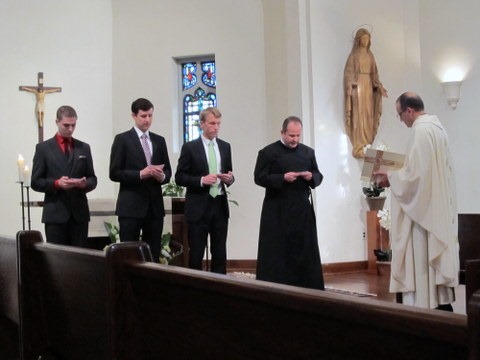
What’s a habit, you ask?  Let me show you a picture.

That sharp-dressed fellow on the left of that picture over there is Fr. Thomas Ryan.  He is the Director of Ecumenical and Interfaith Relations for the Paulists and he’s dressed in the high-collared, five button habit that has marked the order since the 1800s.

When Evan completed his First Promises this past summer, he earned the right to put CSP (Congregation of St. Paul) behind his name and the privilege of wearing the habit.

I can tell you this.  When you go to Mass with a guy in a habit, you get all the looks.  That suggests to me that people — even practicing Catholics — may not be overly familiar with the history or function of the habit.

So…a short summary with an interesting side note from St. Pope John Paul II.

The Wikipedia article lays it pretty well when it notes that “A religious habit is a distinctive set of garments worn by members of a religious order.”  Most folks, if they think about habits at all, identify the with religious sisters.  Aside from the sisters, you’ll often see Franciscan priests in their distinctive hooded robes with their triple-knotted rope belts.  (Bonus internet points for anyone who knows the meaning of the three knots…or just keep reading.) Or you might be a fan of Thomas Merton and remember pictures of him in his Trappist habit.

That’s as good a place as any to start with the question of why anyone would want to wear something so unusual.

Msrg. Charles Pope from the Archdiocese of DC puts it beautifully when he says:

Religious life is not hidden, neither is it occasional. To enter the priesthood or religious life is to publicly accept the consecration of one’s whole self to the service of God and neighbor. That is why the most traditional religious garb covers the whole body. It is more than a tee-shirt, a hat or an emblem of some sort. It is a covering of the whole body to indicate the entirety of the consecration.

Further, each habit is distinctive since each religious community has a particular charism or gift by which they collectively serve the Church. Religious and priests do not merely consecrate themselves for their own agenda. Rather they join others with a similar and proven charisms in communities recognized by the Church.

The word “habit” also suggests that religious life and priesthood are not an occasional activity, or even a 9 to 5 job. The are the habitual identity and life of the one who receives the call. That is also why the habit is usually worn at all times.

As Catholics we embrace the idea of visible signs of things which cannot otherwise be seen.  Habits make vocations visible to the world.  They remind the world that there are people who are dedicating themselves to the faith.

And the reminder the wearer of their own vocation.

Remember the question about the three knots of the Franciscans’ rope belt?  The obvious answer is that they stand for the Trinity — the Father, Son and Holy Spirit.  That was my guess, anyway.  And I was wrong.  They stand for the three vows of the Franciscans — Poverty, Chastity and Obedience.  A constant reminder of the promises they have made to God.

In a 1996 Post-Apostolic Exhortation called Vita consecrata, St. Pope John Paul II encouraged the wearing of habits by saying:

§25 … Since the habit is a sign of consecration, poverty and membership in a particular Religious family, I join the Fathers of the Synod in strongly recommending to men and women religious that they wear their proper habit, suitably adapted to the conditions of time and place. Where valid reasons of their apostolate call for it, Religious, in conformity with the norms of their Institute, may also dress in a simple and modest manner, with an appropriate symbol, in such a way that their consecration is recognizable.

As I said, when you’re with a man in a habit, you get all of the looks.

Which got me thinking.  Although not all of us are consecrated, we all have a vocation — a call to live as God wills and to carry out our Baptismal mission.  What habits — or at least outward signs — do we show to let the world know that we are living out the identity of our faith?

— Dad
Journey to Bethlehem; A Christmas Prayer

There is no room at the inn.Since 2006 the good Christian folk of Mountain View Baptist Church have been kind in allowing Cathy and I to participate in their interactive drama Journey to Bethlehem.  The play runs four nights each December and typically draws between four and five thousand guests.

The guests are gathered into groups of approximately 40 people and introduced to the character of Gadielle; a working-class resident of first century Nazareth, devoted family man, and occasional target for Roman harassment.  Following a run-in with a local centurion, Gadielle tells the assembled guests that they will be safe if they become part of his family for the evening.  He takes them from the streets of Nazareth to his home where they meet his wife Naomi and their only child, hear a brief speech from the local Rabbi, and once again come face-to-face with the Romans.  On Caesar’s  orders, the “family” must travel from Nazareth to Bethlehem to be numbered in the census and to pay the Roman tax.

Having no alternative, Gadielle and Naomi lead the family south to Bethlehem.  Along the way they encounter more Romans, meet the magi, experience an angelic visitation with the shepherds, receive interpretation of prophecy from another rabbi, encounter more Romans, shop in the busy Bethlehem marketplace, fail to find room at the inn, and — finally — catch up with Mary and Joseph who are caring for their newborn in the stable.  The journey covers nearly a mile of the church grounds and ends with a brief gospel message at a simple wooden cross followed by a visit to the “cocoa tent”.

The logistics of the drama are complex, requiring close coordination among the 150+ cast and crew.  In addition to the cast members at each of the “stations” along the journey, there are eight or more Gadielle/Naomi couples.  At any given moment there are between four and six “families” somewhere along the journey with new groups starting out every ten minutes.

Cathy and I got involved through my parents who are long time members of Mountain View.  Mom got stepped up first and later Dad joined her.  They recruited us to be a Gadielle/Naomi couple in 2006 and we’ve been in every production since.  Up until Dad’s death in 2011, my parents tended the inn.  Mom continues to be involved as a greeter who hands out Jewish passports to the guests as they register for the journey.

During our participation with the production, Cathy and I have seen some remarkable things.  When the angel appears to proclaim the birth of the newborn king, we kneel in awe and reverence.  More than once, we’ve had our entire family spontaneously kneel with us.  At the manger we’ve seen small children creep forward for a closer look at the doll representing the infant Jesus.  Memorably, this year, Cathy had a brief interaction with a tattooed-and-multiply-pierced young lady who hung to the back of the family during the entire journey.  “Thank you for letting me come along,” she said as the journey ended, apparently grateful to have been included.

At the end of each year’s production, the cast and crew are utterly spent.  The long nights of performance in cold and wet weather have taxed people’s reserve and the final farewells are delivered in raw, hoarse voices.  The guests themselves are no less hardy.  People of all faiths and none travel from all parts of Utah, Idaho and Wyoming.  They wait in line for hours for the opportunity to spend an hour walking through the darkness experiencing the journey.

I’ve thought a lot about what drives us — cast, crew and guests alike — to go to such extremes.

I think it’s simply the experience.  Journey to Bethlehem is incredibly visceral.  From the first moment of the journey to the last, the family is on the move.  The trail is full of sights, sounds and smells.  The light from a campfire reflects off the polished Roman armor.  The smoke drifts past as the angel proclaims his message of peace.  The merchants of Bethlehem call out to the guests, offering goods for sale and begging for news of the promise messiah. The dark and the cold contract close, convincing everyone that we are indeed travelling through the ancient world.

Human beings, I think, crave an experience of faith.  The journey gives that to them.

One of the problems with religion in America (and perhaps the western world in general) is that we have over-intellectualized it.  We treat belief as a subject for academic study; something that can be gained or given through mental exercise.  In so doing, we have traded away the best part of faith.  It is little wonder people are wary of religion; we talk to them about God, but never show Him to them.  We are like professors trying to frame a scientific explanation for love and completely missing the point.  Faith isn’t subject to rational evaluation.  It is a suprarational act.

Perhaps it is time we remember that and invite the world to share in the experience of faith rather than endlessly debating it.

Which brings me to my Christmas prayer for all of you.

God, creator of all things,
grant us the grace to encounter Your infinite love
through our experiences with Your bountiful creation.
In the name of the Father,
And of the Son,
And of the Holy Spirit.
Amen

— Dad

Visiting the King in Memphis

St Mary's Memphis

Last Saturday found me in Memphis, Tennessee at the tail end of an educational conference.  My colleagues took advantage of the the opportunity to head off to tour the king’s home, Graceland. I stayed behind for the vigil Mass for the Feast of Christ the King at St. Mary’s parish.


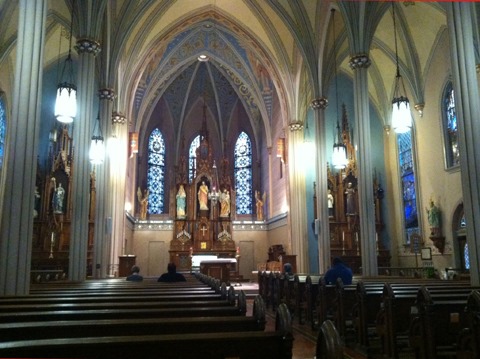
From the outside, St. Mary’s is a sturdy, unassuming brick building built along familiar lines.  A cornerstone near the front door anchors the parish in 1864, the start of the post-Civil War reconstruction.  Classic column-and-arch architecture lends the compact interior the feeling a European cathedral.  Fitting, as it was built originally as a German parish.  The hand-carved wooden pews, confessional and altar give the space a sense of weight and dignity; the earthly embodiment of the heavenly ideal.

There is no denying the beauty of the church and its parishioners are justly proud of having just celebrated the parish’s sesquicentennial.  What struck me most — and moved me during my time there — was the sense of community beyond the walls of the church.

As I entered, a small group near the front prayed the Rosary.

Hail Mary, full of grace…

Their public prayers formed a sort of Greek chorus behind my own private prayer before the Mass, reminding me that I am loved by God individually and as part of a larger community.  The modest crowd that filtered in was a visible sign of the universality of the Church.  Across the world, in thousands of other parishes, hundreds of thousands of people were celebrating the same Mass with the same Liturgy and the same readings.

It was comforting and moving, sitting in the company of other believers whom I had never met and would likely never see again; yet sharing the experience of the Eucharist.  It was a moment both commonplace and profound.

And that, I think, is what I took away from the experience.  Not the homily (although it was a good homily), not the music, or the readings or even the beauty of the space.  The gift I received from the King that day was the simple truth that none of us is alone; we are all pilgrims on a journey toward heaven and there is great comfort in knowing we that none of us is alone.

Fr. Martin’s Confession

Noted Jesuit Fr. James Martin published a piece on CNN.COM this week called “Confessions of a Catholic Priest.”  In it, he makes a couple of interesting points.

First of all, he speaks to a fact that might surprise some:

This may disappoint some readers, but I love being a Catholic priest. And I’m not alone. Survey after survey, year after year, shows that the priesthood is among the most satisfying of jobs.

He expands on that:

Think of just three moments of deep joy and deep sorrow in life: a wedding, a baptism and a funeral. You’re invited to participate in each of those moments with all manner of people — from families and friends you’ve known for years to nearly complete strangers. By virtue of your priesthood, you’re sharing people’s most important moments.

The rest of the article is interesting and well worth reading.  Especially as it was published to promote an episode of This is the Life with Lisa Ling which will explore the call to the priesthood.

Back to School

200px-Logo_of_The_Catholic_University_of_America_svgThe Paulist students — along with a host of students from other orders and those preparing for diocesan ordination — headed back to school this week.  Ever wonder what (and where) they study?

St. Paul’s College is the formation house for the Paulist order and it’s located just a few blocks from Catholic University of America.

CUA is a private university and also a pontifical university.  This means that CUA has been approved by the Holy See itself and is authorized to grant degrees following the European system sacred faculties.  (More about that in a minute.)

The university mission statement nicely sums out what CUA is all about:

As the national university of the Catholic Church in the United States, founded and sponsored by the bishops of the country with the approval of the Holy See, The Catholic University of America is committed to being a comprehensive Catholic and American institution of higher learning, faithful to the teachings of Jesus Christ as handed on by the Church. Dedicated to advancing the dialogue between faith and reason, The Catholic University of America seeks to discover and impart the truth through excellence in teaching and research, all in service to the Church, the nation and the world.

CUA was originally founded in 1887 and is the only higher ed institution founded by the U.S. Bishops.  When it began life in 1887 as a graduate research center, it was approved by Pope Leo XIII.  In 1904, it began offering undergraduate degrees and has been in continuous operation since then.

Its location — the Brookland neighborhood of DC — is sometimes called “Little Rome” due to the significant number of Catholic institutions located there.  (Some students jokingly refers to the area as the Catholic ghetto.)

The University offers both undergraduate and graduate degrees.  Evan and the other students are all working on their Masters degrees — specifically the Master of Divinity.  This is the typical path for those discerning the priesthood.  When I asked Evan to give me some taste of what he might be studying, he sent a list of some of the typical courses; History and Method of Theology, Pentateuch, Synoptic Gospels, Intro to Christian Moral Life, Theology of Sacraments of Initiation, Preaching, and Basic Supervised Ministry.

(Smart aleck that I am, I expressed the hope that this wasn’t the first time students had experienced “Into to Christian Moral Life.”)

The CUA web page for the M.Div degree gives a somewhat broader picture of the requirements:

The M.Div. degree requires a minimum of 90 credit hours of graduate courses distributed as follows: systematic theology (18), moral theology (12), biblical studies (12), and one course each in canon law, church history, liturgical studies, and spirituality (12), academic electives (12), pastoral ministry (18), and the ministry seminars (6). All students are ordinarily required to take six credits of Basic Supervised Ministry. At least one course must be taken in a non-Catholic ecclesial tradition through the offerings of the Washington Theological Consortium.

All students entering the program must take the following courses in the first fall semester: Proseminar for Masters Students, Introduction to the History and Method of Theology, and Foundations of Christian Moral Life. Of the 500 level courses, only some may be taken by M.Div. students in fulfillment of degree requirements.

This is the usual path for students in discernment.  There is, however, another.  Because CUA is a pontifical university, it is authorized to offer sacred faculty degrees.  Students can opt to pursue an STB degree; otherwise (confusingly) called the Bachelor of Sacred Theology.  Despite the name (confusing, right?) this is a masters degree in theology.  It offers more depth in theology and prepares students to pursue an STL (Licentiate of Sacred Theology) and an STD (Doctor of Sacred Theology).

CUA offers a combined M.Div and STB program for students who want to pursue a more academic track.

Evan started his classes this week and seems to be enjoying them.  It sounds more-or-less like a typical grad school experience.  He’s in classes with a wide variety of students; some of them from other orders, some of them pursuing diocesan ordination.  It’s a good mix and he’s enjoying the intellectual challenge.

On Thursday they had a school-wide Mass at the Basilica in DC.  The students from all of the various orders showed up in the clerical garb appropriate to their order and Archbishop Donald Wuerl celebrated.  A significant number of priests con-celebrated and Evan said it was quite the experience.

And…to my mind…it seems like a great way to kick off an M.Div program.

News from the Web

Global-Network-iconComing to you from around the globe via the world-wide-web, it’s News from the Web!

(Imagine that read in an urgent, nasally voice accompanied by twitchy black-and-white film footage and you’ll get the idea I was shooting for.)

This week we ran across several interesting items on the web that seemed to be worth sharing in this space.  The first is a blog post by Amy V who is the mother of a seminarian.  In part she writes:

When he was in middle school, priests would ask him if he had ever thought about being a priest someday. He hated when people asked him this and from about 8th grade until 11th grade he started saying, “No way!” He loved Jesus though, and the Lord was always leading my son more deeply into a relationship with Him. My son also loved being Catholic, and since he attended a public school, was always looking for ways to defend his beloved faith. So, right before his senior year in high school, my son felt very strongly that the Lord was confirming in his heart a call to discern the Catholic Priesthood with a deliberate and an intentional heart.

There’s quite a bit more to the post and it’s worth your time to read the whole thing.

Next up, a reflection by Paolo Puccini on his experience of the First Promises Mass.

Making my first promise to the Paulists is much like making a down payment to “buy the field.” I was led here from my encounters with the treasure that is the Kingdom of God alive in my family and my experience of church throughout my life. Though I didn’t exactly sell my possessions because the Paulists don’t make a vow of poverty, I did have to leave behind my family, many close friendships, and a job I really enjoyed in Houston.

The whole post gives some great insights into Paolo’s journey to the Paulists.

Speaking of the journey to the Priesthood, the Los Angeles diocese posted a great article about discernment and the care which is taken in identifying appropriate candidates.

The challenge for us in the Office of Vocations is to be cognizant of an ever-present reality — the need for both quality and quantity of candidates for the priesthood. Certainly we have a great need in the archdiocese for many, many more priests. 

But what the Church does not need is just anyone to become a priest. Rather, we need those who are truly called by God and recognized by the Church to have an authentic priestly vocation. 

Our previous article, “Priestly Formation and the New Evangelization: The 4 Pillars of Formation” (July 4), dealt with the four essential dimensions of priestly formation in the seminary. We need well-rounded, holy men of prayer and study and learning who demonstrate the capacity to serve God’s people well as parish priests. Thus, while a great quantity of new seminarians is a primary goal, the quality of each candidate is also of supreme importance.

Although the article is specific to the LA diocese, it is good reading for anyone contemplating a vocation.

Finally, over at The Word on Fire, Fr. Robert Baron and his team released a short film called Heroic Priesthood.  Fr. Baron explained his motivations for the project:

My goal with this film is to reach as many people as possible—certainly priests and seminarians, but especially young Catholic men. I want them to see that holiness is heroic and that Jesus Christ’s invitation to the priesthood is an invitation to an extraordinary life.

It’s a terrific film; well shot and worth twelve minutes of your time.  And — even for a sports illiterate like me — the basketball theme still worked.

— Dad

First Promises Mass 2014

Fr. Eric Andrews delivers encouraging words to the novices during his homily at the First Promises Mass.Last weekend we made our first visit to St. Paul’s College in Washington, DC.  Taking advantage of a Utah state holiday, we left early Thursday morning and returned on Sunday.  The occasion was the 2014 First Promises Mass.

As I understand it (and if I get this wrong, please let me know and I’ll correct myself) the novice year is explicitly a time of discernment — both for the candidate and for the community.  As the end of the year approached, all four of this year’s novices were evaluated and a decision was made about their suitability for the community and their readiness to continue their formation.  It is also the point at which the novices become full members of the society and earn the privilege of putting CSP (Congregation of St. Paul) after their names.

All four of this year’s novices were invited to make their first promises.  This involves promising to be faithful to the Paulist Constitution and to fully engage in the community for the coming year.  (Aside: While they are students, the promises are renewed each year up to the point that these men are ordained as Transitional Deacons.)

This year's novices promising to obey the Paulist Constitution and professing their belief that they are called to be missionaries.Fr. Eric Andrews, the newly elected president of the Paulists, traveled to DC to celebrate the Mass and to receive the promises from the students.  Director of Novices, Fr. Rich Colgan, con-celebrated the Mass.

It is difficult to capture the Mass using the written word.


There are moments that stand out strongly in my memory.

In his homily, it was clear that Fr. Andrews knew each of the novices and could speak to the experiences they’d had during the last year — both inside the community and out.  Working from the readings (the 17th week in Ordinary Time Year A) he wove the story of Solomon asking for wisdom with Pauls’ firm belief that we are called according to God’s purpose with the parable of the Pearl of Great Price.  Each of the readings reinforced the idea that following God’s call is worth the cost.  (Aside: Evan and the other novices asked me to serve as one of the lectors for the Mass and I was honored and humbled to be involved.)

As always, the promises took place after the Liturgy of the Word and before the Liturgy of the Eucharist; the same place you’d find a Wedding or Baptism.  The novices stood, enunciated their names and joined their voices in making their promises.  (They had crib notes to work from to ensure they got the words right.)

The four moms presenting the gifts to Fr. Andrews.To her great surprise, Cathy found herself weeping when Evan took his promises and then signed the book recording the event.  I’ll have to admit it was a more powerful moment than I had expected.  (Note to self: bring tissues for future significant liturgical events.)

When it came time for the Liturgy of the Eucharist, the four mothers were asked to bring up the gifts.  This  was especially powerful.  It spoke to the fact that these women had made gifts of their sons to God — much like Hannah giving Samuel to God.  For me, this was a profound sign of their faith in God.

After the Mass, there was a reception in the common room with finger foods and good company. Of course the families of the novices were present including parents, siblings and more distant relations; our own contingent consisted Cathy, Ian and I as well as Cathy’s parents and sister from Erie.  The priests from St. Paul’s college were in attendance as were the externs — priests who are living at St. Paul’s while they work on their studies at the nearby CUA.  Although the students are all away on summer assignments, many of them returned for the Mass.  That gave us the opportunity to meet Stuart Wilson-Smith, Michael Hennessy and Matt Berrios (who was the cantor for the Mass — he has an awesome voice and an epic beard).  We also got to meet several of the Paulist Fathers including Fr. Frank DeSiano, Fr. Charlie Donahue (who was very kind and supportive when he talked to Cathy and shared his vocation story), and Fr. Steven Bell (Busted Halo and shortly to be re-assigned to Ohio).  We met so many people it was hard to keep track of them all and I apologize if I missed anyone.

Not remembering all of them is a shame because what we found was an incredible community filled with light and the joy of a shared mission.  As guests of the house, we were able to participate in the life of the community by attending the Friday morning prayers and Mass and by taking our meals with the community.  (Aside: The cooking staff at St. Paul’s college does an incredible job of providing great meals for all who live there.)  Everyone we met was genuinely welcoming and we had some fascinating conversations over our meals.

Likewise, it was great to meet the other novices and their parents; to hear about their spiritual journeys and how their experiences were similar to our own.  It made me wish we lived in a more Catholic part of the country so that we might be able to form some sort of parents’ group for vocations.

We also managed to fit in a few tourist-y things; the Smithsonian Museum of Natural History, the monuments of the National Mall, the Franciscan Monastery of the Holy Land in America, and the Basilica of the National Shrine of the Immaculate Conception.

All of these were wonderful moments during the trip, but what I most remember is the joy of having our family together to celebrate this important moment in Evan’s formation journey.

Evan, Cathy, Kevin and Ian at St. Pauls' college after the First Promises Mass, July 26, 2014.

— Dad

Seminarian Brewers?

There are folks who think of the seminary as a sort of monastery where silence reigns and every moment is taken up with prayer and contemplation of the mysteries.

There’s certainly a place in the seminary life for that kind of thing, but there are also moments when the parts of the community comes together to share their talents.  Seminarian Mike Hennessy is using his love of brewing beer as a springboard for evangelization.

An article on the Michigan Live website fills in the details:

If you like good beer and drinking deep of spirituality, chances are you will enjoy an upcoming class Hennessy is teaching at the Catholic Information Center. “Holy Brew: Trappists, Monks and the Catholic Tradition of Brewing Beer” is being offered at the CIC next week. A third night was added after the Tuesday class filled up.

Small wonder. The CIC is run by the Paulist Fathers, an order of priests whose prime mission is evangelization. If you want to evangelize in Grand Rapids, good beer is a surefire way to get people in the door.

In this case you won’t find a better evangelist than Hennessy. A Paulist seminarian attending Catholic University of America in Washington, D.C., he is also a home brewer for his fellow seminarians there and an avid appreciator of craft brews. When he was assigned to spend this summer in Grand Rapids, he cheerfully offers that it was “most likely the Holy Spirit” at work.

There’s more if you’d like to swing over and read the whole story.