
News from the Web

Global-Network-iconComing to you from around the globe via the world-wide-web, it’s News from the Web!

(Imagine that read in an urgent, nasally voice accompanied by twitchy black-and-white film footage and you’ll get the idea I was shooting for.)

This week we ran across several interesting items on the web that seemed to be worth sharing in this space.  The first is a blog post by Amy V who is the mother of a seminarian.  In part she writes:

When he was in middle school, priests would ask him if he had ever thought about being a priest someday. He hated when people asked him this and from about 8th grade until 11th grade he started saying, “No way!” He loved Jesus though, and the Lord was always leading my son more deeply into a relationship with Him. My son also loved being Catholic, and since he attended a public school, was always looking for ways to defend his beloved faith. So, right before his senior year in high school, my son felt very strongly that the Lord was confirming in his heart a call to discern the Catholic Priesthood with a deliberate and an intentional heart.

There’s quite a bit more to the post and it’s worth your time to read the whole thing.

Next up, a reflection by Paolo Puccini on his experience of the First Promises Mass.

Making my first promise to the Paulists is much like making a down payment to “buy the field.” I was led here from my encounters with the treasure that is the Kingdom of God alive in my family and my experience of church throughout my life. Though I didn’t exactly sell my possessions because the Paulists don’t make a vow of poverty, I did have to leave behind my family, many close friendships, and a job I really enjoyed in Houston.

The whole post gives some great insights into Paolo’s journey to the Paulists.

Speaking of the journey to the Priesthood, the Los Angeles diocese posted a great article about discernment and the care which is taken in identifying appropriate candidates.

The challenge for us in the Office of Vocations is to be cognizant of an ever-present reality — the need for both quality and quantity of candidates for the priesthood. Certainly we have a great need in the archdiocese for many, many more priests. 

But what the Church does not need is just anyone to become a priest. Rather, we need those who are truly called by God and recognized by the Church to have an authentic priestly vocation. 

Our previous article, “Priestly Formation and the New Evangelization: The 4 Pillars of Formation” (July 4), dealt with the four essential dimensions of priestly formation in the seminary. We need well-rounded, holy men of prayer and study and learning who demonstrate the capacity to serve God’s people well as parish priests. Thus, while a great quantity of new seminarians is a primary goal, the quality of each candidate is also of supreme importance.

Although the article is specific to the LA diocese, it is good reading for anyone contemplating a vocation.

Finally, over at The Word on Fire, Fr. Robert Baron and his team released a short film called Heroic Priesthood.  Fr. Baron explained his motivations for the project:

My goal with this film is to reach as many people as possible—certainly priests and seminarians, but especially young Catholic men. I want them to see that holiness is heroic and that Jesus Christ’s invitation to the priesthood is an invitation to an extraordinary life.

It’s a terrific film; well shot and worth twelve minutes of your time.  And — even for a sports illiterate like me — the basketball theme still worked.

— Dad

First Promises Mass 2014

Fr. Eric Andrews delivers encouraging words to the novices during his homily at the First Promises Mass.Last weekend we made our first visit to St. Paul’s College in Washington, DC.  Taking advantage of a Utah state holiday, we left early Thursday morning and returned on Sunday.  The occasion was the 2014 First Promises Mass.

As I understand it (and if I get this wrong, please let me know and I’ll correct myself) the novice year is explicitly a time of discernment — both for the candidate and for the community.  As the end of the year approached, all four of this year’s novices were evaluated and a decision was made about their suitability for the community and their readiness to continue their formation.  It is also the point at which the novices become full members of the society and earn the privilege of putting CSP (Congregation of St. Paul) after their names.

All four of this year’s novices were invited to make their first promises.  This involves promising to be faithful to the Paulist Constitution and to fully engage in the community for the coming year.  (Aside: While they are students, the promises are renewed each year up to the point that these men are ordained as Transitional Deacons.)

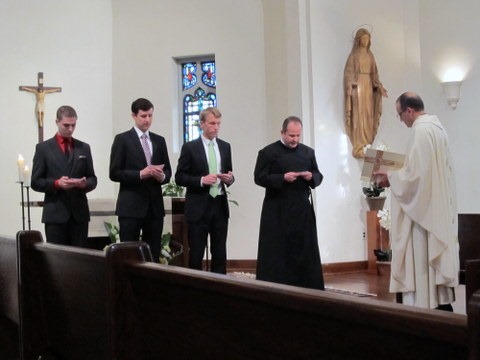
This year's novices promising to obey the Paulist Constitution and professing their belief that they are called to be missionaries.Fr. Eric Andrews, the newly elected president of the Paulists, traveled to DC to celebrate the Mass and to receive the promises from the students.  Director of Novices, Fr. Rich Colgan, con-celebrated the Mass.

It is difficult to capture the Mass using the written word.


There are moments that stand out strongly in my memory.

In his homily, it was clear that Fr. Andrews knew each of the novices and could speak to the experiences they’d had during the last year — both inside the community and out.  Working from the readings (the 17th week in Ordinary Time Year A) he wove the story of Solomon asking for wisdom with Pauls’ firm belief that we are called according to God’s purpose with the parable of the Pearl of Great Price.  Each of the readings reinforced the idea that following God’s call is worth the cost.  (Aside: Evan and the other novices asked me to serve as one of the lectors for the Mass and I was honored and humbled to be involved.)

As always, the promises took place after the Liturgy of the Word and before the Liturgy of the Eucharist; the same place you’d find a Wedding or Baptism.  The novices stood, enunciated their names and joined their voices in making their promises.  (They had crib notes to work from to ensure they got the words right.)

The four moms presenting the gifts to Fr. Andrews.To her great surprise, Cathy found herself weeping when Evan took his promises and then signed the book recording the event.  I’ll have to admit it was a more powerful moment than I had expected.  (Note to self: bring tissues for future significant liturgical events.)

When it came time for the Liturgy of the Eucharist, the four mothers were asked to bring up the gifts.  This  was especially powerful.  It spoke to the fact that these women had made gifts of their sons to God — much like Hannah giving Samuel to God.  For me, this was a profound sign of their faith in God.

After the Mass, there was a reception in the common room with finger foods and good company. Of course the families of the novices were present including parents, siblings and more distant relations; our own contingent consisted Cathy, Ian and I as well as Cathy’s parents and sister from Erie.  The priests from St. Paul’s college were in attendance as were the externs — priests who are living at St. Paul’s while they work on their studies at the nearby CUA.  Although the students are all away on summer assignments, many of them returned for the Mass.  That gave us the opportunity to meet Stuart Wilson-Smith, Michael Hennessy and Matt Berrios (who was the cantor for the Mass — he has an awesome voice and an epic beard).  We also got to meet several of the Paulist Fathers including Fr. Frank DeSiano, Fr. Charlie Donahue (who was very kind and supportive when he talked to Cathy and shared his vocation story), and Fr. Steven Bell (Busted Halo and shortly to be re-assigned to Ohio).  We met so many people it was hard to keep track of them all and I apologize if I missed anyone.

Not remembering all of them is a shame because what we found was an incredible community filled with light and the joy of a shared mission.  As guests of the house, we were able to participate in the life of the community by attending the Friday morning prayers and Mass and by taking our meals with the community.  (Aside: The cooking staff at St. Paul’s college does an incredible job of providing great meals for all who live there.)  Everyone we met was genuinely welcoming and we had some fascinating conversations over our meals.

Likewise, it was great to meet the other novices and their parents; to hear about their spiritual journeys and how their experiences were similar to our own.  It made me wish we lived in a more Catholic part of the country so that we might be able to form some sort of parents’ group for vocations.

We also managed to fit in a few tourist-y things; the Smithsonian Museum of Natural History, the monuments of the National Mall, the Franciscan Monastery of the Holy Land in America, and the Basilica of the National Shrine of the Immaculate Conception.

All of these were wonderful moments during the trip, but what I most remember is the joy of having our family together to celebrate this important moment in Evan’s formation journey.

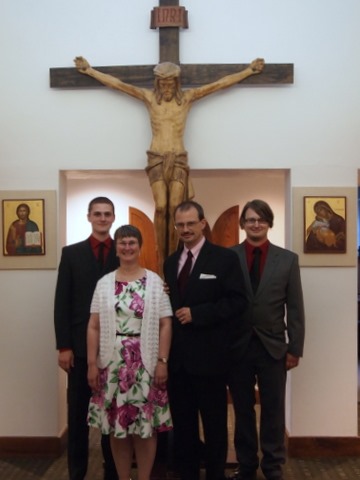
Evan, Cathy, Kevin and Ian at St. Pauls' college after the First Promises Mass, July 26, 2014.

— Dad

Seminarian Brewers?

There are folks who think of the seminary as a sort of monastery where silence reigns and every moment is taken up with prayer and contemplation of the mysteries.

There’s certainly a place in the seminary life for that kind of thing, but there are also moments when the parts of the community comes together to share their talents.  Seminarian Mike Hennessy is using his love of brewing beer as a springboard for evangelization.

An article on the Michigan Live website fills in the details:

If you like good beer and drinking deep of spirituality, chances are you will enjoy an upcoming class Hennessy is teaching at the Catholic Information Center. “Holy Brew: Trappists, Monks and the Catholic Tradition of Brewing Beer” is being offered at the CIC next week. A third night was added after the Tuesday class filled up.

Small wonder. The CIC is run by the Paulist Fathers, an order of priests whose prime mission is evangelization. If you want to evangelize in Grand Rapids, good beer is a surefire way to get people in the door.

In this case you won’t find a better evangelist than Hennessy. A Paulist seminarian attending Catholic University of America in Washington, D.C., he is also a home brewer for his fellow seminarians there and an avid appreciator of craft brews. When he was assigned to spend this summer in Grand Rapids, he cheerfully offers that it was “most likely the Holy Spirit” at work.

There’s more if you’d like to swing over and read the whole story.

Path to the Priesthood

Saturday, May 24, 2014 saw the addition of a new priest to the Paulist ranks.  “Jimmy” Hsu, having completed his formation period was ordained by Bishop Joe Vasquez of Austin, Texas.
If you dig into the archives of the Paulist Fathers’ website, you can trace Jimmy’s formation.

It starts with an article from August 2009 detailing the Mass at which Jimmy marked the transition from novice to student by making his first promises to the community.  In part, the article says:

For Yao “Jimmy” Hsu, the novitiate year was a chance to experience St. Paul, the legacy of faith left by Paulist founder Servant of God Father Isaac T. Hecker and being part of a community.

“[Making first promises] is the first formal step to being part of the Paulist community, but is another small step in the road ahead,” he said.

Fast-forwarding to September of 2013 brings us to Jimmy’s final promises, payment for service (one penny) and ordination as a transitional deacon.

Jimmy Hsu, CSP, took his final steps toward the priesthood by pledging a lifetime of service with the Paulist Fathers before his Paulist brothers, family and friends Sept. 6 in the chapel of St. Paul’s College in Washington, D.C. The next morning, Mr. Hsu was ordained to the diaconate in the Crypt Church of the Basilica of the National Shrine of the Immaculate Conception by Most Rev. Barry C. Knestout, auxiliary bishop of Washington, D.C.

After one year of ordained service as a deacon, and update on the Paulist Fathers’ website reflects on Jimmy’s journey and his impending ordination.

Encouraged by family and friends, Deacon Hsu was inspired by the example of the Paulists he met at the University Catholic Center while earning a philosophy degree at the University of Texas at Austin.

“My family has always been supportive of whatever I do, and they are proud of my decision [to become a priest],” Deacon Hsu said. “And the Paulists have been there to help me process my experiences in formation and become part of the community.”

The big moment came on May 24, 2014 when Jimmy Hsu was ordained.

“You will be consecrated to Christ in a very special way,” said Bishop Joe S. Vasquez of the Diocese of Austin, Texas – Deacon Hsu’s home diocese – who presided over the ordination.

“Impart to everyone the word of God you have received with such joy,” the bishop said, “so that by your example you will build up the house that is God’s Church.”

One of the things that has impressed us the most about the Paulists is the strong sense of community.  (I suspect the same is true of most orders.)  Evan has become part of a larger family and considers Jimmy a brother.

We extend our congratulations to the newly ordained Reverend Jimmy Hsu and pray that God blesses his ministry.

— Dad

Still the Father

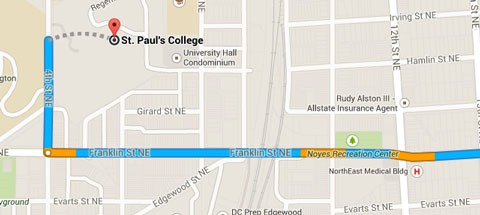
DC_Map

Last Sunday I was sitting at the computer when my phone rang.

It was Evan.  Unusual for him to call on a Sunday.

“Hi,” I said.  “What’s up?”

“I need an exit.”

“Huh?”

“I’m lost in DC and need help getting back to the college.”

“Ah…where are you?”

“Ummm…Ord and…hang on…there’s a cross street coming up…4th.”

“Okay…stand by…”  I called up Google maps and felt a little like an air traffic controller in one of those disaster movies.  Here I was, thousands of miles away, guiding Evan in with my voice.  “Got you.  Tell me the next cross street.”

“Okay.  Here is comes…45the Place.”

“Bingo.  You’re headed west.”  I asked Google for directions to St. Paul’s college and it obligingly tossed up a cheerful blue line tracing a path across the city.”

“Okay.  I can guide you in from here.”

So I stayed on the line, giving directions, tweaking the route when real-world road conditions didn’t match my tidy-bird’s eye view, and easing Evan back home.  While he drove, he filled me in on just how he’d come to be in an unfamiliar part of the city.

As part of his training, he is encouraged to attend other churches.  In his novice year he’s attended services in churches where English is never spoken, he’s taken some of his classmates to a Mormon ward meeting, and he’s developed a particular fondness for the spirituality of the Eastern Rite churches.  This past Sunday he went to a Ruthenian church.  Like many of the Easter Rite churches, it is considered to be in full communion with Rome.  The rites are different, though, from those you’d find in the average Roman Catholic church in the U.S.

Evan enjoyed his visit, but got turned around on the way out and needed a little help finding his way.

Which reminded me that — even a continent away — I’m still the Dad.

Both of my sons still seek my advice on matters small and large.  (They don’t always take my advice — that’s the beauty of asking for advice.  Just because somebody gives it to you, you don’t have to accept it.)  While he was an undergraduate, Evan frequently asked me to review his papers and make suggestions as I saw fit.  Ian has sought my advice on school projects, his novels and various job situations.  And, at various times, I’ve served as their personal OnStar.

(Aside: I don’t blame Evan for getting lost.  Out here where Evan grew up, the cities are laid out in nice, square grids.  Addresses tend to be things like 550 East 300 South.  If you know the city and the E/W and N/S coordinates, it’s almost impossible to get lost.  Especially if you know that the Wasatch Mountain range lies to the east.  If your destination is to the east, drive toward the mountains.  South?  Keep the mountains on your left side.  By contrast, the roads of Washington DC appear to have been laid out after a night of heavy drinking by contractors who were unclear on the concept of “the shortest distance between two points.”  Of course, that could just be my western bias.)

All of which got me thinking about my relationship with God.  You know, God the Father?

(To be clear — and to avoid giving offense — I’m not suggesting that I’m God or even particularly God-like.  The situation just gave me pause to think.)

When we call out to God for help, it’s usually because we’re lost somewhere.  We’ve gotten stuck or confused or overwhelmed and need to find a way back home.  And God is still the Father.  Still there.  Waiting to give us guidance and advice.

Even though I don’t follow that advice as often (or as closely) as I should, I still find the fact of God’s presence comforting.

— Dad

P.S.

For a more elegant exploration of this idea, I suggest you click over to the Ignatian Spirituality blog.

Newsiness

A quick post with a couple of updates from St. Paul’s college.  If you’re looking for deep insights today, wander on over to the Catholic channel on Patheos.com.  Today’s post is just a metaphorical postcard from DC.

First up, this past weekend the college held a “Come and See” weekend retreat for men contemplating a vocation.  Evan reports that it went well.  If I understood him correctly, there were about fifteen men in attendance.  I pray that in calling those whom He will, God invites many new members to join the Paulist community.

The other news is that Evan will be travelling to Austin, Texas later this week to serve his Lenten Apostolate at St. Austin Catholic parish.  As part of the novice year, the novices spend Lent working in a Paulist parish.  This gives them a taste of pastoral work away from the rarified air of the seminary.  While he’s there, Evan will be giving a presentation on (I think) food and spirituality.

Have I mentioned that Evan is a great cook?  This past week when the snow was thick on the ground and folks couldn’t get in to prepare meals, he was called on to fix the evening meal.  He made kebabs with a strawberry sauce.  He says they were good and well received…and promised to make them for us on his next visit.

We’re looking forward to hearing about his adventures in Austin and are already grateful to the priests and parish there who will be part of his formation.

— Dad

Minor Orders

320px-StMarysWestMelbAltarThe holidays are over and it’s time to get back to ordinary time — which, for me, includes blogging.

While Evan was home (we had him for the better part of a month) we spent some time talking about the seminary and what’s he’s been learning and doing.  Among other things, this past fall he was working at drop-in shelter/soup kitchen.  When they found out that he could bake, they set him to work making cookies and pies and such — anything that didn’t need to rise to be cooked.  We also spent a little time talking about how religious formation has changed over time.

This might sound a bit esoteric, but it actually gives an interesting peek inside the history of the church in the post Vatican II era.

Prior to 1973, candidates for the priesthood went through several well-defined steps during their training.  It started with the tonsure — a ceremonial haircut to mark the candidate’s entry into religious life.  Think of the bowl cut you associate with Friar Tuck or Brother Cadfael.  It was considered a sign that the candidate no longer cared about worldly fashion.  By the middle of the last century, though, the bowl cut had given way to a ceremonial clipping of five tiny tufts of hair as the points of a cross on top of the candidate’s head.

During formation, the candidate would go through the four minor ordersporter, lector, exorcist and acolyte.  The progression through the minor orders was a bit like gaining rank in the military, each of them brought the candidate new responsibilities.  None of them were Divine or Apostolic in origin and they were added to the church at different times.

Formal ordination began with the order of the subdeacon.  As the name implies, the subdeacon shares in some of the responsibilities, but not the full authority of an ordained deacon.

Candidates then — and now — go through ordination to the deaconate before making their final vows as priests.

In 1973 Pope Paul VI issued the Ministeria Quaedam which changed the minor orders into ministries.  In doing so, he said:

Nevertheless, since the minor orders have not always been the same and many functions connected with them, as at present, have also been exercised by the laity, it seems fitting to reexamine this practice and to adapt it to contemporary needs. What is obsolete in these offices will thus be removed and what is useful retained; also anything new that is needed will be introduced and at the same time the requirements for candidates for holy orders will be established.

Two of the minor orders — Lector and Acolyte — have been retained as ministries in formation programs to mark the candidate’s progress.

Many of the tasks which had been reserved for those in training have been taken over by the laity.  This reflects the goal of Vatican II to encourage “full, conscious and active participation” by “all of the faithful”.

What’s interesting to me is that there are groups seeking a return to the use of minor orders.  They feel that we have somehow lost something important.  I wouldn’t want to interfere with anyone’s personal piety, but I think they may be missing the larger picture.  Minor orders were never dogma nor did they reflect core theology.  They were simply a process which reflected the needs of the church at the time.  I would even suggest that the minor orders made it possible for the laity to sit back in the pews and treat the church as something to be observed rather than experienced; an inactive religion that kept faith at a distance from life.

For myself, getting involved has helped grow my faith.  When you dedicate time to an activity — a job, a hobby, a cause or a religion — you naturally engage more fully in it.  You learn, you question and you grow.  Which, I guess, is my ultimate point.

The formation for Holy Orders is vital to the future of the church.  We need the religious to fulfill their particular roles.  But we’re fooling ourselves if we think that we shouldn’t be in constant formation as well.

— Dad

Question: Who Pays for Seminary?

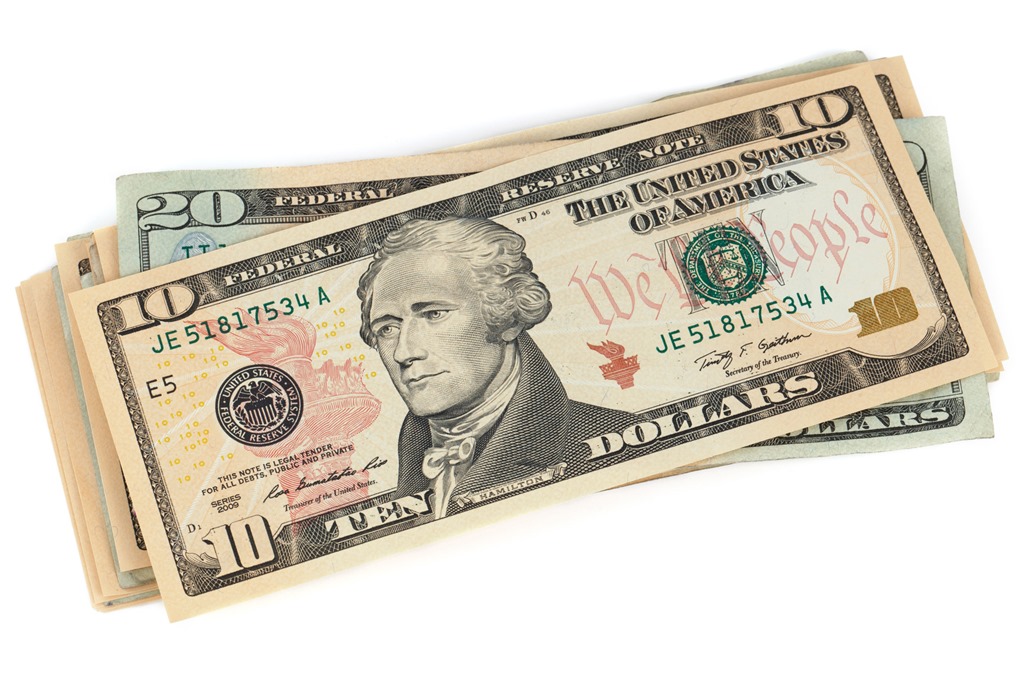
stack of dollars

Not all the questions about the seminary experience deal with weighty theological issues.  Some of them are, in fact, pretty mundane.

Seminary — like most higher education — isn’t cheap.  So, who is paying for the training for the next generation of priests and religious?

The answer is: it depends.

As we mentioned a while back, there are two kinds of priests:  diocesan and order.  (Sometimes referred to as secular and religious priests — toss out that bit of trivia at a party and watch your friends try to puzzle out the difference.)  Among the other differences, diocesan priests generally draw a salary and are expected to pay for their own food, transportation, etc.  Order priests generally do not draw a salary and are dependent on their order for all of their material needs.  In practice, this means that diocesan priests need to be careful managers of their money as the salary isn’t that great while order priests rely on the order to balance needs the of the entire community.  As our previous pastor put it (with tongue firmly in cheek), “Order priests take the vow of poverty, diocesan priests live it.”

This is important because diocesan seminarians often attend seminaries which aren’t associated with the diocese and will be assessed tuition.  This responsibility may be picked up by the seminarian, their parents or the diocese or some combination thereof.  The Office for Vocations for the Archdiocese of Saint Paul and Minneapolis addresses the question by saying:

How much does it cost?  Who pays?
Everyone is concerned about the high cost of education, including potential seminarians and their families.  In the Archdiocese of St. Paul and Minneapolis, the archdiocese will pay for the room and board cost of our college seminarians as a scholarship. This does not need to be paid back. In addition, the University of St. Thomas offers a 35% discount on tuition for seminary students. The seminarian and his family are required to fund the rest of the cost through regular scholarships, financial aid, and loans.

There are (not surprisingly) many scholarships available to seminarians.  Often, there is also a distinction between those entering “college seminary” for the purpose of earning an undergraduate degree and those who have earned a bachelors degree and are moving to the next level of formation.  The Diocese of Des Moines outlines such a program:

How much will it cost to go to the seminary?

This depends on which level of Seminary formation you enter.  For those that enter as college seminarians, the cost will be the responsibility of the seminarian.  As would be typical for any other college student, you will fill out FAFSA forms for student loans.  The college seminary programs we use typically have reduced tuition for seminarians as well as scholarships that are available.  One college seminary program gives a scholarship that covers your full tuition.  Regardless, you can expect significant expenses for college, which will remain your responsibility regardless of whether you are ordained for the diocese.  The rationale behind this policy is that college is a pre-requisite for professional life in any capacity in our culture, and whether or not you become a priest your degree will serve you well into the future.  The Diocese does provide college seminarians with re-imbursement for books and certain travel required by the diocese, as well as a monthly stipend.  You are encouraged to work during the summer for extra spending money.

The policy is different for men that enter seminary for Pre-Theology (those with a college degree but in need of required philosophy before studying Theology) or Theology.  The Diocese will cover the entire amount of your tuition, room and board, as well reimburse you for books, certain travel required by the diocese, and will provide a monthly stipend.   These expenses do not have to be re-paid in the event you discern out of seminary formation.

What do I do if I have previous student loans that are not fully paid off yet?

The diocese, while it provides for much of your training as a seminarian, cannot offer assistance in paying off previous college loans. However, many loans can be deferred, some without accruing extra interest, until the time you finish seminary training and are ordained a priest, at which time you receive a salary and can pay off your loans.

As much as possible, Vocations Offices and Seminaries try to remove the obstacle of money.  And there are plenty of private donors who are doing what they can to aid in preparing the next generation of priests. An article on the Vision Vocation Network website notes:

Fortunately there are many benefactors who donate directly to seminaries or make funds available through scholarships or grants. Two Catholic organizations that have generously supported vocations are the Knights of Columbus (contact your local council) and the Laboure Society (www.labourefoundation.org).

At the diocesan level, the Vocations Director would be able to provide better information for a particular case.

Seminarians who enter as part of an order, often have their training provided for (in whole or in part) by the order.  The Priestly Fraternity of St. Peter’s Our Lady of Guadalupe Seminary uses a mixed approach:

How much does it cost to educate a seminarian?

he actual cost is about $22,000 per year. Most of this cost is paid through the generosity of our benefactors, who deserve our prayers every day. The cost that FSSP seminarians currently are responsible for is $7,000 per year for tuition, room and board.

What if I cannot pay for my annual tuition and room/board?

We ask all seminarians to do their best to pay everything they are able to pay. This includes actively seeking benefactors, running an ad in your home parish bulletin, asking priests for financial help, and applying for scholarships with various Catholic support groups. However, if you do not come up with all of the tuition money you will not be required to leave. Nor do we deny entrance to men due to an inability to pay these costs.

In Evan’s case, he was required to be debt-free (with the exception of his student loans) before he could be accepted as a novice.  His room, board, and training are all provided by the order and he is given a small stipend each month for incidentals such as toiletries, clothing, and personal transportation.  Living in DC (and having to switch for a college wardrobe of jeans and t-shirts to a wardrobe of business casual) the stipend is adequate, but not excessive.  Fortunately, two different Utah Councils of the Knights of Columbus (St. Olaf’s in Bountiful and St. Mary of the Assumption in Park City) have adopted Evan under the RSVP program.  He wasn’t aware of the program until they contacted him.  He was (and is) touched by their generosity.

— Dad

Reflection: Self-Sacrifice

(Editor’s Note: As part of the discernment and training process, the novices and students write and lead prayer services.  Evan will share his from time to time as he writes them.)

Novice Prayer Service Thursday October 15th, 2013
On Sacrifice

You will save more souls through prayer and suffering than will a missionary through his teachings and sermons alone.
-Jesus to St. Faustina, Diary of St. Faustina, 1767

Miss no single opportunity of making some small sacrifice, here by a smiling look, there by a kindly word; always doing the smallest right and doing it all for love.
-St. Thérèse of Lisieux

Tonight I thought we could use this prayer service to reflect on the sacrificing nature of a vocation. We willing give ourselves in love to the service of others, especially as future priests. There is also an aspect of sacrificing the “normal” life. We won’t have the small suburb home with a white picket fence, a wife, two kids, and a dog. Instead, we are called to live for the world, not simply in it. I thought one of the best ways to explore sacrifice would actually be to look at a few scenes from movies that have sacrifice as a central theme in a prayerful manner. I’ll give a little set-up explaining each scene.

Movie One: Road to Perdition, scene at 1:33:15

After a fellow gangster kills his wife and kids, Tom Hanks has to take his son across the country in order to keep him alive. In this scene, Tom confronts his mob boss about the gangster who is also stealing money from the boss. In the end, Tom does get his son across the country, but dies in the process of protecting his son.

Movie Two: The Iron Giant, scene at 1:14:00

 Set in Maine during the 1950’s, a giant robot crashes to Earth and befriends a 10 year old child. The  robot has amnesia and cannot remember his mission. He learns about Superman and being a hero from  the child. When the local town finds out about the robot when he save a kid from falling to his death,  they go into full panic thinking he is a monster sent to destroy them. The military is called in and the  robot goes into a rage and remembers his mission (which is to destroy the Earth). This leads to the  military launching a nuclear missile at the town.

Movie Three: Stranger than Fiction, scenes at 1:31:09 and 1:35:45

 Will Ferrell starts hearing his own life being narrated as though he was a character in a book. One  morning he hears the voice say that things were set in motion for him to die. He eventually tracks  down the author and reads the finished manuscript detailing how he will die.

So in all of these films there is a sense of love for others, even total strangers, where one is
willing to sacrifice themselves completely. A vocation, especially one to God, can be seen in a very  similar way. We don’t have to find a way to get ourselves killed, but we can find small things to do for others, not for ourselves. We can take an example after Christ and His most Holy sacrifice. In our  sacrifices we can find God, His love for us, and our own conversion to holiness (to being superman).

Share any thoughts or feelings.

 Closing Prayer:

Jesus, tender and loving Lamb of God, Utmost Sacrifice of all sacrifices, Your glory is  reverberated in  the highest. Being preoccupied with my well-being, You chose to self-sacrifice Yourself, Setting aside all Your personal glories. I thank You Lord Jesus for Your act of love! Your action has drawn me closer to You. Teach me to model in smaller things, To sacrifice in order to help others, Guiding my soul to endure abstinence. Lamb of God, I thank you endlessly!

Amen.  (Unknown origin)

— Novice

My Baby’s Face

Every 8-23-05- 1901new mother loves taking photos of their baby. That new face inspires a fascination that never goes away, no matter how old they are. This week my baby’s face was added to the Paulist website under novice and student bios. I think he is the most handsome face on the page but I allow myself some personal bias on that point. Evan’s favorite food -Indian- a no brainer, his saint -St. Michael- of course, the call to the Priesthood: he had expressed all that to us a long time ago. Then t I took a moment to read all the other novice and student bios. Reading all the info on all the other students and novices was eye-opening. All the different ways that they came to hear and respond to God’s call in their lives. God really meets each of us where we are. It made me feel how they are all someone’s baby and that In the bigger picture, we are all God’s babies. Looking for Christ in the face of everyone we come across is easier when you realize how we are all truly the children of God.

— Mom

Question: What is the Paulist Mission?

Hecker1This past week the novices spent some time with Fr. Colgan learning more about the Paulist mission.  Seemed a good excuse to post a few words about what make the Paulists unique.

In short, the Paulists are a missionary order who work primarily in North America.

Their three-fold mission is:

— Evangelization, by giving the Word of God a voice “using tools of the modern age”

— Reconciliation with Catholics who have left the church

— Ecumenical outreach to build bridges with other faiths

All of this relates back to Fr. Isaac Hecker, a Redemptorist priest who was called by the Holy Spirit as a missionary to the people of North America.  This puts the Paulist priests out into the community as much as possible, finding ways to build bridges and understanding.

A couple of notable examples of this ministry include The Busted Halo and Fr. James DiLuzio’s Luke Live.

Busted Halo is a far reaching ministry designed to reach out to the young who have questions of faith.  (Although those of us who are “older” can learn a lot there as well.)  Among the tools of Busted Halo you’ll find a comprehensive and frequently-updated website, a daily radio program on Sirius XM, and a variety of podcasts which include homilies and a more-or-less-weekly Q&A show with Fr. Dave Dwyer and Fr. Steven Bell.

Luke Live is a parish mission in which Fr. James brings his considerable vocal and theatrical talents into play to illuminate and instruct around the Gospel of Luke.  We’ve been privileged to have him bring the mission to our parish twice now and both visits were remarkable and uplifting.

And, of course, I’d be remiss if I didn’t mention two of their more well-known ministries; Paulist Press and Paulist Productions.  The first of these is a publishing house and the second a film production company.

One last note, this week Evan will be meeting with a Sulpician priest.  I had never heard of the Sulpicians and was surprised to discover that they are an order which is dedicated to the formation of priests.  Kind of neat that such and order exists.  I look forward to hearing more about them in the future.

— Dad

Question: What Does A Novice Do?

The first few weeks of Evan’s Novitiate have been somewhat busy, but things are beginning to settle down.

In addition to the initial retreat, his unexpected trip back to Utah, and his brief stay in New York City, he’s had the privilege of attending Jimmy Hsu’s Final Promise Mass and Mass of Ordination as a Transitional Deacon.  The participation of the entire Paulist Community in DC in these events underscores the deep commitment these men have to the order and their connectedness and it was — by all accounts — a joyous celebration.

With that past, the novices are beginning to settle into the routine that will serve them in their discernment during the coming months.  I’m going to share (as best I can) a snapshot of that life.  If I miss something, I’ll ask that the novices be generous and gentle in correcting my errors.

7:45 a.m. — Morning prayer from the Liturgy of the Hours.  (If you’re interested in sharing that experience, you can find out more at Universalis.com and DivineOffice.org)

Breakfast after prayer

9:30 a.m. — Conference with other novices.  This may be discussions of the texts the novices have been reading, current issues facing the Church or the order, events of the day, explorations of different forms of prayer and spirituality, and theology discussions.  From what I gather, this is sort of an updated version of the old academic notion of a colloquy or seminar.

Noon — Lunch, like all meals, taken in common with the community.

The afternoon is free time during which the novices engage in personal prayer and study as they seek to enter into a deeper relationship with God.  They have all been given a number of books — some of which are mandatory reading and some of which they selected themselves.  The mandatory reading includes 101 Questions and Answers on Paul and the biography of Isaac Hecker (founder of the order), among other books.  For the self-selected reading, Evan just finished a book on Native Meso-American Spirituality and Dan (another novice whom I have gotten to know through Facebook) is reading Where the Hell is God?

4:50 p.m.  — Prayer in front of the Blessed Sacrament in the Blessed Sacrament chapel.

5:15 p.m. — Mass in the adjacent St. Paul chapel.

5:45 p.m. — Pre-Dinner Social.

6:15 p.m. — Dinner, again taken with the community.

7:30 p.m. — Communal prayer, led by the novices.  Each day (in rotation) one of the novices selects the prayer.  Sometimes they pray the Liturgy of the Hours for the evening, sometimes other prayers.  Evan chose the Chaplet of St. Michael last week when it was his turn.

In addition to the daily routine, there are certain special days during the week.

On Wednesday, the schedule is altered to accommodate Mass at noon in the Holy Spirit Chapel and the evening prayer at 5:15 is led by the students.  (Once a candidate complete the novice year and make his first promise, he is considered a student.)

On Friday, Mass and prayer are at 7:30 a.m. and the novices have the rest of the day free.  Evan has been using his time to explore DC a bit and spent last Friday visiting the Air and Space Museum at the Smithsonian.

Saturday is the work period for the novices when they are assigned chores such as cleaning and mopping.

Evan also tells me that a Paulist Father (Tom Ryan, I believe) has generously allowed the novices to participate in his class “Body, Mind and Heart” which connects Christian prayer to the meditative practices of yoga.

They novices are also being trained for their apostolates.  These involve the novices working the local community and parishes to help out.  I don’t have a clear idea of what Evan will be assigned yet, but once I do I’ll be back with another post.

As always, questions are welcome.

— Dad