Following Francis’ Lead

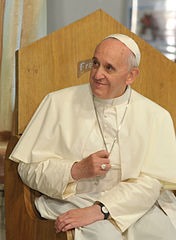
Papa_Francisco_na_JMJ_-_24072013 (This photograph was produced by Agência Brasil, a public Brazilian news agency. Used with attribution under a Creative Commons 3.0 License.)A while back, I noted that Cathy and I had been invited to take part in a catechist training course offered by our diocese.   We’re following the Echoes of Faith (Plus) curriculum and each week we prepare by watching a couple of videos and complete homework out of the workbook.  The real meat of the course, though, comes in the discussions we have when we meet with the other students — some from our parish and some from other parishes in the area.

The mix of people in the class is fascinating.  Some ar very young, others have been around the block a few times.  Some are cradle Catholics and others are converts.  There are representatives of various cultures and occupations and world views.  The first couple of meetings felt a bit like Junior High dances — everybody sat on the edges and didn’t seem to want to get too involved.  The last few weeks, though, the conversation has gotten much more energetic.

A couple of weeks back, the topic of discussion turned to our involvement in our various parishes and someone asked Cathy how much Evan’s process of discernment influenced our own involvement in the church.

I’ve thought a lot about that question since then.

First of all, if you’re being honest with yourself, you can’t have a child working through discernment without calling into question your own commitment to the Faith.  The same would be true if you had a good friend discerning a vocation or contemplating marriage or thinking about moving across the country to take up a new career or applying to grad school or whatever.  We live in relationship with others and, while comparing ourselves to others isn’t necessarily a healthy thing, it is useful to learn from their experiences.  So, yes, Evan’s discernment has given us pause to reflect.

There’s another influence, though.  Pope Francis is an inspiring leader.  His humility, patience and authentic Christian love are both comforting and challenging.  Most of all, his admission that he is a sinner as much as any of us, is a provocative statement that requires us to make a self-assessment of our own response to God’s call to personal holiness.

Pope Francis shows disarming honesty when he talks about how he was formed into the leader he has become.  In an article covering the incident with the child who approached him during Mass on October 26th, the author cites an incident from Francis’ past:

This kind of patience is something the pope has said he learned over time, according to his biographers Sergio Rubin and Francesca Ambrogetti. As the auxiliary bishop in Buenos Aires, Jorge Mario Bergoglio once had a train to catch to a retreat at a convent on the outskirts of Buenos Aires. After finishing his work in the diocese, he had given himself just enough time to walk to the cathedral to pray for a few minutes before getting to the train station. As he left, a young man who appeared to have mental health problems approached him and asked for a confession.

He says he felt annoyed, but tried to hide it. Bishop Bergoglio told him to find a father to confess to because he had to go – even though he knew a father wouldn’t be in right away (admitting to his biographers that because the man appeared to be medicated he probably wouldn’t notice). The auxiliary bishop walked away, but then after a few steps turned around with a “tremendous sense of shame.” He recalled later that he was “playing Tarzan,” trying to do too many things, that he had “an attitude of superiority.”

Today he uses it as a lesson to “travel through patience,” he told the two Argentine journalists. “Traveling with patience is allowing time to rule and shape our lives.”

Most of us would likely forget such a moment — perhaps intentionally. Few of us would take it as an opportunity to learn.  To his credit, Pope Francis is trying to spare us the pain of learning such lessons through unpleasant experience.  One of the constant themes in his homilies is the need for inclusion, for ensuring that everyone has a seat at the table of the Lord.

The Church is not the Church only for good people. Do we want to describe who belongs to the Church, to this feast? The sinners. All of us sinners are invited. At this point there is a community that has diverse gifts: one has the gift of prophecy, another of ministry, who teaching. . . We all have qualities and strengths. But each of us brings to the feast a common gift. Each of us is called to participate fully in the feast. Christian existence cannot be understood without this participation. ‘I go to the feast, but I don’t go beyond the antechamber, because I want to be only with the three or four people that I familiar with. . .’ You can’t do this in the Church! You either participate fully or you remain outside. You can’t pick and choose: the Church is for everyone, beginning with those I’ve already mentioned, the most marginalized. It is everyone’s Church!

And there it is.  Right in the middle of the paragraph.  Each of us is called to participate fully in the feast.

In case any of us missed it, the Pope goes on to say:

To enter into the Church is to become part of a community, the community of the Church. To enter into the Church is to participate in all the virtues, the qualities that the Lord has given us in our service of one for the other. To enter into the Church means to be responsible for those things that the Lord asks of us.

Like I said, challenging.  The natural human reaction when called to serve is, “Gee, I’d like to help, but I don’t have the time.”  If that’s your go-to move for getting out of service, Pope Francis has your number.

Open up your heart and listen to what God is saying to you. Allow your life to “written” by God”. Just as the Good Samaritan did when he stopped to help the stranger, we must all listen to God’s voice and sometimes put our own projects on hold to do his will.

Another common objection is, “I’m not really good at that sort of thing.  You don’t want me to mess it up.”  Um…hate to be the one to tell you, but Pope Francis anticipated that little dodge, too.

“The future of a people is right here…in the elderly and in the children,” he said. “A people who does not take care of the elderly and children has no future because it will have no memory and it will have no promise! The elderly and children are the future of a people!”

Pope Francis warned that it is all too easy to shoo a child away or make them calm down with a candy or a game – or to tune out the elderly and ignore their advice with the excuse that “they’re old, poor people.”

“The disciples wanted efficacy; they wanted the Church to go forward without problems and this can become a temptation for the Church: the Church of functionalism! The well-organized Church! Everything in its place, but without memory and without promise! This Church, in this way, cannot move ahead. It will be the Church of the fight for power; it will be the Church of jealousies between the baptized and many other things that occur when there is no memory and no promise.”

So…God doesn’t want our perfection, he wants our service.

And, by the way, am I the only one who thinks it’s kind of cool that the Pope talked about it being “too easy to shoo a child away” in a homily about a month before he was faced with that very situation during a Mass in St. Peter’s square?  Not that it was prophetic, but that he laid out exactly how he thought it should be handled and then handled it exactly as he had laid it out?  There, again, is the authenticity which makes him so inspiring as a leader and such an example of the lives we are to lead.

So, in our own way, following the lead of Pope Francis and acknowledging the call of our pastor, Cathy and I try to find ways to be open and accepting and to put ourselves in service of others.

— Dad

Reflection: Self-Sacrifice

(Editor’s Note: As part of the discernment and training process, the novices and students write and lead prayer services.  Evan will share his from time to time as he writes them.)

Novice Prayer Service Thursday October 15th, 2013
On Sacrifice

You will save more souls through prayer and suffering than will a missionary through his teachings and sermons alone.
-Jesus to St. Faustina, Diary of St. Faustina, 1767

Miss no single opportunity of making some small sacrifice, here by a smiling look, there by a kindly word; always doing the smallest right and doing it all for love.
-St. Thérèse of Lisieux

Tonight I thought we could use this prayer service to reflect on the sacrificing nature of a vocation. We willing give ourselves in love to the service of others, especially as future priests. There is also an aspect of sacrificing the “normal” life. We won’t have the small suburb home with a white picket fence, a wife, two kids, and a dog. Instead, we are called to live for the world, not simply in it. I thought one of the best ways to explore sacrifice would actually be to look at a few scenes from movies that have sacrifice as a central theme in a prayerful manner. I’ll give a little set-up explaining each scene.

Movie One: Road to Perdition, scene at 1:33:15

After a fellow gangster kills his wife and kids, Tom Hanks has to take his son across the country in order to keep him alive. In this scene, Tom confronts his mob boss about the gangster who is also stealing money from the boss. In the end, Tom does get his son across the country, but dies in the process of protecting his son.

Movie Two: The Iron Giant, scene at 1:14:00

 Set in Maine during the 1950’s, a giant robot crashes to Earth and befriends a 10 year old child. The  robot has amnesia and cannot remember his mission. He learns about Superman and being a hero from  the child. When the local town finds out about the robot when he save a kid from falling to his death,  they go into full panic thinking he is a monster sent to destroy them. The military is called in and the  robot goes into a rage and remembers his mission (which is to destroy the Earth). This leads to the  military launching a nuclear missile at the town.

Movie Three: Stranger than Fiction, scenes at 1:31:09 and 1:35:45

 Will Ferrell starts hearing his own life being narrated as though he was a character in a book. One  morning he hears the voice say that things were set in motion for him to die. He eventually tracks  down the author and reads the finished manuscript detailing how he will die.

So in all of these films there is a sense of love for others, even total strangers, where one is
willing to sacrifice themselves completely. A vocation, especially one to God, can be seen in a very  similar way. We don’t have to find a way to get ourselves killed, but we can find small things to do for others, not for ourselves. We can take an example after Christ and His most Holy sacrifice. In our  sacrifices we can find God, His love for us, and our own conversion to holiness (to being superman).

Share any thoughts or feelings.

 Closing Prayer:

Jesus, tender and loving Lamb of God, Utmost Sacrifice of all sacrifices, Your glory is  reverberated in  the highest. Being preoccupied with my well-being, You chose to self-sacrifice Yourself, Setting aside all Your personal glories. I thank You Lord Jesus for Your act of love! Your action has drawn me closer to You. Teach me to model in smaller things, To sacrifice in order to help others, Guiding my soul to endure abstinence. Lamb of God, I thank you endlessly!

Amen.  (Unknown origin)

— Novice

God, Moral Decisions, Compassion, and Video Games

MasseffectlogoOne of the appealing tenants of Ignatian Spirituality is that you should find God in all things. Somehow, I didn’t expect to encounter Him in a video game.

Last spring Ian started playing the Mass Effect trilogy of games. The games are a sprawling space opera involving villains, aliens, ancient races, cool futuristic technology, and a singular hero. As the player you take the role of Commander Shepard — the hero and a sort of space-going special forces soldier — in his (or her — you can choose whether Shepard is a man or a woman) quest to unravel various plots and defend the galaxy. Much of the gameplay is built around the notion of making choices and living with the consequences and that makes the game different for each player. Thinking (correctly) that it’s the sort of thing I’d enjoy, the boys conspired to buy me the trilogy as a birthday gift. On Sunday afternoons I play as a break from the workaday world.

A week or so ago I was playing a side mission that involved preventing a group of terrorists from dropping an asteroid on a highly populated planet. Doing my best John McClane, I slaughtered my way through dozens of enemies, shut off the fusion engines driving the asteroid toward the planet, and hunted down the terrorist leader. (The game has very cinematic pacing and each episode builds nicely to a climactic moment.)

The terrorist had captured three scientists and locked them in a cell with a remotely-detonated bomb. I had a simple choice. I could let the terrorist go and he’d release the hostages, or I could take him into custody knowing that he’d detonate the bomb before I could get to him.

The game waited patiently while I weighed the alternatives. On the one hand, he was a lying terrorist who had been trying to wipe out millions of peaceful humans. On the other hand, the scientist would surely die. But…terrorist!

I reasoned that he was certainly lying about releasing the hostages and I’d wind up with dead hostages and an escaped terrorist. If I captured him, I could put a stop to his unprovoked attacks on civilians and save countless lives. That seemed a fair trade.

The hostages died and I captured the bad guy. The game gave me ample opportunities to shoot him and I resisted because that wasn’t the moral thing to do. Instead, I arrested him and shipped him off for trail.

Since Ian has shown a keen interest in my progress, I sent him a text. He responded almost immediately, very surprised at my choice.

Bad guy blew up the hostages. At least he’s in custody now.

You chose to let the hostages die?

The needs of the many outweigh the needs of the few.

You chose wrong. He and the rock are stopped either way. He just slips custody.

Ahh…oh well. Now that’s a part of my character’s story.

It’s just funny because I asked you about that choice when I first played it.

Interesting.

And you said freeing the hostages was more important than capturing the terrorist. Did you think the asteroid would hit if you didn’t capture him?

No. I assumed he was lying and would kill the hostages anyway. Poor thinking on my part.

Funny how being in the moment changes things.

I feel there is a lesson in this.

I think so…must ruminate.

You’re going to be a cow?

Yes. Yes I am.

Ian’s wacky sense of wordplay aside, I did ruminate and I came to some interesting conclusions.

First of all, the game had given me a way to practice my faith — albeit in a simulation.

Second of all, I didn’t do very well.

When Ian called me last spring and asked my thoughts on whether or not to free the hostages, it all seemed very clear. In fact, the Catechism addresses this type of question in chapter 1, article 4, The Morality of Human Acts. The article lays out a standard for judging morality which includes the object, the intention and the circumstances. The meat of it shows up in paragraph 1753:

1753 A good intention (for example, that of helping one’s neighbor) does not make behavior that is intrinsically disordered, such as lying and calumny, good or just. The end does not justify the means. Thus the condemnation of an innocent person cannot be justified as a legitimate means of saving the nation. On the other hand, an added bad intention (such as vainglory) makes an act evil that, in and of itself, can be good (such as almsgiving).

That was core of the issue right there. The good intention — stopping the terrorist — did not make it acceptable to intentionally sacrifice the hostages’ lives. By making that choice, I objectified the hostages and stripped them of humanity in favor of achieving my goal. In the words of the catechism, my behavior was “intrinsically disordered.” (That’s fancy talk for “just plain wrong.”)

What had been so easy to answer in the abstract during a telephone conversation with Ian, suddenly seemed very difficult in the heat of the moment.

I’m unlikely to ever face such a choice in real life, but Ian was right to say there was a lesson in the experience.

The first lesson is the importance of formation and a deep understanding of the faith. I’m pretty sure I had a solid basic grasp of the faith and I was certainly able to answer the question for Ian when he called. But in the heat of the moment I forgot what I knew and my answer came from a gut hunch instead of informed reasoning. Had my formation (formal and informal) included more contemplation of how the catechism played out in the real world — or in the simulated world of a video game — I might have had the presence of mind to make the right choice.

Which was the essence of the second lesson. I made the wrong decision even though I knew better. Sometimes real life is like that. Even when we should know better, we do the wrong thing. The Apostle Paul referenced this very issue in Romans 7:19.

For I do not do the good I want, but I do the evil I do not want.

As human beings, we are all subject to concupiscence. That is, we are inclined toward sin despite our better desires. And, if it was true for me in a relatively trivial decision in a video game, how much more true is it for people facing difficult moral decisions in real life? It is easy to sit in the pews and condemn people who face difficult choices such as abortion. (I’m using abortion as an example, but given the wide range of human behaviors and opportunities to miss the mark, there are plenty of other situations I could have chosen.)

It’s easy to convince yourself that you would make the correct moral choice; after all you have a well-formed conscience. Perhaps that is true. But you’ll never really know until find yourself living that moment.

That truth calls us to be caring in our response to people who make those choices. As I noted, condemnation is easy, compassion is hard. The decisions which seem so obvious and simple on the outside can be very difficult for those who live them.

Not that sin should be excused — far from it — we have the Sacrament of Reconciliation for the very purpose of addressing sin. Rather, in addressing the sinner we need to have appropriate concern for the humanity and dignity of that person. Failure to do that is a different sort of moral lapse.

Which brings me back to the game. I had saved an earlier play session and had the option to re-load from that point, reconsider my decision and act in the way I should have acted all along. The terrorist got away and set a timer on the bomb (my instincts weren’t entirely wrong) but I saved the hostages. Unlike real life, the game gave me a chance to undo my mistake; to make it as if it had never happened. And — maybe — the opportunity to repent of an error and return to do better the next time is the model that should encourage us all to trust in God’s Grace.

–Dad

Last Things

eschatologyToday’s vocabulary word is eschatology.  That’s the theological study of “last things” like death, the afterlife, eternity and the end of time.  Hang on to that tidbit, you’ll need it in a minute.

A little over a year ago, Evan’s Vocations Director, Fr. Dave, came out to visit Evan and to meet with us.  We fell to talking about the coursework Evan would have to complete in order to graduate in the spring of ’13.  By dint of hard work (including a summer semester after he changed majors and an insanely challenging semester with 18 credits) he was very, very close.  There was still a chance that he might not graduate.  In order to earn his degree, he choose one of two mandatory classes — and it wasn’t clear that either of them was going to be offered during the year.

“That’s metaphysics and eschatology, right?” I asked.

“No dad,” he said.  “It’s metaphysics and epistemology.”

“Oh.  Right.  EpistemologyEschatology will be one of the last things you’ll study.”

Theology puns.  Does it get any better than that?  (Yeah, probably, but thank you for indulging me by reading that.  The rest of this will be more serious, I promise.)

I’ve been thinking a lot about endings lately.  Evan is leaving.  As Cathy noted, she’s left her career in medicine and moved on to new challenges.  A good friend just lost her adult son to cancer.  It seems to be a season of endings for us.

We’ve been preparing with lots of “lasts” and last minute preparations.  (Which is, in part, why we’ve been so scarce in this space the last couple of weeks.)

When it opened, the boys and I went to see Elysium.  (Capsule review; don’t bother.)  Since the boys have moved out, the three of us have met from time-to-time for dinner and a movie.  I’ve always enjoyed those as I’ve learned how to relate to my sons as adults.  I suspect I’ve not always done a good job of working out this new relationship, but it’s been good getting to know them in a new and different context.

I’m going to miss having those “guys nights”.

A week ago Tuesday, we had Fr. Clarence over for a last dinner with Evan.  Ian, our oldest, was able to join us as well so we had the whole family together for a meal with our parish priest.  He told us about his vocational discernment, his years with the Peace Corps in Lesotho, the importance of myth and storytelling and his advice on entering the seminary.  (Make sure you have a good spiritual director.)

On Wednesday last week we attended the vigil for the Feast of the Assumption and Evan went with us.  That’s the last Mass we’ll share with him for a while.  When the Mass was done he spent a few minutes visiting with people in the parish whom he has known for years and who have been encouraging during this phase of his discernment.

Tuesday evening we had a family dinner together with both boys and my mother.

And, of course, on Wednesday morning (at an abysmally early hour) we said good-bye and sent him off on the plane to D.C.

We’re hardly the first family bid a child farewell.  Every day families send their sons and daughters off to college, to the military, to various kinds of service and education and employment in distant places.  Yet, this is a first for us.  Even though they moved out, both boys have been relatively close to home.  And, as Fr. Clarence pointed out, Evan’s community will become his family now in a profound and important way.

It’s surprisingly tough to see him go.  I’ve passed the last couple of weeks in a sort of anticipatory melancholy which balances my hopes for his on-going discernment process against the reality of his departure.  As they say on the internet, I’m feeling all the feels.

I’m proud of him, of course, and wouldn’t want him not to go.  At the same time I’ll miss having him close by.  I take comfort in the fact that this ending is also a new beginning.  It is not so much a season of endings, but rather a season of change in our lives.  And I look forward to seeing what other changes God has in store for us.

— Dad

Change of Life Indeed

160px-Stack_of_coins_0214I have always joked with the adage “If you are going to go, go big”. Didn’t mean to do it quite to this degree in my life.

Evan leaves this week and that alone is a major life change. Fr. Clarence (our parish priest) mentioned to us that although other people have children move away, this is different. The largest difficulty that our priest’s family experienced was that he was no longer available for time normally considered family times (Holidays, birthdays, anniversaries, etc.) Evan is now, as Fr. Clarence was then, joining a new community, a new family. And effectively leaving our family. Just as Hannah prayed for Samuel and then gave him to the Lord (Samuel 1:27-28), so too, I prayed for Evan and now must give him to the Lord. NOT EASY. I admire Hannah but don’t feel as sure as she was. Guess I have to work on that. Pray for me.

I’m experiencing another change; the one most commonly associated with the phrase “the change”. After almost 28 years of marriage using natural family planning (sympto-thermal method) I am officially post menopausal. For those who are familiar with the method, this now means that we are now permanently post ovulatory. Quite a change after two years of almost constant pre-ovulatory rules. I am probably one of the few people I know who has undergone a natural path to menopause and I know I am the only person of my acquaintance who couldn’t wait to be post menopausal. I have always loved the method and glad my husband and I practiced it. I think it made us closer. I do wonder how long till I stop checking my “symptoms”. I thank the Lord that I married a man brave enough and confident enough in our love to practice our faith together in all aspects of our lives.

And just because I don’t have enough stress in my life (or maybe because I do) I quit my career of 28 years as a clinical laboratory scientist. I spent 24 of those years were at the same laboratory. I have been feeling called to something and praying desperately for guidance. I was presented with an opportunity to assist with formation at our church. My career would not allow me the time or freedom to really involve myself. My husband and I worked at me finding alternate employment that would allow me an out with enough income to not stress us in a new way. I have become the print-shop assistant at  The Davis Applied Technology College. The same place my husband works and where I did a two year stint as a night phlebotomy instructor.  (Insert your own vampire joke here.)

I know the people at the college as friends already, and love being creative and working with big machines. It is a perfect fit. The salary is a third that of my prior job but my (wonderful) husband and I looked over the budget and decided to cut some and make the leap. I will not miss the stress of my former job; you can only worry about life-altering consequences of your actions so long. I will miss terribly all the phenomenal friends that I will no longer see on a regular basis. I cried as I cleared out my locker after the wonderful “so long” party all my co-workers gave me.

Now for the next phase. New physical conditions, new family conditions, new work conditions, new volunteer conditions, same glorious husband, same loving Lord. Thank you Lord

– Mom

Foodie Priests

Photo Credit: Creative Commons courtesy of Alpha by way of Wikimedia CommonsThe Paulist.org website has a nice article about the “Paulist Plunge” retreat for this year.  The article does a gives a peek into the experience, but it doesn’t mention the amazing dinner that Fr. Larry cooked for the men participating in the retreat.

Evan reported that it was an amazing meal featuring grilled salmon and some sort of risotto and (to be honest) I sort of lost track after that as I was very hungry at the time and Evan’s description of the entrée briefly sidelined my ability to process new information.

Fr. Steven Bell, who also participated in the retreat, is a cohost on the Busted Halo podcast and a foodie as well.  At various times on the podcast he’s reported on meals he cooked and I had the same mouth-watering-brain-derailing reaction.  He has also been heard to say that Jesus was a foodie.

The whole idea of foodie priests might seem strange.  A lot of people think of priests as severe ascetics who go out of their way to avoid worldly joys.  These same people tend perceive Catholics as dour, pinch-faced individuals.  I think they’re confusing us with Puritans.

One of the fundamental teachings of Catholicism (and, as a convert it took me a long time to understand this) is that the world is good.  Fallen and corrupt, but good in its very creation.  If God — who is all good and loving — created the world, how could it be otherwise?

The Catechism of the Catholic Church asserts this truth in the very beginning.

339 Each creature possesses its own particular goodness and perfection. For each one of the works of the “six days” it is said: “And God saw that it was good.” “By the very nature of creation, material being is endowed with its own stability, truth and excellence, its own order and laws.” Each of the various creatures, willed in its own being, reflects in its own way a ray of God’s infinite wisdom and goodness. Man must therefore respect the particular goodness of every creature, to avoid any disordered use of things which would be in contempt of the Creator and would bring disastrous consequences for human beings and their environment.

341 The beauty of the universe: The order and harmony of the created world results from the diversity of beings and from the relationships which exist among them. Man discovers them progressively as the laws of nature. They call forth the admiration of scholars. The beauty of creation reflects the infinite beauty of the Creator and ought to inspire the respect and submission of man’s intellect and will.

In a similar vein, the Bishops of Mississippi and Alabama wrote a pastoral letter to their congregations in 1989 asserting:

For Catholics, Biblical teaching has always maintained that our world is good and has been entrusted to our care by God. We do not see it as something evil to escape, rather we embrace our world without embracing the sin within it.

In practical terms, this means that the we are not only free to enjoy the world — we are actively encouraged to engage with God’s creation.  The world is ours to enjoy.  Beauty, good food, and and all the delights of the senses reveal parts of God’s love for his creation to us.  Our God is an awesome God and it’s okay to acknowledge that and embrace his creation.

And that includes good food.

The link between food and faith is particularly strong.  Jesus practiced what is known as “open table fellowship” and is often shown dining with people from a variety of social classes.  The Last Supper is one of the pivotal moments in the New Testament — so important that we reenact it at every Mass and given it special prominence during Holy Week at the Mass of the Lord’s Supper.

The folks at CatholicFoodie.com know this.  Their website and podcast explore the relationship of food and faith.  Plus they have some great recipes.

So, strange as it might seem to some, the idea of a “foodie priest” makes perfect sense.  Enjoying good food (but not to excess) is an act of embracing the gifts that God has given us.

Over the years, Evan has shown himself to be an outstanding cook.  This past summer he and his roommate make a massive batch of incredible pork tamales.  As an undergraduate, he regularly hosted dinners for his friends — calling home to ask advice on food pairings and preparation.

He comes by his talent naturally.  His mother is an awesome cook who learned the craft by working in the kitchen at her parent’s restaurant.  And I think he might get a bit of his talent from my side of the family too.  And, given what I know about the Paulist community and its relationship to food, I think Evan is going to fit right in.

–Dad

The Outside Perspective

Good day all,

This is Sparky, the occasionally referenced elder brother of the Novitiate. My brother leaves town on a largely permanent basis in less than a month so I figured it was high time I put out some words about it.

I think it’s just now hitting me. I mean he and I haven’t spent that much time in each other’s company in years, scheduling trouble and my own reclusive tendencies saw to that. But there is something different in this. I think part of it is geographic. No longer would a trip to see him be just a few hours on the road. But a larger part perhaps is in the nature of his move. Priesthood is a demanding calling, and yes I’m sure he isn’t abandoning his family, and Paulists are rather big on being in the community rather than separated from it, but still. They do refer to it as giving oneself entirely to God. I seem to recall something about a hand on a plowshare,

Now about the title of this post: I am not part of the Church anymore. I often find myself in a position to defend Catholic beliefs and practices but ultimately I struggle with faith on a personal level. I sometimes joke that there was a cosmic mix up and he got all the belief.

So while my parents are watching their younger son go forth in the Service of God I’m watching my brother pursue what he feels is his calling. I’ll not speak a word against it mind you, he does as he feels is right. And there are far far worse things to dedicate one’s life to. But on some level it remains a mystery to me that I can’t quite grasp. Still it is my wish to support him, though probably with less in the way of chaplet crafting.

Another time I shall have to tell the tale of his informing me of his calling, and I’m sure I can come up with a few other posts. But for now I bid you farewell.

–Older Brother

I’m not ready yet

IMG_0317Oh my gosh! He leaves in less than a month. I have things I wanted to do first. Panic sets in.

Okay. Deep breaths. Everyone’s children leave the nest. It is not like he has lived with us for a while. Actually he has not stayed here for any meaningful time period since summer after freshman year of college four years ago. However, there is an additional sorrow for me watching him going across the country. It feel like he is leaving all over again.

To fix my crazies, I decided to finish one project for him that I had set out to do ages ago, a chaplet for St. Michael. He has always had a special devotion to angels and St. Michael in particular. Just as a reminder, a chaplet is a a set of beads used in a intercessory prayer. Most people are very familiar with the most common chaplet, the rosary. Not as many know that there are actually many chaplets devoted to different saints and even to different orders.   I wanted to make a St. Michael’s chaplet for Evan before he left.

I sat down the next day with my jewelry making tool and all my supplies (I found a great website that sells all the stuff you need to make both cord and metal linked rosaries and chaplets called Catholicparts.com) and got to it. The small beads are black glass with an iridescent finish and the large beads are silver with a picture of St. Michael on one side and a Guardian Angel on the other. I had a St. Michael three-way connector but no religious metal to put on the end. The problem was solved by raiding Evan’s old treasure box in the studio closet. I took one of the many St. Michael metals from within and finished the chaplet.

That treasure box was a hindsight 20/20 flash on Evan’s religious bend. It is filled with religious metals, rings, rosaries and other religious articles he had picked up over the years, most with either angels, St. Michael, or crosses on them. We never knew he had them till we packed up his stuff when he moved. Kind of made me laugh to find all these treasures.

The chaplet is finished and was handed to Evan with instructions to get it blessed. He seem pleased. I was very happy that he would have something I made for him to go with him to D.C.

Panic over.

–Mom

Joy and Sorrow

In my last post, I mentioned the Pope’s admonition regarding joy and it’s place in the Christian life.  I certainly believe that, but I wanted to take a moment to address the other side of the equation.

Fr. James Martin is a Jesuit and author of Between Heaven and Mirth: Why Joy, Humor and Laughter are at the Heart of the Spiritual Life.  On his blog this week, he posted an excerpt from the book addressing the difference between mindless happiness and true joy.

So the believer must navigate between a grinning, idiotic, false happiness and carping, caterwauling, complaining mopiness. (Notice again that I’m also not speaking of clinical depression here, which more of a psychological issue.)  Overall, the believer will be happy and sad at different points of his life; but joy is possible in the midst of tragedy, since joy depends on one’s faith and confidence in God.

He goes on to note that:

Likewise, a person in a difficult situation can still find humor in his or her life and still laugh.  Moreover, he can choose to be cheerful around others, not in a masochistic way but rather as a way of not unduly burdening everyone with your latest complaint.  This is not to say that one should never talk about one’s struggles or burdens with anyone. As St. Paul would say, “By no means!” It’s important during times of struggle to speak to a close friend, family member, a priest or minister, or a therapist, things are very difficult. And it’s important to share those struggles with God in prayer.

This has certainly been true in my life.  Even in the most difficult circumstances, there are moments of joy and grace and even laughter.

In my father’s last days, before the cancer finally beat him, there were many, many dark moments.  Times when we despaired as we watched him spiraling down.  Yet, there were also moments of joy and humor.  Sometimes as a result of something we remembered about him from better days or because of some seemingly small event that set us to laughing.

Humor became a relief valve and provided us with moments that I truly believe were God-sent as grace to get us through.

Much of this came back to me this week when I read Thomas McDonald’s account of his father’s last days.  Thomas is a talented blogger who perfectly captured the experience of a slow death in all of its essence.  He, too, experienced those moments of grace and joy.

There were brief “rallies” and flickers here and there. One day, he was muttering something, and when my mother asked him who he was talking to, he said, “All of them” with a smile. He would regain tiny slivers of consciousness and his eyes would focus on blank places in the room, one after another, and smile beatifically.

Thomas sums up the experience at the end of the essay.

The bodies we have are noble and God-created: enfleshed spirit. They are wombs for the soul to be born into heaven, and one day we will return to these bodies, only to find them perfected.  And after this our exile, we will come face to face with the first fruit of that womb, and there will be neither tears, nor death, nor mourning, nor crying, nor pain.

In my mind, these two essays complement one another.  If you have a few moments, please read them both.  They point to the middle path which we should walk as believers and give an example of the journey.  And, both of them point to the fact that even in dark times, there is still joy to be found.

–Dad

Love and Joy

This past week, about 6,000 novices and seminarians visited Rome as part of a Vocations Pilgrimage arranged by the Pontifical Council on the New Evangelization.  I’ve enjoyed reading what the Pope has to say to these young people.

In his homily for July 7, he pulled three strands out of the readings and wove them into a compelling picture of ordained religious life.  The whole homily is worth reading, but for the moment I’d like to concentrate on his first point — the need for joy in the Christian life.

From the first reading (Isaiah 66:10-14) Pope Francis talks about the joy of the consolation of the Lord.

Every Christian, especially you and I, is called to be a bearer of this message of hope that gives serenity and joy: God’s consolation, his tenderness towards all. But if we first experience the joy of being consoled by him, of being loved by him, then we can bring that joy to others. This is important if our mission is to be fruitful: to feel God’s consolation and to pass it on to others!

I think this joy is something that is too often lacking in the lives of Christians.  We shuffle across the Earth with long faces and sour expressions and its little wonder that no one wants to join us.  Somewhere along the line we’ve forgotten the essential nature of God.

God is love.

Stop and re-read that sentence.  It’s become a sort of Christian meme that we toss around carelessly without really contemplating what it means.  If you really consider it, the implications become awesome and a little frightening.

In his review of the film of the musical Les Miserables, Fr. Robert Barron says:

[Speaking of the Bishop’s gift of silver candlesticks.] In this simple and deeply affecting episode, one of the most fundamental principles of the spiritual life is displayed. God is love. God is nothing but gracious self-gift. And what God wants, first and last, is that his human creatures participate in the love that he is, thereby becoming conduits of the divine grace to the world. What Jean Valjean received through the bishop was precisely this divine life and the mission that accompanies and flows from it. If the bishop’s gesture had been, in any sense, self-interested, it would not have conveyed God’s manner of being. But in its utter gratuity, it became a sacrament and instrument of uncreated grace.

Earlier this year, our parish hosted a weekly class built around Fr. Barron’s Seven Deadly Sins/Seven Lively Virtues study course.  That hardly sounds like the sort of topic that would lend itself to a discussion of God’s love.  Dialogue about sin inevitably conjures visions of punishment.  Yet, Fr. Barron constantly drew out the fact that we owe our very existence to God’s love.  He used the phrase “continually loved into being” over-and-over.

If we believed that — really believed that — it would change the way we act; it would change who we are.

I think Pope Francis believes that as well, in an earlier address to the seminarians in Rome, he said that there is “no holiness in sadness“.

Pope Francis took seminarians and novices to task for being “too serious, too sad”. “Something’s not right here,” Francis told them pointing out that `’There is no sadness in holiness,” and adding that such clergy lack “the joy of the Lord.”

“To become a priest or a religious is not primarily our choice; it is our answer to a calling, a calling of love”.

“If you find a seminarian, priest, nun, with a long, sad face, if it seems as if in their life someone threw a wet blanket over them,” then one should conclude “it’s a psychiatric problem, they can leave – `buenos dias’”.

He’s right.  How can we not have joy and confidence when we know God loves us?

–Dad

That’s Funny Right There!

I’m a big fan of humor.  Big fan.  Sure I love a good drama, but I’ll go out of my way for a mediocre comedy.  When it comes to Shakespeare, give me Much Ado About Nothing over Henry V any day.  (Which in no way implies that Much Ado is mediocre…just making the point that my preferences run to the funny.)

Which is why I was struck by a comment Pope Francis made in his homily on July 1.

He was preaching about the need for tenacity in prayer; the need to bring our petitions to God over and over; the need to negotiate with God.  He cited the example of Abraham asking God to spare the cities of Sodom and Gomorrah.

When we speak of courage we always think of apostolic courage – going out to preach the Gospel, these sort of things…But there’s also (the kind of) courage (demonstrated) before the Lord. That sense of paralysis before the Lord: going courageous before the Lord to request things. It makes you laugh a bit; this is funny because Abraham speaks with the Lord in a special way, with this courage, and one doesn’t know: is this a man who prays or is this a‘phoenician deal’ because he’s bartering the price, down, down…And he’s tenacious: from fifty he’s succeeded in lowering the price down to ten. He knew that it wasn’t possible. Only that it was right…. But with that courage, with that tenacity, he went ahead.

There.  Do you see it?  Right in the middle of the paragraph Pope Francis acknowledges the humor of the situation.

It makes you laugh a bit.

As a lector, I love being able to proclaim the reading from Genesis 18:16-33.  Abraham’s character is so vivid and outright funny.  God tells him that Sodom is toast.  Most of us would probably nod and say, “Well, they deserve it.”

Abraham doesn’t.  He starts to negotiate with God.  He starts the bargaining by asking if God really intends to sweep away the righteous with the wicked.  Then he asks

Suppose there were fifty righteous people in the city; would you really sweep away and not spare the place for the sake of the fifty righteous people within it?

God agrees to Abraham’s terms and Abraham — good negotiator that he is — presses further.  With a hilariously formal humility —

See how I am presuming to speak to my Lord, though I am only dust and ashes!

— he drives the bargain to 45 and then 40 and then 30 and then 20 and finally 10.  The whole story has a sort of haggling-in-the-marketplace vibe that makes me chuckle every time.

Yet, as Pope Francis points out, negotiating with God is a perfectly acceptable form of prayer.

Sometimes, the Pope said, one goes to the Lord “to ask something for someone;” one asks for a favor and then goes away. “But that,” he warned, “is not prayer,” because if “you want the Lord to bestow a grace, you have to go with courage and do what Abraham did, with that sort of tenacity.” The Pope recalled that Jesus himself tells us that we must pray as the widow with the judge, like the man who goes in the middle of the night to knock on his friend’s door. With tenacity.

In fact, he observed, Jesus himself praised the woman who tenaciously begged for the healing of her daughter. Tenacity, said the Pope, even though it’s tiring, is really “tiresome.” But this, he added, “is the attitude of prayer.” Saint Teresa, he recalled, “speaks of prayer as negotiating with the Lord” and this “is possible only when there’s familiarity with the Lord.” It is tiring, it’s true, he repeated, but “this is prayer, this is receiving a grace from God.” The Pope stressed here the same sort of reasoning that Abraham uses in his prayer: “take up the arguments, the motivations of Jesus’ own heart.”

Like all good humor, the story of Abraham’s negotiation is funny because it is true.  And it tells us something about ourselves and our world.

–Dad