
Blog

Coffee, Catechism and a Black Apron

P2020473

Our oldest son, Ian, works as a Starbucks barista and trained as a Coffee Master.

“Coffee Master?” you ask. “What’s that?”

Coffee Masters are the Starbucks equivalent of the geniuses in the Apple Stores.  They’re the ones who know exactly what makes a blonde roast different from a dark roast and why sun dried Sumatra tastes so much better than it’s more mundane cousins.  They’re distinguished from other Starbucks partners with a black apron.  The Starbucks Melody blog explains it this way:

If you are a customer, and you have a question about coffee, look for the Starbucks baristas in black aprons:  They can talk to you about the four fundamentals of great coffee (water, proportion, grind, freshness), or if you want a low acidity coffee, a black apron Starbucks barista might steer you in the direction of Italian Roast, or if you want to try something fun and new as an espresso shot, again the barista can help answer those questions.  (The new Yirgacheffe works beautifully as a shot of espresso!).

Earning the apron was no easy task and, along the way, Ian taught me a lot about coffee.  I learned (for example) that coffee is the world’s second most traded commodity.  (Oil takes the top spot.)  I also learned to identify the various component flavors of individual blends and to articulate what I like and dislike about each.

P2020471As part of the training, Ian hosted a series of coffee tastings in his store.  These involved selecting and pairing different coffees with different foods to explore the ways in which flavors interact and strengthen one another.  In one surprising match, Ian paired a blonde roast (which I find a bit bitter) with some smoked gouda.  To my delighted, the cheese smoothed out the coffee and improved the flavor of both.

I’ve also learned to sound a bit snobbish when I say (in all sincerity) that the new Ethiopia blend has a smooth flavor that lingers on the back of the the tongue and has a chocolaty aftertaste.

I bring all of this up for three reasons;

1) I’m proud of Ian and how hard he worked to earn this distinction

2) It reminds me that the created world is good and God meant for us to enjoy it

3) There’s a link between this and the importance of catechesis

Really.

I’ve been a fan of coffee for since I took up the habit in college more than a quarter century ago.  And, for most of that time, I drank whatever was available.  I’d occasionally say something like, “That was a good cup of coffee.”  Except, I only said that because it tasted good to me.

I had no real understanding of coffee.  No appreciation for what it took to go from raw coffee cherries (they’re not really beans, I learned) to the dark liquid in my cup.  The language to describe the coffee in any meaningful way — to be able to communicate with others what I was experiencing — was beyond me.

Once I started to learn, though, a whole new universe of appreciation opened up for me.  The coffee hadn’t changed, I had.

I think the same is true for catechesis.  Cathy and I have been taking a catechist preparation course this year based on the Echoes of Faith series.  At the start, I assumed that teaching religious education was more-or-less like teaching any other subject.  It was about getting the students to understand the content.  They needed to be able to answer the questions appropriately and demonstrate some knowledge of the material.

As the class goes on, I’m rethinking that.  Certainly the knowledge is important.  Understanding is the basis of appreciation.  More importantly, though, my students need to have the experience that comes of out that knowledge.  If Ian had simply described different roast profiles to me, I’d still be stuck at the “Gee, that’s good coffee” stage of development.  By coupling the knowledge with the experience of tasting and giving me the opportunity to articulate what I was experiencing, Ian helped me to expand my appreciation of coffee.

That’s not to say that the knowledge is unimportant, but it’s too shallow a way to share the Faith.  The Catholic church isn’t a series of rules or historical anecdotes.  It is a living faith which should be experienced and integrated into daily life.  It is a way of being which fundamentally alters the believer.  Perhaps we’ve overlooked that in the past.

My “coffee formation” (if I can use that phrase respectfully) has brought me to a place of deeper understanding of and appreciation for coffee.  Bad coffee (which is sadly abundant in Utah) has become nearly intolerable and I’m willing to expend time, energy and money to get good coffee.  Imagine what would happen if our catechism programs made people turn away from lukewarm faith and made them willing to work hard at what they believe.

— Dad

Priesthood as Exemplary Masculinity

Word on Fire posted an article this week that really needs no commentary from me.  So, other than noting that the passage below caught my eye, I’ll leave it to you to read the whole thing.

In the priest’s role we find what manhood is actually all about, that being service to the Bride. In his collar of strength he gives his life day in and day out to the needs of his fellow man and the desires of his Bride, the Church. If only more men would look to this place of encouragement and follow in the footsteps of the great men who came before them, not fearing their testosterone but embracing it and letting its great fire burn within the heart of the hero we men are called to be!

Read more.

Are You Listening?

HomerListenSo, Pope Francis talked about the internet this week in the context of World Communications Day.  Much of the coverage focused on the Pope’s assertion that the internet is a ‘Gift from God‘.  I’m not going to argue that point; I have a hard time imagining a life without an always-on connection.

What really caught my attention, though, was this little nugget near the end of the Message for World Communications Day 2014.

Effective Christian witness is not about bombarding people with religious messages, but about our willingness to be available to others “by patiently and respectfully engaging their questions and their doubts as they advance in their search for the truth and the meaning of human existence” (BENEDICT XVI, Message for the 47th World Communications Day, 2013). We need but recall the story of the disciples on the way to Emmaus. We have to be able to dialogue with the men and women of today, to understand their expectations, doubts and hopes, and to bring them the Gospel, Jesus Christ himself, God incarnate, who died and rose to free us from sin and death. We are challenged to be people of depth, attentive to what is happening around us and spiritually alert. To dialogue means to believe that the “other” has something worthwhile to say, and to entertain his or her point of view and perspective. Engaging in dialogue does not mean renouncing our own ideas and traditions, but the claim that they alone are valid or absolute.

DiplomaThis caught me because I’ve trained as a mediator and have a Master’s degree in Negotiation and Conflict Management.  True story.  Also, fun fact: I earned the degree from Cal State Dominguez Hills which means it was signed by the President of the Board of Trustees who is also the Governor of California.  Thus, my degree in Negotiation and Conflict Management was signed by the Terminator.

One of the lessons that they pound into you over and over and over in conflict work is that the key to resolving conflict lies in getting people to listen to one another.  I mean, really listen.  Most of us think that we are good listeners and we’re all pretty much wrong on that point.  Let me give you a little listening test.  Check out these two quotes from Pope Francis.  What do you think he meant?

The ability to compromise is not a diplomatic politeness toward a partner but rather taking into account and respecting your partner’s legitimate interests.

No references to the need to fight terror can be an argument for restricting human rights.

Boy that Pope Francis is pretty direct, isn’t he?  And always consistently on message.  You have to respect that.

Except I lied to you.

Those quotes weren’t from the Pope.  They came from former KGB agent Vladimir Putin. Go ahead and read the quotes again.  I’ll wait.

The ability to compromise is not a diplomatic politeness toward a partner but rather taking into account and respecting your partner’s legitimate interests.

No references to the need to fight terror can be an argument for restricting human rights.

Kinda puts a different spin on them, doesn’t it?  It also raises questions about your skills as a listener.  When you thought the quotes came from Pope Francis, you probably felt warm and fuzzy.  When you learned they came from Putin, you probably wondered what he really meant.

I use this exercise when I lecture on conflict resolution.  It helps to illustrate the truth that most of us are poor listeners.  We aren’t really listening, we’re filtering what someone else says through our preconceptions and expectations.  We’re picking apart what they say with the intent of proving our point by disproving theirs.  Listening means sitting back, being open, and really hearing what the other party is saying.

In western culture we tend to confuse the phrase “I hear what you are saying” with “I’m in complete agreement with you.”  Hearing and understanding a point of view does not mean that you are persuaded by it.  It does mean that you can begin the search for meaningful common ground for dialogue.  Until dialogue beings, we are just shouting at one another over the chasm of misunderstanding.

Pope Francis summed it up better than I can when he said:

To dialogue means to believe that the “other” has something worthwhile to say, and to entertain his or her point of view and perspective.

Now, what does all of this have to with the Paulists?  (After all, this blog should occasionally connect back to the Paulist mission, right?)  One of the key Paulist charisms is the development of interfaith dialogue.  On the Paulist Ecumenism page it’s expressed this way:

The goal of interfaith dialogue is not unity in faith and worship, but mutual understanding and respect, and mutual enrichment enabling us all to respond more fully to God’s call. It includes collaboration wherever possible in response to the societal problems we commonly face. For this reason, the purpose of theological dialogue will not be to prove that one side is right and the other is wrong, but rather to explore respective positions in order to understand them better. When this is done, many prejudices, built on half-truths, will fall by the wayside.

Like all of the faithful, I long for the day when we are not divided.  More to the point, I’m responsible to help bring that about.  From my studies in conflict, the best way forward is to begin by listening to find the places where we can meet and begin our journey together.

Minor Orders

320px-StMarysWestMelbAltarThe holidays are over and it’s time to get back to ordinary time — which, for me, includes blogging.

While Evan was home (we had him for the better part of a month) we spent some time talking about the seminary and what’s he’s been learning and doing.  Among other things, this past fall he was working at drop-in shelter/soup kitchen.  When they found out that he could bake, they set him to work making cookies and pies and such — anything that didn’t need to rise to be cooked.  We also spent a little time talking about how religious formation has changed over time.

This might sound a bit esoteric, but it actually gives an interesting peek inside the history of the church in the post Vatican II era.

Prior to 1973, candidates for the priesthood went through several well-defined steps during their training.  It started with the tonsure — a ceremonial haircut to mark the candidate’s entry into religious life.  Think of the bowl cut you associate with Friar Tuck or Brother Cadfael.  It was considered a sign that the candidate no longer cared about worldly fashion.  By the middle of the last century, though, the bowl cut had given way to a ceremonial clipping of five tiny tufts of hair as the points of a cross on top of the candidate’s head.

During formation, the candidate would go through the four minor ordersporter, lector, exorcist and acolyte.  The progression through the minor orders was a bit like gaining rank in the military, each of them brought the candidate new responsibilities.  None of them were Divine or Apostolic in origin and they were added to the church at different times.

Formal ordination began with the order of the subdeacon.  As the name implies, the subdeacon shares in some of the responsibilities, but not the full authority of an ordained deacon.

Candidates then — and now — go through ordination to the deaconate before making their final vows as priests.

In 1973 Pope Paul VI issued the Ministeria Quaedam which changed the minor orders into ministries.  In doing so, he said:

Nevertheless, since the minor orders have not always been the same and many functions connected with them, as at present, have also been exercised by the laity, it seems fitting to reexamine this practice and to adapt it to contemporary needs. What is obsolete in these offices will thus be removed and what is useful retained; also anything new that is needed will be introduced and at the same time the requirements for candidates for holy orders will be established.

Two of the minor orders — Lector and Acolyte — have been retained as ministries in formation programs to mark the candidate’s progress.

Many of the tasks which had been reserved for those in training have been taken over by the laity.  This reflects the goal of Vatican II to encourage “full, conscious and active participation” by “all of the faithful”.

What’s interesting to me is that there are groups seeking a return to the use of minor orders.  They feel that we have somehow lost something important.  I wouldn’t want to interfere with anyone’s personal piety, but I think they may be missing the larger picture.  Minor orders were never dogma nor did they reflect core theology.  They were simply a process which reflected the needs of the church at the time.  I would even suggest that the minor orders made it possible for the laity to sit back in the pews and treat the church as something to be observed rather than experienced; an inactive religion that kept faith at a distance from life.

For myself, getting involved has helped grow my faith.  When you dedicate time to an activity — a job, a hobby, a cause or a religion — you naturally engage more fully in it.  You learn, you question and you grow.  Which, I guess, is my ultimate point.

The formation for Holy Orders is vital to the future of the church.  We need the religious to fulfill their particular roles.  But we’re fooling ourselves if we think that we shouldn’t be in constant formation as well.

— Dad

Luke Live – A Paulist Mission!

Luke-Live

The first Paulist priest that we met — at least knowingly — was Fr. James DiLuzio.  Fr. James performs a mission called “Luke Live” which is built around a recitation (from memory) of the book of Luke along with popular songs and an invitation to personal reflection.

Our pastor, Fr. Clarence, invited Fr. James to bring his mission to St. Rose two years ago.  This was a few months after Evan had told us of his discernment toward the priesthood and, specifically, the Paulists.  We jumped at the opportunity to meet Fr. James and to get to know him.

He’s a great example of the Paulist charism, using his talents as a performer (his resume includes SAG/AFTRA membership) and storyteller to make the Gospel of Luke meaningful and personal.  Interspersed with the performance, he walks his audiences through a series of exercises designed to bring deeper understanding of the scripture.

We’ve attend the past two years and are looking forward to attending this year’s presentation.  It’s difficult to capture in words, the feeling of refreshment and spiritual nourishment that we’ve gotten from attending Luke Live.

If you’re in the area — or in any of the areas that Fr. James will be visiting — it’s worth your time to attend this mission.

I’ll leave you with a press release describing the mission in a bit more detail and with the hope that you’ll be able to attend Luke Live some day.

FOR IMMEDIATE RELEASE

Live Gospel Proclamation to Return to Davis County Parish

Layton, Utah — January 5, 2014

Residents of northern Utah will have the opportunity to hear parts of the Gospel of Luke proclaimed live, from memory, along with Broadway-style singing and guided reflections.  Paulist Fr. James DiLuzio from New York will offer the presentation on February 3, 4 and 5 with sessions at 9:00 a.m. and 7:00 p.m. at St. Rose of Lima parish in Layton, Utah. The event is free to the public and is fitting for all ages — Families with children age 10+, teens, singles, and seniors.

The event is part of the “Luke Live” mission which is performed all over the country.  Fr. DiLuzio has committed the book of Luke to memory and performs it as a one man show, incorporating popular music along with reflections on the meaning of scripture in relation to modern life.  The performances come naturally to Fr. DiLuzio who once dreamed of becoming a professional actor and completed a masters degree in drama at the University of Southern California.

In the early 1980s, when he was working in customer service at the Metropolitan Opera in New York, DiLuzio began attending Mass at the church of St. Paul the Apostle.  He found himself drawn to the Paulist mission of evangelization through engagement.  The attraction drew him into the order and he was ordained a priest on May 8, 1993.

After serving nine years in parish and campus ministry, he wanted to find a way to integrate his dramatic training with evangelization.  Returning to the early days of the church — when the Gospels were shared from memory — he developed Luke Live.

“It’s not the kind of evangelization that says, ‘I have the truth and I am going to convince you’,” DiLuzio says.  “It’s really about sharing, about dialogue.  It’s about transforming not only the listener, but the person who is doing the sharing.”

Luke Live is ecumenical in nature, respectful of people of all faiths and creeds.  Although the majority of Fr. DiLuzio’s performances have been in Catholic parishes, this past year he was invited to share the Gospel at St. Luke’s United Methodist church in Memphis, Tennessee and his audiences have included people of many different faiths.

The program has resonated with audiences.  Speaking of a performance at St. Thomas Aquinas parish in Logan, St. Rose pastor Fr. Clarence Sandoval said, “It was interesting to watch the people listen — maybe for the first time — to the Gospel, God’s Word.”  Members of other parishes who have participated have described Luke Live as “a new and exciting way of hearing the book of Luke” and “inspired and inspiring.”

This year’s presentation at St. Rose will continue the work, focusing on Luke chapters 13 through 18.  Each day of the mission will focus on two chapters with the morning and evening sessions offering the same content.  The event is free to the public.

— Dad

God’s Dreams

Do you want your dreams for your life
or
God’s dreams for your life?

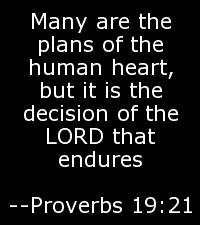
proverbs_quoteWell.  Really.  That’s not the sort of question you expect to be asked in the confessional.  The deal is that you go in, confess, get a penance to help point you in the right direction, pray the Act of Contrition, hear the prayer of Absolution, and head back out.

Unless the confessor thinks you might benefit from a bit of counsel.

Which left me sitting with a kindly priest faced with a pretty blunt question.  And, in truth, after nearly a half century on the planet I’m slowly moving to the place of wanting God’s dreams for my life.  (The obvious “right” answer is that I want God’s dreams.  The more honest answer is that I often put my dreams ahead of God’s.)

If you’re like me, answering that question correctly only raises others.  Most specifically, how do you discover God’s dreams for your life?

The Bible is full of stories of angelic visitations and divinely inspired visions.  While that might seem to simplify the question, I doubt that most of us are actually prepared for that level of openness and directness in our relationship with God.  So, we must find other ways to discern what God dreams for us.

Ironically, I think the key lies exactly in seeking a relationship of openness and honesty with God.  It involves being vulnerable and willing to listen and take in what God is trying to communicate to us.  Blogger Will Duquette puts it this way:

For me, listening to God means sitting and pondering about things: my problems, a scripture reading, a book I’m studying, the weather, or what have you. And as I ponder, I need to pay attention to the ideas that occur to me, and follow the threads to see where they go. It’s about testing the conclusions I come to, to see if they are consistent with what I know about God’s word, and God’s character, and that involves more pondering. And the essential thing is that when I sit down to ponder, I invite God to come along and I make Him welcome.

This sounds like solid advice, but as before, it still raises that next question; even if you’re determined to invite God to communicate, how do you do that?  Fortunately, there are some good folks who have already walked this path and sent back field reports to point us in the right direction.

St. Ignatius of Loyola starts with the idea of a personal relationship with God.  A structure for achieving this is laid out step-by-step in the Spiritual Exercises.  One of the key elements of the exercises is prayer.  Makes sense.  After all, if you’re going to enter into a relationship with someone, you have to talk to them.  This also helps with what St. Ignatius calls the orientation of your life.  Are you trying to stay on the right path?  Are you trying to live a decent Christian life?

With that as a starting point, you can begin to listen to “the movements of your heart.”  What do you feel when you pray?  What are the thoughts that come to mind then and throughout the day?  Test them to see if they are consistent with what you know of God.

One of the interesting things that St. Ignatius pointed out is that these movement (he called them “spirits”) change depending on where you are in your spiritual journey.  William A. Barry, SJ, puts it like this:

Now let’s take up the orientation of most of us, who are trying to live honestly and uprightly to the best of our ability. In this case, Ignatius says, the good and bad spirits act in ways opposite to how they act with those turned away from God’s path. The bad spirit raises doubts and questions that cause inner turmoil and self-­absorption, while the good spirit tries to encourage us and to increase our peace, joy, faith, hope, and love.

If you are trying to live as a good Christian, you might have thoughts like these: “Who do you think you are—some kind of saint?” “Everyone else cuts corners in this office. What’s the matter with you? Are you ­holier-than-thou?” “God doesn’t have time for the likes of you.” “Most people, even if they believe in God, don’t try to live the way you do.” Such questions and thoughts have only one aim, to trouble your spirit and keep you troubled and questioning. Moreover, you will notice that all the questions and doubts focus on you, not on God or God’s people.

The good spirit, on the other hand, might inspire thoughts like these: “I’m genuinely happy with my decision to make amends with my estranged sister.” “I wish that I had stopped drinking a long time ago. I’m much happier and healthier now, and easier to live with.” “God seems so much closer to me since I began to take some time every day for prayer, and I feel less anxious and insecure.” I hope you can see in your own experience how these two spirits have led you.

Sometimes, that spirit that wants to distract you from God’s will comes dressed in pious clothes.  It’s easy to get distracted by that voice and decide that God doesn’t have any big dreams for you.  It’s safer and easier just to sit quietly.  Along the way, Ignatius tells us that we will likely experience Spiritual Consolation and Spiritual Desolation.  These, too, are part of that journey of understanding God’s dreams for us.

As a practical matter, you can take St. Ignatius’ road map and put it into practice with a low tech tool; a notebook.  Over at www.godinallthings.com , Andy Otto outlines a simple practice which involves jotting down your thoughts and feelings during the day and reviewing them regularly to see where God might be speaking to you.

Like they used to say, “Knowing is half the battle”.  Once you know (or have a good idea) you can begin to seek out ways to cooperate with God in bringing about his dreams for your life.  You might be surprised by what you discover.  The theologian Parker Palmer understood that when he said:

Discovering vocation does not mean scrambling toward some prize just beyond my reach but accepting the treasure of true self I already possess. Vocation does not come from a voice out there calling me to be something I am not. It comes from a voice in here calling me to be the person I was born to be, to fulfill the original selfhood given me at birth by God.

–Dad

With Great Power Comes Great Humility?

180px-ScholasticNarniaA little over a week ago, my friend Mette posted a link on her Facebook page to an article entitled “Finding a Feminist Theology in C.S. Lewis’s Narnia.”  I was sufficiently intrigued — since C.S. Lewis didn’t seem to be an especially feminist writer — to click through.

The article starts out recounting Lewis’s many critics who call him out for fearing and disliking women, disliking sexuality, and equating “ultimate good” with “ultimate masculinity”.  Then it moves on to talk about a new view of Lewis’s work which is presented in Monika Hilder’s book The Feminine Ethos is C.S. Lewis’s Chronicles of Narnia.  So far this all sounds like an academic cat fight, right?  A clutch of post-modern professors and lit crit snobs mixing up it for the sake of entertainment.

Except that (echoing Hilder’s text) the authors suggest that the modern idea of feminism misses the point.

In an age that worships the cult of personality and aggrandizes the “virtues” of the energetic, the magnetic, the stunning, and the forceful – because these traits lead to more materialistic wealth and power – what room left is there for the fruit of the Spirit? Qualities such as self-control, meekness, patience, and peace sound quite out of vogue; “Let’s see how far the meek, patient, and peace-loving female can succeed,” I can hear the cynic ask. Hilder, though, suggests that our struggle for independence, power, and autonomy echo Satan’s thirst for domination more than Christ’s model of humble servanthood.

Take a moment to consider that last line.  When was the last time you heard someone — anyone — praised for being a good and humble servant?  That’s crazy talk, right?

If we are uncomfortable with some of the female characterizations throughout Lewis’s series, perhaps we should reconsider where this discomfort stems from. While we as women are right to strive for gender equality, we are wrong to measure it according to mere chauvinistic ideas of accomplishment. As Hilder states, “to the extent we have not examined our own chauvinism, we demean the ‘feminine’ qualities and extol the ‘masculine’—not noticing that Lewis does the opposite.” And indeed, it is in doing exactly that opposite that Hilder suggests Lewis’s radical theological feminism can be found.

More importantly, Lewis seems to be saying that the servant-minded approach cuts both ways.  Men, as well as women, should strive to live up to that lofty standard.

Lewis’s idea of true spiritual strength— for both men and women— rests in openness to our Father, community, submission, compassion, truth, grace, and humility. So, when Lewis has Lucy run towards Eustace-the-dragon and bestow upon him grace only expressible in a child’s unrestrained kisses, or Lucy and Susan weep with Aslan while he is on the stone table, or, even Mrs. Beaver demonstrate foresight and responsibility for those in her care (or one could even dare say, community mindedness) in bringing along her domestically stigmatized sewing machine, Lewis wasn’t belittling these characters. I can learn that true spiritual strength, or spiritual heroism as Hilder terms it, “establishes the kingdom of heaven through humility,” not independence.

The article goes on to talk about how much of what we perceive to be sexism reflects our own biases more than the objective truth.  That wasn’t what stayed with me after reading the article, though.  I kept coming back to the idea of servanthood being the mark of a successful adult.

I encountered that idea again a few days later when we attended a Mass for the Admission to the Candidacy for the new Deaconate class in Utah.  (A friend from our parish is one of the candidates.)  The second reading was from Matthew.

But Jesus summoned them and said, “You know that the rulers of the Gentiles lord it over them, and the great ones make their authority over them felt. But it shall not be so among you. Rather, whoever wishes to be great among you shall be your servant; whoever wishes to be first among you shall be your slave.  Just so, the Son of Man did not come to be served but to serve and to give his life as a ransom for many.”

Oh.  Right.  Jesus mentioned this idea a couple of millennia back.  At the time it was clearly a challenging idea; unusual and non-intuitive enough that he felt a need to address it with his disciples.  You would think that in the past 2,000 years this idea would have caught on.  I’ve read a goodly number of books about leadership and management and I’ve attended lectures and seminars and institutes, but all of them focused on ways to consolidate exploit power.  Sure, there’s been talk of “servant leadership“, but it’s always in the context of “getting the job done”.  The implication is that there is some goal to be achieved or target to be hit and it’s the leader’s responsibility to make sure that happens.  If servant leadership can get you there, great.  If not, find some other tool and keep pressing forward.

In other words, the modern ideal of leadership is the accumulation and application of power.  Whether you’re a man or a woman, your goal should be to reach the top.

Except there’s this one guy who keeps telling a different story.  In case you’ve missed the theme of humility in the homilies, interviews, and public talks Pope Francis has given in the past several months, he kindly included it in Evangelii Gaudium — his first Apostolic Exhortation.

I’m a long way from having read all 244 pages, but I’ve skimmed a bit of it and read some reliable commentaries from trusted sources, and the thing which sticks out is how deeply counter-cultural it is.  In a world which judges us largely on how well we “succeed”, Pope Francis is calling for us to step out of the game.  He’s not telling us to lose the game.  He’s telling us to get out and spend our energy on something better.  He even goes so far as to point out that we are guilty of this kind of thinking within the bounds of our religious practices.

(93) Spiritual worldliness, which hides behind the appearance of piety and even love for the Church, consists in seeking not the Lord’s glory but human glory and personal well-being. It is what the Lord reprimanded the Pharisees for: “How can you believe, who receive glory from one another and do not seek the glory that comes from the only God?” (Jn 5:44).

(94) …those who ultimately trust only in their own powers and feel superior to others because they observe certain rules or remain intransigently faithful to a particular Catholic style from the past. A supposed soundness of doctrine or discipline leads instead to a narcissistic and authoritarian elitism, whereby instead of evangelizing, one analyzes and classifies others, and instead of opening the door to grace, one exhausts his or her energies in inspecting and verifying.

(271)  It is true that in our dealings with the world, we are told to give reasons for our hope, but not as an enemy who critiques and condemns. We are told quite clearly: “do so with gentleness and reverence” (1 Pet 3:15) and “if possible, so far as it depends upon you, live peaceably with all” (Rom 12:18). We are also told to overcome “evil with good” (Rom 12:21) and to “work for the good of all” (Gal 6:10). Far from trying to appear better than others, we should “in humility count others better” than ourselves (Phil 2:3). The Lord’s apostles themselves enjoyed “favour with all the people” (Acts 2:47; 4:21, 33; 5:13). Clearly Jesus does not want us to be grandees who look down upon others, but men and women of the people. This is not an idea of the Pope, or one pastoral option among others; they are injunctions contained in the word of God which are so clear, direct and convincing that they need no interpretations which might diminish their power to challenge us. Let us live them sine glossa, without commentaries. By so doing we will know the missionary joy of sharing life with God’s faithful people as we strive to light a fire in the heart of the world.

When he was first elected, we knew there was something different about Pope Francis.  His humility was refreshing and his simplicity endearing.  Now he is asking the same as us; he is inviting us to follow him in humility.  For those of us who grew up in western nations where “success” as a human being is defined by power and wealth, this is tremendously challenging idea.  I wonder how many of us will be willing to follow through?

— Dad

Reflection: Vocation and Discernment

Novice Prayer Service Wednesday October 23rd, 2013

On Discernment

God, come to our assistance. Glory to the Father. As it was in the beginning. Alleluia.

Psalm 25

Antiphon: Lord, allow your guiding spirit to enter our hearts.

To you, O LORD, I lift up my soul.
O my God, in you I trust;
do not let me be put to shame;
do not let my enemies exult over me.
Do not let those who wait for you be put to shame;
let them be ashamed who are wantonly treacherous.

Make me to know your ways, O LORD;
teach me your paths.
Lead me in your truth, and teach me,
for you are the God of my salvation;
for you I wait all day long.

Be mindful of your mercy, O LORD, and of your steadfast love,
for they have been from of old.
Do not remember the sins of my youth or my transgressions;
according to your steadfast love remember me,
for your goodness’ sake, O LORD!

Good and upright is the LORD;
therefore he instructs sinners in the way.
He leads the humble in what is right,
and teaches the humble his way.
All the paths of the Lord are steadfast love and faithfulness,
for those who keep his covenant and his decrees.

Reading from Hecker’s diary, June 6, 1844

What would the spirit have me to do? To say? It seems to give me no rest, would it have me to be still, quiet and peaceful?

What is the work that the spirit is doing now within me?

The spirit draws me ever inward and will not permit me to read, think, or do anything else but attend to it. It is like a young bride; it would have me ever in its presence speaking of its charms.

Responsory

Incline my heart according to your will, O God.

Incline my heart according to your will, O God.

Speed my steps along your path,

according to your will, O God.

Glory to the Father…

Incline my heart according to your will, O God.

Intercessions

We pray for all of us present, that we might discern where the Holy Spirit is guiding us.

Lord hear our prayer.

We pray for all earnest seekers to find where God leads them in life.

Lord hear our prayer.

We pray for the young men joining us this weekend who are discerning a life with the Paulists.

Lord hear our prayer.

We pray that all leaders, civil and religious, listen to the people and to God

Lord hear our prayer.

For what else shall we pray?

Our Father…

O God, who enlightens the minds and inflames the hearts of the faithful by the Holy Spirit, grant that through the same Spirit we hear in our hearts where you are guiding us. We ask this through Christ our Lord. Amen.

The Lord bless us, protect us from all evil, and bring us to everlasting life.
Amen.
Let us bless the Lord.
And give God thanks.

— Novice

Question: Who Pays for Seminary?

stack of dollars

Not all the questions about the seminary experience deal with weighty theological issues.  Some of them are, in fact, pretty mundane.

Seminary — like most higher education — isn’t cheap.  So, who is paying for the training for the next generation of priests and religious?

The answer is: it depends.

As we mentioned a while back, there are two kinds of priests:  diocesan and order.  (Sometimes referred to as secular and religious priests — toss out that bit of trivia at a party and watch your friends try to puzzle out the difference.)  Among the other differences, diocesan priests generally draw a salary and are expected to pay for their own food, transportation, etc.  Order priests generally do not draw a salary and are dependent on their order for all of their material needs.  In practice, this means that diocesan priests need to be careful managers of their money as the salary isn’t that great while order priests rely on the order to balance needs the of the entire community.  As our previous pastor put it (with tongue firmly in cheek), “Order priests take the vow of poverty, diocesan priests live it.”

This is important because diocesan seminarians often attend seminaries which aren’t associated with the diocese and will be assessed tuition.  This responsibility may be picked up by the seminarian, their parents or the diocese or some combination thereof.  The Office for Vocations for the Archdiocese of Saint Paul and Minneapolis addresses the question by saying:

How much does it cost?  Who pays?
Everyone is concerned about the high cost of education, including potential seminarians and their families.  In the Archdiocese of St. Paul and Minneapolis, the archdiocese will pay for the room and board cost of our college seminarians as a scholarship. This does not need to be paid back. In addition, the University of St. Thomas offers a 35% discount on tuition for seminary students. The seminarian and his family are required to fund the rest of the cost through regular scholarships, financial aid, and loans.

There are (not surprisingly) many scholarships available to seminarians.  Often, there is also a distinction between those entering “college seminary” for the purpose of earning an undergraduate degree and those who have earned a bachelors degree and are moving to the next level of formation.  The Diocese of Des Moines outlines such a program:

How much will it cost to go to the seminary?

This depends on which level of Seminary formation you enter.  For those that enter as college seminarians, the cost will be the responsibility of the seminarian.  As would be typical for any other college student, you will fill out FAFSA forms for student loans.  The college seminary programs we use typically have reduced tuition for seminarians as well as scholarships that are available.  One college seminary program gives a scholarship that covers your full tuition.  Regardless, you can expect significant expenses for college, which will remain your responsibility regardless of whether you are ordained for the diocese.  The rationale behind this policy is that college is a pre-requisite for professional life in any capacity in our culture, and whether or not you become a priest your degree will serve you well into the future.  The Diocese does provide college seminarians with re-imbursement for books and certain travel required by the diocese, as well as a monthly stipend.  You are encouraged to work during the summer for extra spending money.

The policy is different for men that enter seminary for Pre-Theology (those with a college degree but in need of required philosophy before studying Theology) or Theology.  The Diocese will cover the entire amount of your tuition, room and board, as well reimburse you for books, certain travel required by the diocese, and will provide a monthly stipend.   These expenses do not have to be re-paid in the event you discern out of seminary formation.

What do I do if I have previous student loans that are not fully paid off yet?

The diocese, while it provides for much of your training as a seminarian, cannot offer assistance in paying off previous college loans. However, many loans can be deferred, some without accruing extra interest, until the time you finish seminary training and are ordained a priest, at which time you receive a salary and can pay off your loans.

As much as possible, Vocations Offices and Seminaries try to remove the obstacle of money.  And there are plenty of private donors who are doing what they can to aid in preparing the next generation of priests. An article on the Vision Vocation Network website notes:

Fortunately there are many benefactors who donate directly to seminaries or make funds available through scholarships or grants. Two Catholic organizations that have generously supported vocations are the Knights of Columbus (contact your local council) and the Laboure Society (www.labourefoundation.org).

At the diocesan level, the Vocations Director would be able to provide better information for a particular case.

Seminarians who enter as part of an order, often have their training provided for (in whole or in part) by the order.  The Priestly Fraternity of St. Peter’s Our Lady of Guadalupe Seminary uses a mixed approach:

How much does it cost to educate a seminarian?

he actual cost is about $22,000 per year. Most of this cost is paid through the generosity of our benefactors, who deserve our prayers every day. The cost that FSSP seminarians currently are responsible for is $7,000 per year for tuition, room and board.

What if I cannot pay for my annual tuition and room/board?

We ask all seminarians to do their best to pay everything they are able to pay. This includes actively seeking benefactors, running an ad in your home parish bulletin, asking priests for financial help, and applying for scholarships with various Catholic support groups. However, if you do not come up with all of the tuition money you will not be required to leave. Nor do we deny entrance to men due to an inability to pay these costs.

In Evan’s case, he was required to be debt-free (with the exception of his student loans) before he could be accepted as a novice.  His room, board, and training are all provided by the order and he is given a small stipend each month for incidentals such as toiletries, clothing, and personal transportation.  Living in DC (and having to switch for a college wardrobe of jeans and t-shirts to a wardrobe of business casual) the stipend is adequate, but not excessive.  Fortunately, two different Utah Councils of the Knights of Columbus (St. Olaf’s in Bountiful and St. Mary of the Assumption in Park City) have adopted Evan under the RSVP program.  He wasn’t aware of the program until they contacted him.  He was (and is) touched by their generosity.

— Dad

Following Francis’ Lead

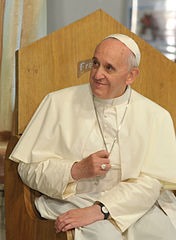
Papa_Francisco_na_JMJ_-_24072013 (This photograph was produced by Agência Brasil, a public Brazilian news agency. Used with attribution under a Creative Commons 3.0 License.)A while back, I noted that Cathy and I had been invited to take part in a catechist training course offered by our diocese.   We’re following the Echoes of Faith (Plus) curriculum and each week we prepare by watching a couple of videos and complete homework out of the workbook.  The real meat of the course, though, comes in the discussions we have when we meet with the other students — some from our parish and some from other parishes in the area.

The mix of people in the class is fascinating.  Some ar very young, others have been around the block a few times.  Some are cradle Catholics and others are converts.  There are representatives of various cultures and occupations and world views.  The first couple of meetings felt a bit like Junior High dances — everybody sat on the edges and didn’t seem to want to get too involved.  The last few weeks, though, the conversation has gotten much more energetic.

A couple of weeks back, the topic of discussion turned to our involvement in our various parishes and someone asked Cathy how much Evan’s process of discernment influenced our own involvement in the church.

I’ve thought a lot about that question since then.

First of all, if you’re being honest with yourself, you can’t have a child working through discernment without calling into question your own commitment to the Faith.  The same would be true if you had a good friend discerning a vocation or contemplating marriage or thinking about moving across the country to take up a new career or applying to grad school or whatever.  We live in relationship with others and, while comparing ourselves to others isn’t necessarily a healthy thing, it is useful to learn from their experiences.  So, yes, Evan’s discernment has given us pause to reflect.

There’s another influence, though.  Pope Francis is an inspiring leader.  His humility, patience and authentic Christian love are both comforting and challenging.  Most of all, his admission that he is a sinner as much as any of us, is a provocative statement that requires us to make a self-assessment of our own response to God’s call to personal holiness.

Pope Francis shows disarming honesty when he talks about how he was formed into the leader he has become.  In an article covering the incident with the child who approached him during Mass on October 26th, the author cites an incident from Francis’ past:

This kind of patience is something the pope has said he learned over time, according to his biographers Sergio Rubin and Francesca Ambrogetti. As the auxiliary bishop in Buenos Aires, Jorge Mario Bergoglio once had a train to catch to a retreat at a convent on the outskirts of Buenos Aires. After finishing his work in the diocese, he had given himself just enough time to walk to the cathedral to pray for a few minutes before getting to the train station. As he left, a young man who appeared to have mental health problems approached him and asked for a confession.

He says he felt annoyed, but tried to hide it. Bishop Bergoglio told him to find a father to confess to because he had to go – even though he knew a father wouldn’t be in right away (admitting to his biographers that because the man appeared to be medicated he probably wouldn’t notice). The auxiliary bishop walked away, but then after a few steps turned around with a “tremendous sense of shame.” He recalled later that he was “playing Tarzan,” trying to do too many things, that he had “an attitude of superiority.”

Today he uses it as a lesson to “travel through patience,” he told the two Argentine journalists. “Traveling with patience is allowing time to rule and shape our lives.”

Most of us would likely forget such a moment — perhaps intentionally. Few of us would take it as an opportunity to learn.  To his credit, Pope Francis is trying to spare us the pain of learning such lessons through unpleasant experience.  One of the constant themes in his homilies is the need for inclusion, for ensuring that everyone has a seat at the table of the Lord.

The Church is not the Church only for good people. Do we want to describe who belongs to the Church, to this feast? The sinners. All of us sinners are invited. At this point there is a community that has diverse gifts: one has the gift of prophecy, another of ministry, who teaching. . . We all have qualities and strengths. But each of us brings to the feast a common gift. Each of us is called to participate fully in the feast. Christian existence cannot be understood without this participation. ‘I go to the feast, but I don’t go beyond the antechamber, because I want to be only with the three or four people that I familiar with. . .’ You can’t do this in the Church! You either participate fully or you remain outside. You can’t pick and choose: the Church is for everyone, beginning with those I’ve already mentioned, the most marginalized. It is everyone’s Church!

And there it is.  Right in the middle of the paragraph.  Each of us is called to participate fully in the feast.

In case any of us missed it, the Pope goes on to say:

To enter into the Church is to become part of a community, the community of the Church. To enter into the Church is to participate in all the virtues, the qualities that the Lord has given us in our service of one for the other. To enter into the Church means to be responsible for those things that the Lord asks of us.

Like I said, challenging.  The natural human reaction when called to serve is, “Gee, I’d like to help, but I don’t have the time.”  If that’s your go-to move for getting out of service, Pope Francis has your number.

Open up your heart and listen to what God is saying to you. Allow your life to “written” by God”. Just as the Good Samaritan did when he stopped to help the stranger, we must all listen to God’s voice and sometimes put our own projects on hold to do his will.

Another common objection is, “I’m not really good at that sort of thing.  You don’t want me to mess it up.”  Um…hate to be the one to tell you, but Pope Francis anticipated that little dodge, too.

“The future of a people is right here…in the elderly and in the children,” he said. “A people who does not take care of the elderly and children has no future because it will have no memory and it will have no promise! The elderly and children are the future of a people!”

Pope Francis warned that it is all too easy to shoo a child away or make them calm down with a candy or a game – or to tune out the elderly and ignore their advice with the excuse that “they’re old, poor people.”

“The disciples wanted efficacy; they wanted the Church to go forward without problems and this can become a temptation for the Church: the Church of functionalism! The well-organized Church! Everything in its place, but without memory and without promise! This Church, in this way, cannot move ahead. It will be the Church of the fight for power; it will be the Church of jealousies between the baptized and many other things that occur when there is no memory and no promise.”

So…God doesn’t want our perfection, he wants our service.

And, by the way, am I the only one who thinks it’s kind of cool that the Pope talked about it being “too easy to shoo a child away” in a homily about a month before he was faced with that very situation during a Mass in St. Peter’s square?  Not that it was prophetic, but that he laid out exactly how he thought it should be handled and then handled it exactly as he had laid it out?  There, again, is the authenticity which makes him so inspiring as a leader and such an example of the lives we are to lead.

So, in our own way, following the lead of Pope Francis and acknowledging the call of our pastor, Cathy and I try to find ways to be open and accepting and to put ourselves in service of others.

— Dad

Catholics and Mormons Working Together

This past week, a small film premiered in Salt Lake City.  What’s remarkable about the film is that it was created as a collaboration between Paulist Productions and Covenant Communications.  The local news featured a short segment highlighting the event and introducing some of the people behind the project.

What’s cool about this is that it so fully expresses the Paulist commitment to ecumenism and the use of modern media to “reveal God’s presence in the contemporary human experience.”

The film is called “Christmas for a Dollar“.  It tells the tale of a poor, Depression-era family that is seeking to find joy in a (forcibly) non-material Christmas.  It’s the sort of story you expect to see at Christmas and I imagine it’ll play well when it runs on the UP Network on December 15, 2013.

Cathy and I were excited to hear about it because the current President of Paulist Productions — Fr. Eric Andrews — is the President Elect of the Order.  Even if it was a brief glimpse of him on the news, it was nice to see and hear him.

— Dad

Reflection: Self-Sacrifice

(Editor’s Note: As part of the discernment and training process, the novices and students write and lead prayer services.  Evan will share his from time to time as he writes them.)

Novice Prayer Service Thursday October 15th, 2013
On Sacrifice

You will save more souls through prayer and suffering than will a missionary through his teachings and sermons alone.
-Jesus to St. Faustina, Diary of St. Faustina, 1767

Miss no single opportunity of making some small sacrifice, here by a smiling look, there by a kindly word; always doing the smallest right and doing it all for love.
-St. Thérèse of Lisieux

Tonight I thought we could use this prayer service to reflect on the sacrificing nature of a vocation. We willing give ourselves in love to the service of others, especially as future priests. There is also an aspect of sacrificing the “normal” life. We won’t have the small suburb home with a white picket fence, a wife, two kids, and a dog. Instead, we are called to live for the world, not simply in it. I thought one of the best ways to explore sacrifice would actually be to look at a few scenes from movies that have sacrifice as a central theme in a prayerful manner. I’ll give a little set-up explaining each scene.

Movie One: Road to Perdition, scene at 1:33:15

After a fellow gangster kills his wife and kids, Tom Hanks has to take his son across the country in order to keep him alive. In this scene, Tom confronts his mob boss about the gangster who is also stealing money from the boss. In the end, Tom does get his son across the country, but dies in the process of protecting his son.

Movie Two: The Iron Giant, scene at 1:14:00

 Set in Maine during the 1950’s, a giant robot crashes to Earth and befriends a 10 year old child. The  robot has amnesia and cannot remember his mission. He learns about Superman and being a hero from  the child. When the local town finds out about the robot when he save a kid from falling to his death,  they go into full panic thinking he is a monster sent to destroy them. The military is called in and the  robot goes into a rage and remembers his mission (which is to destroy the Earth). This leads to the  military launching a nuclear missile at the town.

Movie Three: Stranger than Fiction, scenes at 1:31:09 and 1:35:45

 Will Ferrell starts hearing his own life being narrated as though he was a character in a book. One  morning he hears the voice say that things were set in motion for him to die. He eventually tracks  down the author and reads the finished manuscript detailing how he will die.

So in all of these films there is a sense of love for others, even total strangers, where one is
willing to sacrifice themselves completely. A vocation, especially one to God, can be seen in a very  similar way. We don’t have to find a way to get ourselves killed, but we can find small things to do for others, not for ourselves. We can take an example after Christ and His most Holy sacrifice. In our  sacrifices we can find God, His love for us, and our own conversion to holiness (to being superman).

Share any thoughts or feelings.

 Closing Prayer:

Jesus, tender and loving Lamb of God, Utmost Sacrifice of all sacrifices, Your glory is  reverberated in  the highest. Being preoccupied with my well-being, You chose to self-sacrifice Yourself, Setting aside all Your personal glories. I thank You Lord Jesus for Your act of love! Your action has drawn me closer to You. Teach me to model in smaller things, To sacrifice in order to help others, Guiding my soul to endure abstinence. Lamb of God, I thank you endlessly!

Amen.  (Unknown origin)

— Novice

My Baby’s Face

Every 8-23-05- 1901new mother loves taking photos of their baby. That new face inspires a fascination that never goes away, no matter how old they are. This week my baby’s face was added to the Paulist website under novice and student bios. I think he is the most handsome face on the page but I allow myself some personal bias on that point. Evan’s favorite food -Indian- a no brainer, his saint -St. Michael- of course, the call to the Priesthood: he had expressed all that to us a long time ago. Then t I took a moment to read all the other novice and student bios. Reading all the info on all the other students and novices was eye-opening. All the different ways that they came to hear and respond to God’s call in their lives. God really meets each of us where we are. It made me feel how they are all someone’s baby and that In the bigger picture, we are all God’s babies. Looking for Christ in the face of everyone we come across is easier when you realize how we are all truly the children of God.

— Mom

Catechesis

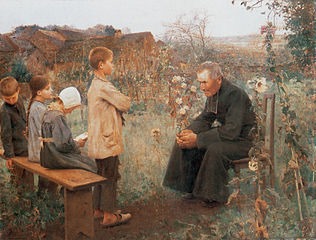
Catechism Lesson - Jules-Alexis MuenierThe Pope says that Cathy and I are special.

Well, not really.  What he said was that catechists are “pillars” for education in the faith.  This came in the context of his remarks to the participants in the International Conference on Catechesis.

This was a neat article for Cathy and I as we are both catechists.  Cathy is in her second year teaching a fifth grade formation class for our parish.  She does sword drills with them (an idea we borrowed from our Protestant friends), has crafts, lets the journal privately and works to help them understand the sacraments.  It’s been a great experience for her.

I’ve been asked to take on a special class for a group of young people who have never had any of the sacraments.  I’ll be meeting them soon to set a schedule and get started.  They range in age (I think) from about eight to about fourteen, so it should be an interesting challenge.  I’m looking forward to it.

Cathy and I have also been invited to take formal catechist training through the Salt Lake Diocese.

So, the article resonated with us.  As is his way, Pope Francis also dropped a challenge in along with the praise.

“This is a beautiful experience, and a bit paradoxical…Why? Because the person who puts Christ at the centre of his life is off-centre. The more you unite with Jesus and make Him the centre of your life, the more He makes you abandon yourself, decentralize yourself, and open yourself to others…In the heart of the catechist, there always lives this ‘systolic- diastolic’ movement: union with Jesus; encounter with the other…If at one of these two movements is no longer beating, then you do not live.”

This reminds me a bit of a story that Fr. Rolheiser shared in a recent column.

A priest friend of mine who teaches at a secular university was once asked by one of his students: “Father, have you met Jesus Christ?” His answer, no doubt, reflected some fatigue: “Yes,” he replied, “I have met Jesus Christ, and it messed-up my whole life! There are days when I wish I hadn’t met him!” What his answer, in its irreverence, correctly highlights is that meeting Jesus implies a lot more than a private, romantic, affective, and safe encounter with him and that meeting Jesus is more than having a private feeling in the soul that we are loved by and secure with God.

Like that tired priest, Pope Francis is reminding us that following Jesus is deeply countercultural and challenging and we cannot expect it to be easy.  As catechists, we have to accept that challenge and expect that we will have moments of doubt and difficulty.  At the same time, Pope Francis reminds us in his gentle, pastoral tone:

This is our beauty and our strength: If we go, if we go out to bring his Gospel with love, with true apostolic spirit , with frankness , He walks with us , before us always [preceding] us.

— Dad