
Blog

5 Myths and Facts about Discernment or Isn’t there a book about this somewhere?


When my son first told me he thought God was calling him to be a priest, I had no real family meetingunderstanding of the discernment process.   Being a cradle catholic, I was surprised to realize that all of my questions and concerns were based on misunderstandings, false information or myths.  Within 2 weeks of my son’s announcement, I found a book that answered all my questions and some I had not thought of yet:  “To Save a Thousand Souls” by Fr. Brett Brannen. Although the book is written for the young man discerning, I found it gave me accurate information, interesting anecdotes and a better understanding of the discernment process. Here is how Amazon.com describes it:

In what has been hailed as “a groundbreaking work” Fr. Brett Brannen compiles all the wisdom of a master VSave a thousand soulsocation Director into one volume. Using powerful and entertaining stories, the book explains in down-to-earth language how to discern a vocation to diocesan priesthood.

The book has received universal praise from bishops and vocation directors: “Fr. Brannen’s book is tremendous—inspirational, imminently practical, and amazingly comprehensive. It is a clearly written ‘how to’ manual filled with solid advice for men discerning the priesthood. A marvelous work of immense value.” – Fr. Len Plazewski, President, National Conference of Diocesan Vocation Directors

Fr. Brannen has since published another very good book to specifically address the concerns and questions of parents, “A Priest in the Family”.  Here is a description:

“A Priest in the Family is a comprehensive resource for the parents …. thoughtfully addressingPriest in Family common questions and concerns about seminary, celibacy, and the life of a priest. Whether you’re uneasy or elated about your son’s interest in the priesthood, this book is for you.”

and

Like his previous book, To Save a Thousand Souls, Fr. Brannen’s new book for parents is filled with humor, anecdotes, and dramatic stories from his own life as a priest. In twelve short, easy-to-read chapters, he explains priesthood, seminary, celibacy, and how a man discerns his vocation—all while keeping in mind parents’ legitimate concerns.

Readers have praised A Priest in the Family as an entertaining read that manages to allay parents’ fears and show them how to support their son, while offering a few laughs and a dose of inspiration along the way.

If you are struggling to understand what is going on with your son or have some questions that are just too embarrassing to ask,  I urge you to open up a new window in your browser and go to  vianneyvocations.com  and order one or both of these books today.  Until you can read these books for yourself, here is a brief summary of what I learned:

 5 Things I Learned about the Discernment Process:

Myth:
Once you enter seminary, you are pretty sure that you will become a priest.
Fact:
Discernment is a long, gradual process that is ongoing. Many people are involved with helping an individual during the discernment process: spiritual director, vocation director, seminary faculty and others.

Myth:
Once you enter seminary, you are expected to go all the way through to ordination. Leaving seminary is a failure, shameful and humiliating. Everyone will be disappointed if you leave.
Fact:
“Discerning out” of seminary is actually a good thing. A few rough weeks in seminary is not a reason to discern out. The decision to “discern out” is made in conjunction with the Spiritual Director, Vocation Director and others involved in his discernment process. It means the man has determined that priesthood is not his true vocation. For the rest of his life, he will not need to wonder if he should have been a priest. This is not considered a failure or an embarrassment. Others at the seminary are actually happy for the man to be able to pursue his true vocation. Guys do not sneak out in the middle of the night. The seminary community, faculty and peers wish him well. The time spent in seminary is not wasted. The growth and maturity in his faith can only be a benefit to a young man as a future husband or single man.

Myth:
You are too young to go into college seminary right out of high school.
Fact:
The Father calls men at many different ages and at different times in their life. If your son feels called, he should take the time to discern if this is his vocation.  There are significant advantages in going to college seminary right out of high school that are outlined in the book for parents by Fr Brannen.  A post on this website also addresses this: Advantages of Going to Seminary

Myth:
You need to go to college, date more and live in the “real world” before you go to seminary.
Fact:
If your son is feeling called now, it is best to discern now rather than try to put it on the back burner or push it away. Going to seminary is not leaving the “real world.”   Seminarians do have a more structured, healthy environment than a typical college. This environment allows more opportunity to focus on courses, strengthen their prayer life, increase knowledge of the faith and self-discipline. These are all good things for any young man to learn. Seminarians still hang out with friends, go to movies and parties, work summer jobs, drink beer and play sports. Finding the” right girl” is not a “remedy” for discerning a priestly vocation.

Myth:
You should go to college and get a degree first. Then you can go to seminary if you still want to.   If this priest thing doesn’t work out, you’ll have something to fall back on.

Fact:
Priesthood is a vocation that God has designed for the individual  where he will find the most happiness in his life. It is not something that “works out.”  He will find he either has a priestly vocation or he doesn’t. You can’t put discernment on hold for 4 years just so he can have something to “fall back on”.

Forest road. Landscape for backgroundAlthough this post is all about getting factual information, please do not let gathering data be your only method of understanding. As a parent, you will never be able to understand this with only your head.  You must take your concerns and questions of the heart to prayer consistently until you find some peace which the Father will give you.  Please know that the contributing authors of this blog pray for all parents of discerning sons and daughters to find understanding and peace.

How long does it take to become a priest? Part 2 or How does the average high school graduate adapt to academic life in the seminary?

When we first learned that the undergraduate degree at college seminary is Philosophy, I was surprised. Educationally, I understand the need for an in depth knowledge of philosophy as a framework to build the graduate Theology coursework.Guy with books But my first reaction was “Philosophy? Really?” It sounded like a very tough course of study. I knew this kind of degree would require an enormous amount of reading and writing as well as being able to express your thoughts cogently in discussions by having an in depth grasp of the subject. Would he be able to handle it?

I must digress here to tell you a little about my son’s academic history.

My son has never been what I would call a “scholar”. Since grade school, he was the one who would “forget” that he had homework, or “forget” it at home, or “forget” to turn it in. This was a constant battle all through grade school and even high school. We like to joke that as soon as he learned there was no math in being a priest, then he was all for it.

My husband and I are voracious readers. Our children have grown up with books and magazines in every room of the house. Truly, from infancy we were reading to them. We had vinyl books for the bathtub and the touch and feel books like “Pat the Bunny.” As they grew up, we would snuggle up on the couch after bath time in pajamas to read from the Little House book series. Our other 2 children developed a habit of reading for pleasure and had no difficulty keeping up with reading in college. Somehow, this son never learned to read for pleasure.

Many times as he was growing up, I would take him to the bookstore to find something, anything, that would spark an interest in reading. I tried every book series from “The Magic Tree House” books to Harry Potter. Nothing worked.

So imagine my surprise to hear that the next 8 years of his life would be filled with reading. Not novels or interesting case studies, but philosophy and theology books. Many of these seminal works have been written hundreds if not thousands of years ago. At this point, my son was just starting his senior year in high school and I did not know how his new focus on attending seminary would impact his school work.

In his final year of high school, he did his homework without reminder, worked on long term projects and brought home mostly A’s and a few B’s including an A in Latin. He would complain if a course was boring because it was so easy. This was a complete reversal in behavior and attitude. It seems that once my son knew what he wanted to do, he developed more focus and a reason to strive to do well in his classes.

Once he started at the seminary, he would come home on his monthly weekend off campus ready to quiz us on concepts in Theology and Philosophy. This was a new experience to see our son so interested in a subject that he would talk about it outside of school.

As any parent knows, motivation and desire can only get a student so far. Clearly, the environment in college seminary is a contributing factor to academic success. In contrast to the state university where my son  would have attended, seminary actually had a “curfew” 7 days per week, no visitors in the dorms, and a strict zero tolerance policy on drugs or alcohol.

Although there are plenty of diversions and recreation available on campus, seminarians are not overwhelmed with 100’s of options to divide their time on any given day. School days are structured and predictable to allow for sleep, mass, prayer, class, study hours, recreation and just hanging out. Weekends even have structure with free time from after morning prayer and mass in the morning until curfew. On weekends, students can leave campus to shop, go to a movie, visit friends or go out to eat. The curfew is reasonable and is what I probably would impose if my son was living at home and going to a local college.

The freshman class had 12 students and the entire college seminary had less than 50 students. This means that if you cut class, oversleep and miss morning prayer or mass, it will be noticed and addressed. You can’t fly under the radar in seminary. Class sizes are small so the faculty actually get to know the students. Most freshmen are taking the same classes so it is common to study together and help someone who is struggling. Obviously, this is worlds away from the state university with 27,000 students on campus.

Based on my experience, I can say that an average high school student can adapt to the academic rigors of college seminary with the right motivation and attitude with environmental structure and support.

How long does it take to become a priest? Part 1

Mundelein Seminary in Chicago has posted a video on the academic steps to become a priest: from College Seminary or Pre-Theology to Major Seminary to Transitional Diaconate to Ordination.   This is a very clear explanation of the process.

Being an Educator for 25 years, I was very interested in reviewing the coursework my son would take as part of the intellectual formation in seminary.

After  reviewing the curriculum, I was struck by how well educated our priests are through this process. I always knew priests had a graduate (Masters) degree, but the course work seems longer and more in depth than most Master’s degrees.   Most full time graduate programs such as an MBA, MHA, MSW, MSN are only 2 years beyond a bachelor’s degree.

Typically, a priest graduates with a Masters in Divinity degree.  Some students also take course work to earn an additional graduate degree in Theology.  It is not uncommon for a priest to be sent for further education to earn a degree in Canon Law or a doctorate by his bishop.

When learning about the academic road to priesthood, some people have commented that it seems like a long time to go to school “just to be a priest.”  Others have expressed dismay that it would take so long with an air of “is it really worth it?”  In my experience, these people identify as Protestant or Evangelical where bible college, mission trips and service projects may be the extent of the formation process.

Other well respected career options can take as long or longer than priestly formation. The road to become a doctor is 4 years of college, 4 years of medical school and then at least 2 years or more to complete a clinical Residency. A Surgical Residency is at least 6 years!  That’s a total of at least 14 years without further specialization.  Lawyers spend 4 years in college and 3 years in law school. No one seems to mind how long it takes to be a doctor or a lawyer. Scientists, college professors and others spend many more years doing research to earn a PhD.  The length of academic preparation for these careers is respected for its perseverance and advanced knowledge. These careers are attained through mainly intellectual “formation” and skill application.

For seminarians, intellectual formation is only one of the four pillars of formation.  The road to priesthood also requires the development of  personal maturity, knowledge and skills in the spiritual, pastoral and human pillars of formation.  Progress in these 3 pillars tends to develop slowly as behavior, judgement and skills become integrated into one’s personality. The 6 – 8 years required for priestly formation is a growth process that is far more than learning an advanced level of content and skill application. It is a highly structured program of comprehensive development of the entire person. The bar is set high for our future priests  which is no less than what the people of God deserve.

I will post Part 2 soon on how an average high school student adapted to the rigors of academic life in the seminary.

E-mail and a Note about Discernment

This week a lovely note landed in the Seminarian Parents inbox.  It came from the Mum of a seminarian who…well, since she graciously offered permission to share her letter, I’ll let her tell the story.

Three years ago our 19 year old son entered a Diocesan seminary.

While not shocked – we were initially quite surprised and unsure that this was a good idea for someone so young.

At the time my husband and I tried to encourage him to ‘live’ a little before he entered. Maybe gain a bit more maturity, and life experience.  To his credit he was not to be deterred by our initial reticence and lack of enthusiasm : he was sure of his decision. He proceeded initially to ‘pre-seminary’ for a year and then the national  seminary.

And of course we supported him, loved him and were proud of him.

As parents we have always tried to support our children (he has an older brother & sister) – and when necessary offer guidance – in their life choices. University, and overseas travel for the others was a more familiar path for us  – but the seminary and priesthood was an altogether different scenario – and one I assumed other people’s sons would follow – not ours!

I desperately wanted to talk to someone in my situation who understood what I was going through – another mother of a seminarian. There seemed to be no one around – I assumed that they must all be very holy – too busy praying and going about the Lord’s work – and would have no understanding of my feelings, fears and worries for my son and his future!

I quickly became aware that the role and relationship of parents and their seminarian son is at times different than that of our other children. (Not better or worse – just different)

Because of this unique role, the opportunity for the parents and families of our seminarians to meet and get to know one another (for both support & friendship) is important.  Whether the family are heavily involved in ‘church’ – or not at all – the procedures, processes and emotions are usually uncharted territory for everyone. But nothing seemed to exist – at a local level or online.

Towards the end of last year, our son decided to leave the seminary  – I didn’t want him to enter – but now I found I didn’t want him to leave! More uncharted waters – and once again, another parent to talk to would have been great.

While he has learnt a lot in these 3 years in the seminary – I know we as parents have as well.

In immersing himself in all things ‘Catholic’ – much has also been absorbed by us too. There have been many conversations as we talked with him before he entered – and in holidays when he was home

(I am a ‘cradle Catholic’ though I think the term ‘cultural Catholic’ would have been a better description. I loved the culture and familiarity of being catholic – the nitty gritty of my faith was largely ignored. )

For me I know my knowledge of catholic ‘stuff’, liturgical matters, seminarian studies and subjects, canon law, has increased – but above all this superfluous information, my Faith has deepened and (I think) matured. For that I will always be thankful and grateful to my son  – for testing my understanding of my faith, challenging my assumptions and encouraging me to seek and develop a more personal relationship with God.

This letter was encouraging to all of us.  We recognized our own questions, fears and concerns in this mother’s story.  Cathy and I chuckled at her assumption that the parents of prospective priest must somehow be above-average on the holiness meter.  We certainly aren’t, but we are trying to improve our relationship with God.

One of the concerns she had was her son’s age.  Cathy shared that concern and … well … I’ll let her explain:

Worry about Evan being too young was a big concern of mine as well. I spoke to the formation director of his order and he offered me an interesting perspective. He stated that they encourage men to explore the priesthood as early as possible (as soon as they hear the call). If it doesn’t work out there are no hard feelings, on the contrary, they often remain friends of the group for life. If they discern that the ordained life isn’t for them, they are still young enough to enter into the secular life and have a full career. If they wait till their late 30’s, for example, they are in their forty’s when they go back to their careers and it can be difficult.

All of which brings me to a brief point that I’d like to make about the discernment process.

Discernment is a process.  Some people think that discernment is sitting around, praying for Divine guidance and getting a lightning bolt from the sky in response.  Prayer is definitely important, but prayer needs to be accompanied by action.  A great post over at Verso L’alto talks about the danger of “passive discernment.”

People tend to talk about a priestly vocation as if entering seminary is a final decision with ordination as a foregone conclusion.  That isn’t the case at all.  You might as well start making wedding plans the first time your son takes a girl out on a date.  Yes, it could lead to marriage, but it might not.  It’s important to live through the process — it’s a journey, not a destination.

When young people perceive a call to religious life, they should explore it.  That means investigating seminaries and talking to vocations directors.  It probably means entering the seminary.  Whatever happens — that time in seminary is part of the journey.

I’d be so bold as to say that active discernment is good practice for all of us.  If you think God is calling you to something — a ministry in your parish, some task in your neighborhood or your workplace, or even more prayer and study — don’t sit back and think about it.  With openness to the Spirit, jump in and listen to God through your actions.

Lessons from the Seminary

The always excellent Word-on-Fire recently posted an essay by Diocesan Seminarian Joe Heschmeyer titled 10 Things I Learned in my First Year of Seminary.  The whole essay is worth reading, but I wanted to share his tenth point because I found it particularly encouraging.

Perhaps nothing exposes one’s lingering faults quite like seminary. It is a group of Christian men who are serious about sanctity, and have cultivated an attention to detail. Furthermore, we are encouraged to engage in “fraternal correction,” on the theory that iron sharpens iron (Proverbs 27:17), and we have a moral duty to look out for one another. But fortunately, God is there through all of this. Where I succeed, it is due to His grace. Where I fail, He stands ready to pick me up again. No matter how big my failings, faults, and sins, God’s Mercy is always bigger. As St. Thérèse of Lisieux is said to have said, “everything is grace.” 

The first year was quite a journey, but it’s one that I was humbled and thrilled to take.

I don’t know if Joe’s experience is universal for seminarians, but I have to imagine that a year spent in prayer and contemplation with a focus on spiritual growth couldn’t help but bring about a change.  And, even more encouraging is Joe’s reminder that God is always there to pick us up when we fall.

— Dad (Evan)

What’s Life Like in the Seminary

A couple of weeks back Sr. Theresa Aletheia Noble linked to this video on her blog.  It’s a nice peek into life in the seminary and well worth your eight minutes.  (In case you’re curious, the video comes from St. John’s Seminary in Camarillo, California.)

Brotherhood from Adspectus on Vimeo.

On a related note, Sr. Noble’s blog is also worth your time.  And she’s written a terrific book called “The Prodigal You Love.”  It’s a great resource if you want to help lapsed Catholics find their way back into church.  And — spoiler alert — the book says you’ll need to start by changing yourself.

A son is a son…..

photo

I grew up hearing the rhyme, ” A daughter’s a daughter all of her life, but a son is a son till he takes on a wife”. But what happens when the son doesn’t take on a wife, like when he becomes a priest. The most common question I get from other people is “What about grandkids?” I am okay with not having grandkids but my first question was “Am I going to lose my son?”

I recently took a trip to D.C. The trip was not only to see my son, but as a surprise for my mother as well. My very thoughtful sister, Beth, was bringing my mother down from Pennsylvania to visit Evan for a weekend. She suggested that I also come to D.C. and surprise Mom. The plan worked worked like a dream and even my father kept the secret. My mother was surprised and happy to see me. It was wonderful getting to spend time with her and my sister.

I arrived a day earlier than my sister and mother and Evan had to work that morning. I wandered down to the kitchen for a cup of tea and found another seminarian doing the same. Michael C. is a lovely man about nine years older than Evan. We struck up a conversation that lead to him talking about his calling and the path his life is taking. At the end of the conversation he commented that it was like talking to his mom, but not. There are some things you can never talk to your mom about because….she’s your mom. I also felt like I was talking to a son. A son I was just getting to know and who was already fully grown.

The conversation got me thinking and I took some time to ask a few of the priests in residence at the college about their moms, and moms in general. Usually these gentlemen talked about the fact that they were close to both their mom and dads but became closer to their moms around the time of formation. Some commented, as the “single” man in the family, they were often looked on to coordinate family events and help their mother.  One individual commented the the death of a mother was often a mid life crisis event for priests.

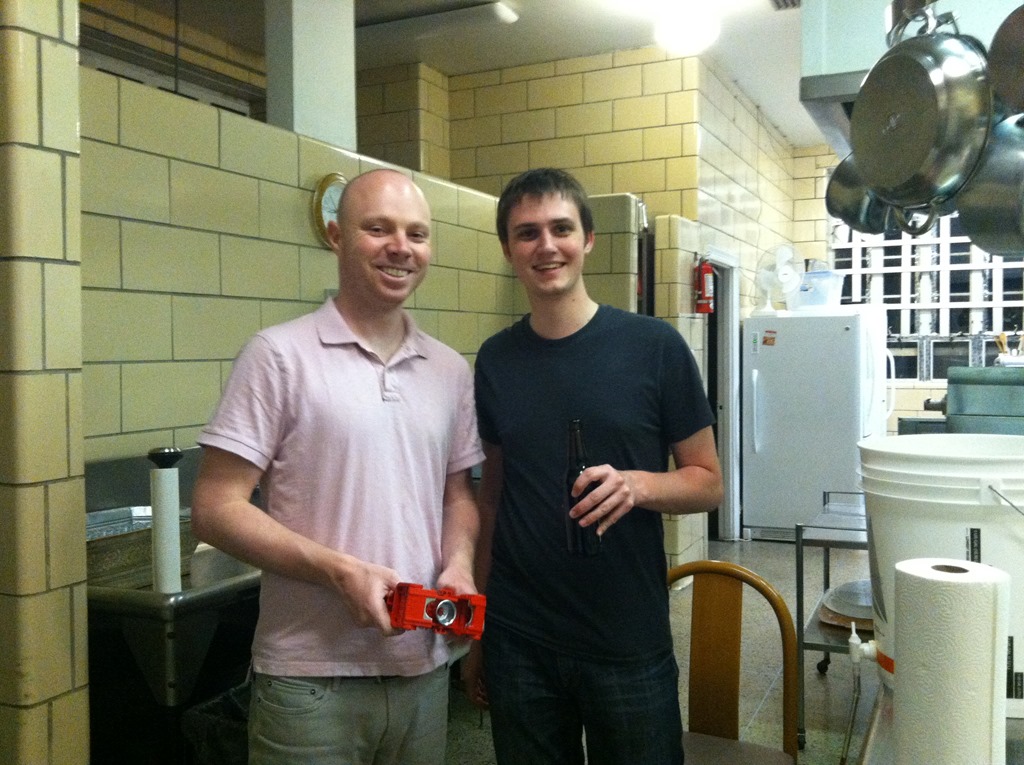
After two days of visiting and touring DC on bus, Beth and Mom returned to Erie on Sunday morning. I stayed because my flight wasn’t until Monday morning. Evan and I had some time to visit the church of his spiritual director. I attended my first Eastern Rite Catholic Mass (a lovely spiritual event if you ever have the opportunity to partake) and dinner that evening was takeout from Evan’s favorite pizza joint (& Pizza). After the meal, Evan left me saying he and Mike H. were bottling a batch of beer they had brewed earlier. I stayed in my room for a while then suddenly grabbed my phone (camera) and went down to the kitchen. I got to spend two lovely hours talking and taking pictures of these young men while they bottled their cream stout beer. Mike loved asking me questions about Evan as a child. Evan groaned and Mike laughed about Evan’s climbing prowess and escape abilities at ten months.  This made for a very congenial evening. A toast at the end with flat beer and Mike commented, “I know you don’t see it because you aren’t here all the time, but the whole house gets lighter when a mom visits. There is just something about a mom, even if it isn’t your mom.”  (Another new fully grown son!)

I have had time to reflect on all this and I have come up with my own interpretation of the mom-son-priest relationship. God made man and woman to be support and help to each other. In a relationship where the man marries, that support and help comes from the wife. When a son gets married the mother steps back and allows the marriage relationship to flourish. A man who becomes a priest will still need that relationship of support and the benefit of a female perspective. Usually, the woman who suits that role best will be his mother. So a son is a son… for the rest of her life.

BTW. When asked if I would call Evan “Father” after ordination, I cheerfully reply “Of course, Father Sweetheart”

-Mom C.

This is just a phase… or… I don’t want another trumpet in the attic.

As a parent, how do you know if your son’s  interest in discerning a vocation is the real thing or is it just a phase?  When he is  young, it is  hard for a parent to believe this could be for real.  I always thought this kind of decision took years of struggle.  How could this happen so fast and still be real?   Is this just a whim?  An idealized fantasy?  Is this going to be like the trumpet lessons that he was so desperate for and then lost interest within a few months?  Here is a little bit of my son’s story and how I came to understand that this was a serious desire and not just a phase.

When my son first told me he thought God was calling him to the priesthood, he was  17 years old and finishing Junior year. About 3 months before this, he attended a Kairos retreat held by his catholic high school.  When he returned, I knew something was different by his attitude and behavior.

Within the first week after the retreat, the group decided to all go to 7 am mass every day before school.   Now, any catholic mother would be pleased to see a teenager do this.  For my son, something else made it significant.

Prior to this, I could hardly get him out of bed to get to school.  Normally, we had to leave home by 7 am to get to school by 740.  It was common for me to check on him at 630 am…still in bed, 645 am… still in bed.  “I’m up , I’m up”…  then still find him in bed at 7 am.

Going to 7 am mass meant that he would need to get up at least an hour earlier to get to school.   Since I was driving him, getting to school by 7 am meant that he had to be ready to leave the house by 615 am.  It was significant to see him up and ready to leave at 615 am and worried if I would make him late.

This change in behavior was surprising to me, based on his love of sleeping.  But I still thought, “This is  great!   But I know my son, how long can this possibly last?  This is a phase.”  On the weekends, my son could sleep in as late as noon or 1 pm if I was not home to get him up.   By the first weekend, I was surprised to hear that he was planning to go to morning mass on Saturday and meet some of the Kairos kids there.  That gave me pause, but I still thought,  “This is a phase.  I’m glad he is doing this, but I don’t see this lasting for any length of time.”

As the weeks wore on, he continued to go to the 7 am mass at school even when no other Kairos kids were attending.   Right after the retreat, the group would meet in the chapel after school to say the rosary or just to pray together about 2 – 3 times per week.   Gradually this petered out about 6 weeks later.  My son either stayed after school to go to the chapel, or he would get in the car and ask if we could stop at our parish church on the way home.  Although surprised, I was happy to do it.

The first time he asked, I said, “Sure, how long do you think we will be there?  I have to get dinner in the oven.”  His response was “I don’t know, it is not up to me”.   “Okay,” I thought  “I’ll just respect the time he needs and not push.”  This happened at least 3 times per week during the next few months where he would stay between 30 – 45 minutes.

At this point, my attitude was pleased, but still watchful and waiting to see how long it would last.   My son  was different is some ways, but not others.  He seemed much more pleasant and cooperative at home for a typical 17 year old boy. But he would still fight with his brother, grumble over taking out the garbage, and leave wet towels on the bathroom floor.

At this point, he did not have his driver’s license, so whenever he wanted to go to church, confession or daily mass, he had to have someone drive him.  Most of the time, it was me.  This meant that during that first summer, I went to mass with him every day, including Saturday.

Sometimes we would sit together and sometimes we wouldn’t.  After mass we would go out for coffee and talk about this idea of being a priest and applying to seminary.  This was a very special time for me to be able to listen to his concerns, fears and excitement.  If he had been able to drive, we would not have had that time together.

Prior to these events, getting his license was not a big issue.  Now he became much more aggressive trying to get enough hours of practice in so he could get his license.  Once he did, it seemed he asked to use the car to go to church frequently. I admit, I did think this was a ploy to get to drive more, but at least he was going to church.

During the summer, he would drive to confession once a week.  I have never gone to confession once a week in my life.  Again, I was impressed as he always had a better attitude when he returned.   By the end of the summer, he was going to confession on Wednesdays and Saturdays; twice in one week.  I think this was the point that I knew this was serious and not just a phase.

Please know that I am not as cynical and callous as this story may sound.  Remember, I have 2 older children who went through their own phases of interests and passions which typically gave way to the next new thing.  Certainly, my son’s increase in a devotion to his faith was not something I had ever seen before.  But the sudden onset and fervor seemed to fit the pattern of other phases I saw in his older brother and sister.  It honestly never seriously occurred to me that his behavior would only increase over time.

My take away bit of advice for other parents is this:  Look at the behavior changes:  Is he changing his priorities, his friends, his schedule, his hobbies?  How long has this been going on?  Has it been sustained or even increased over time?  For me, seeing these sustained changes  in my son over time was what helped me realize that this was not just a phase, but a serious interest in pursing further discernment.

I hope this can help other parents who are wondering if this is just a phase for a son or daughter or is it a serious desire that needs exploration.

Welcoming a New Contributor

Just a quick note about this post.

It has always been our hope and prayer that this blog would become a place where those discerning and their parents came for information and encouragement.  Pam contacted us on Easter Sunday to let us know she’d found the blog and to inquire about our experience as seminarian parents and bloggers.  It was clear from her e-mail messages that she was a great writer and had a different perspective.  Our conversation naturally turned to asking her to contribute and we’re thrilled that she accepted.

As she notes, her son is in a college seminary and entered shortly after high school.  This is different from our experience, but is an experience shared by many, many parents.

In the coming months, you’ll see posts from all of us as our individual journeys continue.

As always, we want your questions.  Feel free to e-mail us at seminarianparents@gmail.com.

— Dad of Evan

How Agnostics Pray

Candle FlameRight, so this isn’t really all that directly linked to my brother’s current work but it seemed the right place to post it.

You’ve heard the saying “There are no atheists in foxholes” right? Well I can’t speak to that specifically but I admit I’ve been doing a bit of praying myself lately. And no that doesn’t mean I have any more faith than the last time I wrote, or that I’ve returned to the fold or joined a new church. I still don’t believe in much of anything, and if something does exist I have no reason to believe inherently that it is the Abrahamic God. So, I don’t know if anyone is there to listen, if someone can listen I don’t know if they are, and if they are I don’t know if they care, and if they care I don’t know if they can do anything. Seems a losing proposition doesn’t it? Yeah it kind of is.

Rationalists would say I’m either trying to shift my problems onto a force beyond my power so I can blame them if things go pear shaped or I am attempting to control the universe in ways that are flatly impossible. And maybe they are right. But right now, right now I’ll take anything I can get.

So how do agnostics pray? In my case with desperation and hope. Without giving out details I find myself in a situation that could end badly and there is nothing I can do to influence the outcome right now. So I have others pray for me, I’m never one to turn my nose up at someone offering aid. And as stress increases I start to pray myself. I don’t know if anyone can hear me and I don’t believe anyone does but I cling to the hope that I’m wrong. That some benevolent figure can pick up what I’m sending out and help out somehow. But I suppose that’s more of a why than a how. The how is more mundane. Lots of pleading silently and hoping against my own mind as I detail my troubles. And in my case lighting candles as a vigil. I’ve always been in favor of enduring actions as an article of ritual, so as I type this there are candles burning in my window, a light to guide someone if they want to find their way back. And on occasion I incorporate saints. They serve as handy symbols of precise desire, like the deities of pre-christian pantheons.

–Evan’s Brother

Mom: A New Contributing Author

I am very happy to find this blog as a place for parents and other family members to discuss the discernment and formation process.

I have been looking for a place to share what I have learned in the past 2 years.   In that time, my son started discerning a vocation to the priesthood (age 17), applied and was accepted to our diocese as a seminarian and started his first year in college seminary (now age 19).

The parents who started this blog have a son who is in formation in a religious community, while my posts will focus on a son discerning diocesan priesthood.  By contributing on this blog, I hope readers will have a view of the similarities and differences of the our experience as parents  as well as our sons in discernment and formation.

As a cradle catholic, I attended catholic school from kindergarten through high school as well as graduating from a catholic college in the early 80’s.   Based on my background, I thought I was fairly knowledgeable on all things catholic. But, I was in for a surprise to realize that what little I did know about seminary, discernment and the priesthood was completely wrong, misinterpreted or based on urban legend.

When my son first told me he thought God was calling him to the priesthood, I had most of the common concerns and objections.    You’re too young…. Go to college first…  Get some life experience….etc.

Over the next few weeks; it took finding the right resources and a lot of prayer to come to a better understanding of the elements of discernment.   By contributing to this blog, I hope to shed some light on these issues and the ongoing discernment process and seminary formation for diocesan priesthood.

I was shocked and saddened to find out that 48% of newly ordained priests reported that they were discouraged from considering the priesthood by one or more persons.  This data from CARA (Center for Applied Research in the Apostolate) has remained at 48% for the 2014 and 2015 reports on newly ordained priests.  Remember, these are the ones who actually completed seminary and were ordained!   How many others never made it very far without the support of their family?    This fact alone has motivated me to find a place for parents to discuss issues and encourage each other during their son’s journey wherever it leads.

I have searched the internet for resources or advice or personal experiences from other mothers/parents of seminarians, but have found almost nothing. Everyone I ask about this tells me it is needed.  If we are truly trying to “create a culture of vocations”, then the feelings and experiences of parents and other family members should to be a part of the conversation to open up the exploration of religious vocations in our families.

I welcome your questions and feedback.

What is a Spiritual Director?

Mid-remodel. Yes, it is a mess.  Thank you for noticing.It strikes me as funny that we Americans often take a “do it yourself” attitude to spiritual development.  By contrast, we are willing to pay vast sums of money to small armies of consultants, advisors, and coaches.

When Cathy and I remodeled our home, we hired professionals to hang the cabinets, update the wiring and connect the plumbing.  (Safety pro tip: Never – EVER – enter a building where I have personally done any of the wiring or plumbing.)

When we remodeled, we were concentrating on the interior of our house — taking what we already had and improving it.  We wanted a more functional space and a more comfortable life.  I guess you could say that we wanted our house to be more of what we knew it could be.

It would be a mistake to reduce the work of a spiritual director to a mere remodeling of the soul, but there are some useful similarities.  As St. Josemaria Escriva said, “You wouldn’t think of building a good house to live in here on earth without an architect. How can you ever hope, without a director, to build the castle of your sanctification in order to live forever in heaven?”

William A. Barry, SJ, clarifies a bit in his book The Practice of Spiritual Direction when he notes that spiritual direction is “help given by one Christian to another which enables that person to pay attention to God’s personal communication to him or her, to respond to this personally communicating God, to grow in intimacy with this God, and to live out the consequences of the relationship.”

The work of a spiritual director is done in a series of private meetings between the individual seeking direction (sometimes called a “directee”) and the the director.  An article on the OSV website explains the process this way:

Since the goal of spiritual direction is to deepen your connection and commitment to Our Lord, sessions are always deeply personal. In general, you will meet with your spiritual director on a regular basis, be it weekly or monthly, but not less frequently than every two months. In your session, you will talk about your desires and struggles in the spiritual life — not confessing sin per se, unless your spiritual director also happens to be your confessor — and trends and tendencies in such areas as prayer and self-control. Your director will make suggestions for reading or devotional exercises, and help you find answers to your spiritual questions. Often you will end the session by praying together.

A spiritual director is a guide to interior growth and renewal, not counselor or therapist.  The discussions center on the relationship between the directee and God.  The Ignatian Spirituality website lays out four key points about spiritual direction:

Spiritual direction focuses on religious experience. It is concerned with a person’s actual experience of a relationship with God.

Spiritual direction is about a relationship. The religious experience is not isolated, nor does it consist of extraordinary events. It is what happens in an ongoing relationship between the person and God. Most often this is a relationship that is experienced in prayer.

Spiritual direction is a relationship that is going somewhere. God is leading the person to deeper faith and more generous service. The spiritual director asks not just “what is happening?” but “what is moving forward?””

The real spiritual director is God. God touches the human heart directly. The human spiritual director does not “direct” in the sense of giving advice and solving problems. Rather, the director helps a person respond to God’s invitation to a deeper relationship.

All seminarians — in fact all religious — are required to have a spiritual director.  All of the Paulist Novices and Students have one.  As do all sisters, brothers, priests and deacons.  Interestingly, while all religious are obliged to have a spiritual director, spiritual directors themselves are not obliged to be religious.  In fact, Saint Pope John Paul II’s first spiritual director was a tailor by the name of Jan Tyranowski.

More importantly, anyone can have a spiritual director.  Anyone who is seeking to improve their relationship with God, to better carry out the mission of their Baptismal call, or to deepen their spirituality can engage the assistance of a spiritual director.  Fr. John C. McCloskey reminds us:

During his pontificate, Benedict XVI several times urged faithful Catholics who desired to pursue holiness and grow closer to God to make use of a spiritual director: “We always need a guide, dialogue, to go to the Lord. . . .We cannot do it with our reflections alone. And this is also the meaning of the ecclesiality of our faith, of finding this guide.” By this means, he explained, we can avoid being limited by our own subjectivist interpretations of God and what he might be calling us to do, as well as benefiting from our guide’s “own supply of knowledge and experiences in following Jesus.”

After.  Much nicer, isn't it?If you are interested in finding a spiritual director, a good place to start is with your parish priest.  Not that he would necessarily become your director, but he probably knows you well enough to steer you in the right director and he should be familiar with the resources available in your parish and your diocese.  Once you’ve identified a director, you’ll begin to meet with them to pray and discuss.  You may have a defined “trial” period to see if the relationship is a good fit for both of you.  You will certainly be introduced to new readings and (possibly) new devotions.

Along the way — if you are open — God will be speaking to you and helping you grow to become more of what He knew you could be.

— Dad