Blog

Question: What is the Paulist Mission?

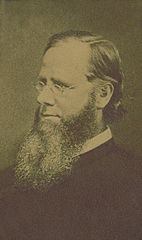
Hecker1This past week the novices spent some time with Fr. Colgan learning more about the Paulist mission.  Seemed a good excuse to post a few words about what make the Paulists unique.

In short, the Paulists are a missionary order who work primarily in North America.

Their three-fold mission is:

— Evangelization, by giving the Word of God a voice “using tools of the modern age”

— Reconciliation with Catholics who have left the church

— Ecumenical outreach to build bridges with other faiths

All of this relates back to Fr. Isaac Hecker, a Redemptorist priest who was called by the Holy Spirit as a missionary to the people of North America.  This puts the Paulist priests out into the community as much as possible, finding ways to build bridges and understanding.

A couple of notable examples of this ministry include The Busted Halo and Fr. James DiLuzio’s Luke Live.

Busted Halo is a far reaching ministry designed to reach out to the young who have questions of faith.  (Although those of us who are “older” can learn a lot there as well.)  Among the tools of Busted Halo you’ll find a comprehensive and frequently-updated website, a daily radio program on Sirius XM, and a variety of podcasts which include homilies and a more-or-less-weekly Q&A show with Fr. Dave Dwyer and Fr. Steven Bell.

Luke Live is a parish mission in which Fr. James brings his considerable vocal and theatrical talents into play to illuminate and instruct around the Gospel of Luke.  We’ve been privileged to have him bring the mission to our parish twice now and both visits were remarkable and uplifting.

And, of course, I’d be remiss if I didn’t mention two of their more well-known ministries; Paulist Press and Paulist Productions.  The first of these is a publishing house and the second a film production company.

One last note, this week Evan will be meeting with a Sulpician priest.  I had never heard of the Sulpicians and was surprised to discover that they are an order which is dedicated to the formation of priests.  Kind of neat that such and order exists.  I look forward to hearing more about them in the future.

— Dad

Question: What Does A Novice Do?

The first few weeks of Evan’s Novitiate have been somewhat busy, but things are beginning to settle down.

In addition to the initial retreat, his unexpected trip back to Utah, and his brief stay in New York City, he’s had the privilege of attending Jimmy Hsu’s Final Promise Mass and Mass of Ordination as a Transitional Deacon.  The participation of the entire Paulist Community in DC in these events underscores the deep commitment these men have to the order and their connectedness and it was — by all accounts — a joyous celebration.

With that past, the novices are beginning to settle into the routine that will serve them in their discernment during the coming months.  I’m going to share (as best I can) a snapshot of that life.  If I miss something, I’ll ask that the novices be generous and gentle in correcting my errors.

7:45 a.m. — Morning prayer from the Liturgy of the Hours.  (If you’re interested in sharing that experience, you can find out more at Universalis.com and DivineOffice.org)

Breakfast after prayer

9:30 a.m. — Conference with other novices.  This may be discussions of the texts the novices have been reading, current issues facing the Church or the order, events of the day, explorations of different forms of prayer and spirituality, and theology discussions.  From what I gather, this is sort of an updated version of the old academic notion of a colloquy or seminar.

Noon — Lunch, like all meals, taken in common with the community.

The afternoon is free time during which the novices engage in personal prayer and study as they seek to enter into a deeper relationship with God.  They have all been given a number of books — some of which are mandatory reading and some of which they selected themselves.  The mandatory reading includes 101 Questions and Answers on Paul and the biography of Isaac Hecker (founder of the order), among other books.  For the self-selected reading, Evan just finished a book on Native Meso-American Spirituality and Dan (another novice whom I have gotten to know through Facebook) is reading Where the Hell is God?

4:50 p.m.  — Prayer in front of the Blessed Sacrament in the Blessed Sacrament chapel.

5:15 p.m. — Mass in the adjacent St. Paul chapel.

5:45 p.m. — Pre-Dinner Social.

6:15 p.m. — Dinner, again taken with the community.

7:30 p.m. — Communal prayer, led by the novices.  Each day (in rotation) one of the novices selects the prayer.  Sometimes they pray the Liturgy of the Hours for the evening, sometimes other prayers.  Evan chose the Chaplet of St. Michael last week when it was his turn.

In addition to the daily routine, there are certain special days during the week.

On Wednesday, the schedule is altered to accommodate Mass at noon in the Holy Spirit Chapel and the evening prayer at 5:15 is led by the students.  (Once a candidate complete the novice year and make his first promise, he is considered a student.)

On Friday, Mass and prayer are at 7:30 a.m. and the novices have the rest of the day free.  Evan has been using his time to explore DC a bit and spent last Friday visiting the Air and Space Museum at the Smithsonian.

Saturday is the work period for the novices when they are assigned chores such as cleaning and mopping.

Evan also tells me that a Paulist Father (Tom Ryan, I believe) has generously allowed the novices to participate in his class “Body, Mind and Heart” which connects Christian prayer to the meditative practices of yoga.

They novices are also being trained for their apostolates.  These involve the novices working the local community and parishes to help out.  I don’t have a clear idea of what Evan will be assigned yet, but once I do I’ll be back with another post.

As always, questions are welcome.

— Dad

So, Where’ve You Been?

Our boots, showing the red dust from Zion's National ParkIt’s been a little quiet around here this past week.

In celebration of 28 years of marriage, Cathy and I took off on Southwestern vacation; revisiting two of our favorite parks and making our first visit to another.

We hiked the familiar Rim Trail at Bryce Canyon, took in the Emerald Pools and explored Watchman in Zions, and visited the North Rim of the Grand Canyon.  We love the rugged, surreal scenery of the southwest and relished the opportunity to get out in it again.

Along  the way, God watched out for us — despite the fact that it rained every day, it never rained on us.  When our Jeep’s battery died, we were stopped at an actual gas station which actually did service.  So, we had a crisis-free vacation which gave us a chance to relax.

We’ll leave you with a few of our favorite pictures from the trip.

— Dad

The view from Rim Trail in Bryce

Cathy resting at the top of Watchman

A view from a bridge near the Zion Park Lodge

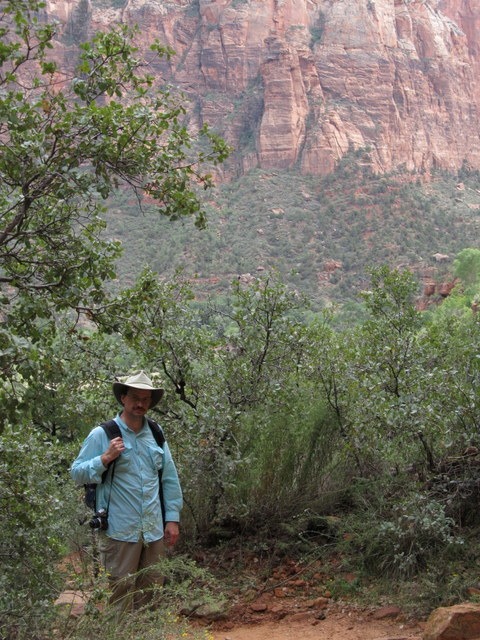
Kevin on the Emerald Pools Trail

Sunset at the North Rim

A Panoramic View of the North Rim Lodge

Question: What is a Vocation?

imageWhen I set out to write this particular post, I thought it would be easy.  You hear about “vocations” all the time.  Except, when I started researching, it seemed to be more subtle and complex than I expected.

I’m going to take my best shot and hope that if I stray, someone will be kind enough to correct me.

I’ll start with a quote from St. John Paul II.

What is a vocation? It is an interior call of grace, which falls into the soul like a seed, to mature within it. (Angelus message, December 14, 1980)

The Lumen Gentium, (one of the principle documents to come out of the Second Vatican Council) explains that there is a sort of universal vocation:

Thus it is evident to everyone, that all the faithful of Christ of whatever rank or status, are called to the fullness of the Christian life and to the perfection of charity; by this holiness as such a more human manner of living is promoted in this earthly society. In order that the faithful may reach this perfection, they must use their strength accordingly as they have received it, as a gift from Christ. They must follow in His footsteps and conform themselves to His image seeking the will of the Father in all things. They must devote themselves with all their being to the glory of God and the service of their neighbor. In this way, the holiness of the People of God will grow into an abundant harvest of good, as is admirably shown by the life of so many saints in Church history. (40)

My first thought was, “Oh.  Is that all?”  The “perfection of charity” and “holiness” seems like something of a tall order.  But it’s right there in black-and-white and (just in case you missed it) there’s a reference to this in paragraph 2013 of the Catechism.

Both those quotes contain within them the notion of a “call” from God; an invitation to live a life of holiness.  What’s interesting is that the Lumen Gentium acknowledges that there are many different ways that this life of holiness can be lived.  Section 41 speaks eloquently about bishops and priests, other consecrated clerics, lay ministers, married couples, widows, single people, “those who engage in labor”, the poor, the infirm, and the sick.  It concludes by sweeping them all up into a final paragraph:

Finally all Christ’s faithful, whatever be the conditions, duties and circumstances of their lives—and indeed through all these, will daily increase in holiness, if they receive all things with faith from the hand of their heavenly Father and if they cooperate with the divine will. In this temporal service, they will manifest to all men the love with which God loved the world. (41)

This is often referred to as the “universal vocation” and I’m taken with this notion that we are all encouraged to pursue holiness as our primary vocation, by acting out our calling.  It’s the word “calling” that most Catholics think of when they hear the word “vocation”.

Traditionally, Catholic thought turns to three different vocations as “primary” vocations or callings; holy orders, consecrated life, or marriage.  Holy orders refers to those who are ordained as deacons, priests and bishops.  Consecrated life refers to those who have taken vows to live “the evangelical councils of poverty, chastity and obedience“; the most common of which are those who live in religious communities such as monks or nuns.  Marriage is also a vocation, although one that is often held in too little regard in the common culture.

All of these primary vocations — these paths to holiness — are a response to God’s call and all of them involve a total gift of self.  For married couples, we are called to give ourselves wholly and unreservedly to our spouse.  For those taking vows, they are giving themselves totally to God.

I found a wonderful article on OSV.COM that explains it very eloquently:

In the case of each primary vocation, that gift of self is not a transitory or temporary thing. It’s not given one day and taken back the next. Rather, the central relationship of each is spousal. It’s exclusive, total and enduring. When the gift of self is made to God, enduring is a “for all eternity” kind of enduring. When the gift of self is made to another person, it’s just an “until death to us part” kind of enduring. Nevertheless, the idea is the same: You fully and freely give yourself to another, and through that giving you pursue your universal vocation, holiness.

One of the keys — if not the key — to working toward holiness is surrender.  It’s that wonderful paradox that comes up again and again in Christ’s teachings — the idea that to attain the most that God has for us, we have to give up our self.

Then he said to all, “If anyone wishes to come after me, he must deny himself and take up his cross daily* and follow me. For whoever wishes to save his life will lose it, but whoever loses his life for my sake will save it. (Luke 9:23-24)

Which doesn’t mean that we turn our backs on life.  Most of us have bills to pay and families to raise and (yes!) parishes to support and that means taking up some form of worldly labor.  You’ll sometimes see this referred to as a “secondary vocation”. Having a job (or even a career) facilitates our survival and it can also be part of our journey toward holiness  The Lumen Gentium recognizes this when it says:

Finally, those who engage in labor—and frequently it is of a heavy nature—should better themselves by their human labors. They should be of aid to their fellow citizens. They should raise all of society, and even creation itself, to a better mode of existence. Indeed, they should imitate by their lively charity, in their joyous hope and by their voluntary sharing of each others’ burdens, the very Christ who plied His hands with carpenter’s tools and Who in union with His Father, is continually working for the salvation of all men. In this, then, their daily work they should climb to the heights of holiness and apostolic activity. (41)

There is — as I discovered in writing this — a lot more territory to cover when it comes to vocations including the question of discerning God’s will for our lives.  I’ll end this now, though, with an encouraging quote from Thomas Merton.

Discovering vocation does not mean scrambling toward some prize just beyond my reach but accepting the treasure of true self I already possess. Vocation does not come from a voice out there calling me to be something I am not. It comes from a voice in here calling me to be the person I was born to be, to fulfill the original selfhood given me at birth by God.

Thomas Merton

–Dad

Sad News

Tuesday, while busy at work, I received an unexpected call from Evan.

“Hi Evan, what’s up?”

“My friend Doug died.  They just called to tell me.”

That morning on the news, I’d heard about an accident at Utah State, but the student’s name hadn’t resonated with me.

The media reported his real name — Eric — not the name he’d been given by his circle of friends — Doug.

“We called him that because we decided there were too many Erics in the world and he looked like the cartoon character,” Evan explained.

Doug was part of the group that Evan ran with at Utah State.  They were close friends who supported one another through school and life and developed a tight bond.  And now one of them was gone.

Evan felt the loss deeply and had already been given permission to return for the weekend for the funeral.

“You’re part of a community back there,” I said.  “Embrace them and let them support you.”

And the Paulist community did, indeed embrace Evan.  They modified the retreat to include a prayer service for Doug (from the Paulist prayer book).  They have supported Evan and helped him with ground transportation.

Once Evan had the time for the funeral, we set about arranging his air travel.  Given that it was the Wednesday before a holiday weekend and Evan had to leave from Albany and return to New York, I was not optimistic about finding available seats.  Praise God, Expedia coughed up a flight that matched Evan’s scheduling and geographical requirements.  We booked it and sent him the confirmation.  He’ll be arriving late tonight and leaving early Monday.

This experience, too, is part of Evan’s formation.  I’ve been reading Just Call Me Lopez (a sort of novel that serves as an introduction to the life of St. Ignatius and Ignatian Spirituality) and I was struck by this passage from the introduction:

Miracles so often happen in the midst of brokenness, inadequacy, and failure. In fact, those experiences would seem to be God’s preferred location for the work of transformation.

So I pray.

I pray for Eric and his family.  I pray for Evan and all of Eric’s friends and ask God to use this experience to let them feel the embrace of His love.

Eternal rest grant unto him, O Lord, and let perpetual light shine upon him. Requiescat in pace.

Edit: Forgot to mention.  Please join us in praying for Eric and his family and, if you want to express your condolences please click here to access the obituary and guest book.

–Dad

God, Moral Decisions, Compassion, and Video Games

MasseffectlogoOne of the appealing tenants of Ignatian Spirituality is that you should find God in all things. Somehow, I didn’t expect to encounter Him in a video game.

Last spring Ian started playing the Mass Effect trilogy of games. The games are a sprawling space opera involving villains, aliens, ancient races, cool futuristic technology, and a singular hero. As the player you take the role of Commander Shepard — the hero and a sort of space-going special forces soldier — in his (or her — you can choose whether Shepard is a man or a woman) quest to unravel various plots and defend the galaxy. Much of the gameplay is built around the notion of making choices and living with the consequences and that makes the game different for each player. Thinking (correctly) that it’s the sort of thing I’d enjoy, the boys conspired to buy me the trilogy as a birthday gift. On Sunday afternoons I play as a break from the workaday world.

A week or so ago I was playing a side mission that involved preventing a group of terrorists from dropping an asteroid on a highly populated planet. Doing my best John McClane, I slaughtered my way through dozens of enemies, shut off the fusion engines driving the asteroid toward the planet, and hunted down the terrorist leader. (The game has very cinematic pacing and each episode builds nicely to a climactic moment.)

The terrorist had captured three scientists and locked them in a cell with a remotely-detonated bomb. I had a simple choice. I could let the terrorist go and he’d release the hostages, or I could take him into custody knowing that he’d detonate the bomb before I could get to him.

The game waited patiently while I weighed the alternatives. On the one hand, he was a lying terrorist who had been trying to wipe out millions of peaceful humans. On the other hand, the scientist would surely die. But…terrorist!

I reasoned that he was certainly lying about releasing the hostages and I’d wind up with dead hostages and an escaped terrorist. If I captured him, I could put a stop to his unprovoked attacks on civilians and save countless lives. That seemed a fair trade.

The hostages died and I captured the bad guy. The game gave me ample opportunities to shoot him and I resisted because that wasn’t the moral thing to do. Instead, I arrested him and shipped him off for trail.

Since Ian has shown a keen interest in my progress, I sent him a text. He responded almost immediately, very surprised at my choice.

Bad guy blew up the hostages. At least he’s in custody now.

You chose to let the hostages die?

The needs of the many outweigh the needs of the few.

You chose wrong. He and the rock are stopped either way. He just slips custody.

Ahh…oh well. Now that’s a part of my character’s story.

It’s just funny because I asked you about that choice when I first played it.

Interesting.

And you said freeing the hostages was more important than capturing the terrorist. Did you think the asteroid would hit if you didn’t capture him?

No. I assumed he was lying and would kill the hostages anyway. Poor thinking on my part.

Funny how being in the moment changes things.

I feel there is a lesson in this.

I think so…must ruminate.

You’re going to be a cow?

Yes. Yes I am.

Ian’s wacky sense of wordplay aside, I did ruminate and I came to some interesting conclusions.

First of all, the game had given me a way to practice my faith — albeit in a simulation.

Second of all, I didn’t do very well.

When Ian called me last spring and asked my thoughts on whether or not to free the hostages, it all seemed very clear. In fact, the Catechism addresses this type of question in chapter 1, article 4, The Morality of Human Acts. The article lays out a standard for judging morality which includes the object, the intention and the circumstances. The meat of it shows up in paragraph 1753:

1753 A good intention (for example, that of helping one’s neighbor) does not make behavior that is intrinsically disordered, such as lying and calumny, good or just. The end does not justify the means. Thus the condemnation of an innocent person cannot be justified as a legitimate means of saving the nation. On the other hand, an added bad intention (such as vainglory) makes an act evil that, in and of itself, can be good (such as almsgiving).

That was core of the issue right there. The good intention — stopping the terrorist — did not make it acceptable to intentionally sacrifice the hostages’ lives. By making that choice, I objectified the hostages and stripped them of humanity in favor of achieving my goal. In the words of the catechism, my behavior was “intrinsically disordered.” (That’s fancy talk for “just plain wrong.”)

What had been so easy to answer in the abstract during a telephone conversation with Ian, suddenly seemed very difficult in the heat of the moment.

I’m unlikely to ever face such a choice in real life, but Ian was right to say there was a lesson in the experience.

The first lesson is the importance of formation and a deep understanding of the faith. I’m pretty sure I had a solid basic grasp of the faith and I was certainly able to answer the question for Ian when he called. But in the heat of the moment I forgot what I knew and my answer came from a gut hunch instead of informed reasoning. Had my formation (formal and informal) included more contemplation of how the catechism played out in the real world — or in the simulated world of a video game — I might have had the presence of mind to make the right choice.

Which was the essence of the second lesson. I made the wrong decision even though I knew better. Sometimes real life is like that. Even when we should know better, we do the wrong thing. The Apostle Paul referenced this very issue in Romans 7:19.

For I do not do the good I want, but I do the evil I do not want.

As human beings, we are all subject to concupiscence. That is, we are inclined toward sin despite our better desires. And, if it was true for me in a relatively trivial decision in a video game, how much more true is it for people facing difficult moral decisions in real life? It is easy to sit in the pews and condemn people who face difficult choices such as abortion. (I’m using abortion as an example, but given the wide range of human behaviors and opportunities to miss the mark, there are plenty of other situations I could have chosen.)

It’s easy to convince yourself that you would make the correct moral choice; after all you have a well-formed conscience. Perhaps that is true. But you’ll never really know until find yourself living that moment.

That truth calls us to be caring in our response to people who make those choices. As I noted, condemnation is easy, compassion is hard. The decisions which seem so obvious and simple on the outside can be very difficult for those who live them.

Not that sin should be excused — far from it — we have the Sacrament of Reconciliation for the very purpose of addressing sin. Rather, in addressing the sinner we need to have appropriate concern for the humanity and dignity of that person. Failure to do that is a different sort of moral lapse.

Which brings me back to the game. I had saved an earlier play session and had the option to re-load from that point, reconsider my decision and act in the way I should have acted all along. The terrorist got away and set a timer on the bomb (my instincts weren’t entirely wrong) but I saved the hostages. Unlike real life, the game gave me a chance to undo my mistake; to make it as if it had never happened. And — maybe — the opportunity to repent of an error and return to do better the next time is the model that should encourage us all to trust in God’s Grace.

–Dad

Question: Can You Talk To Evan?

Phone_numberpadThis past Wednesday we took Evan to the Salt Lake airport at an early hour. (Did you know there’s a five in the morning now?)  As I’ve been talking with my colleagues and telling them that he’s gone to the seminary, one question keeps coming up over and over:

Can you talk to him?

Ummmm….yeah.

In fact, on Friday he took a few moments out of his day to call and wish my mother a happy birthday.  On Saturday, he gave us a call to update us on his first three days at St. Paul’s College.

All along, he’s been swapping texts with his older brother and we’ve been able to send him e-mails.

I think the reason the question keeps coming up is that many of my colleagues are members of the Church of Jesus Christ of Latter Day Saints — Mormons — and they speak out of their experience of sending children off on religious missions.   Although it is not required, young Mormons are encouraged to serve a voluntary mission.  During the time that these young people are away from home (two years for men, eighteen months for women) they are not permitted to call home except on Christmas and Mother’s Day.  Beyond that, Missionaries are encouraged to write a letter home once a week.  In recent years, these letters have come in the form of weekly e-mails.

Since many of these missionaries are young and serving in distant lands, parents are understandably concerned and eager to hear that their children are safe and well.

And, perhaps, some of my colleagues are confusing seminary with a cloistered order in which all communications are strictly controlled.  To be fair, there are seminaries which are more strict and seminaries which are less so.  The Paulists seem to be interested in having their seminarians engaged with the world and so Evan is readily available to communicate with us.  When he was away at college, he called us once a week to chat.  I expect that will continue so long as he’s available.

While we’re on the topic, let me share a few highlights of Evan’s week.

I asked Evan how he was doing and he admitted that it was a lot to absorb in just three days.  He was looking forward to this week’s opening retreat at Lake George.

–Dad

Last Things

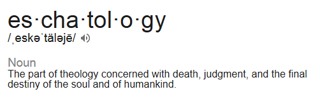
eschatologyToday’s vocabulary word is eschatology.  That’s the theological study of “last things” like death, the afterlife, eternity and the end of time.  Hang on to that tidbit, you’ll need it in a minute.

A little over a year ago, Evan’s Vocations Director, Fr. Dave, came out to visit Evan and to meet with us.  We fell to talking about the coursework Evan would have to complete in order to graduate in the spring of ’13.  By dint of hard work (including a summer semester after he changed majors and an insanely challenging semester with 18 credits) he was very, very close.  There was still a chance that he might not graduate.  In order to earn his degree, he choose one of two mandatory classes — and it wasn’t clear that either of them was going to be offered during the year.

“That’s metaphysics and eschatology, right?” I asked.

“No dad,” he said.  “It’s metaphysics and epistemology.”

“Oh.  Right.  EpistemologyEschatology will be one of the last things you’ll study.”

Theology puns.  Does it get any better than that?  (Yeah, probably, but thank you for indulging me by reading that.  The rest of this will be more serious, I promise.)

I’ve been thinking a lot about endings lately.  Evan is leaving.  As Cathy noted, she’s left her career in medicine and moved on to new challenges.  A good friend just lost her adult son to cancer.  It seems to be a season of endings for us.

We’ve been preparing with lots of “lasts” and last minute preparations.  (Which is, in part, why we’ve been so scarce in this space the last couple of weeks.)

When it opened, the boys and I went to see Elysium.  (Capsule review; don’t bother.)  Since the boys have moved out, the three of us have met from time-to-time for dinner and a movie.  I’ve always enjoyed those as I’ve learned how to relate to my sons as adults.  I suspect I’ve not always done a good job of working out this new relationship, but it’s been good getting to know them in a new and different context.

I’m going to miss having those “guys nights”.

A week ago Tuesday, we had Fr. Clarence over for a last dinner with Evan.  Ian, our oldest, was able to join us as well so we had the whole family together for a meal with our parish priest.  He told us about his vocational discernment, his years with the Peace Corps in Lesotho, the importance of myth and storytelling and his advice on entering the seminary.  (Make sure you have a good spiritual director.)

On Wednesday last week we attended the vigil for the Feast of the Assumption and Evan went with us.  That’s the last Mass we’ll share with him for a while.  When the Mass was done he spent a few minutes visiting with people in the parish whom he has known for years and who have been encouraging during this phase of his discernment.

Tuesday evening we had a family dinner together with both boys and my mother.

And, of course, on Wednesday morning (at an abysmally early hour) we said good-bye and sent him off on the plane to D.C.

We’re hardly the first family bid a child farewell.  Every day families send their sons and daughters off to college, to the military, to various kinds of service and education and employment in distant places.  Yet, this is a first for us.  Even though they moved out, both boys have been relatively close to home.  And, as Fr. Clarence pointed out, Evan’s community will become his family now in a profound and important way.

It’s surprisingly tough to see him go.  I’ve passed the last couple of weeks in a sort of anticipatory melancholy which balances my hopes for his on-going discernment process against the reality of his departure.  As they say on the internet, I’m feeling all the feels.

I’m proud of him, of course, and wouldn’t want him not to go.  At the same time I’ll miss having him close by.  I take comfort in the fact that this ending is also a new beginning.  It is not so much a season of endings, but rather a season of change in our lives.  And I look forward to seeing what other changes God has in store for us.

— Dad

Change of Life Indeed

160px-Stack_of_coins_0214I have always joked with the adage “If you are going to go, go big”. Didn’t mean to do it quite to this degree in my life.

Evan leaves this week and that alone is a major life change. Fr. Clarence (our parish priest) mentioned to us that although other people have children move away, this is different. The largest difficulty that our priest’s family experienced was that he was no longer available for time normally considered family times (Holidays, birthdays, anniversaries, etc.) Evan is now, as Fr. Clarence was then, joining a new community, a new family. And effectively leaving our family. Just as Hannah prayed for Samuel and then gave him to the Lord (Samuel 1:27-28), so too, I prayed for Evan and now must give him to the Lord. NOT EASY. I admire Hannah but don’t feel as sure as she was. Guess I have to work on that. Pray for me.

I’m experiencing another change; the one most commonly associated with the phrase “the change”. After almost 28 years of marriage using natural family planning (sympto-thermal method) I am officially post menopausal. For those who are familiar with the method, this now means that we are now permanently post ovulatory. Quite a change after two years of almost constant pre-ovulatory rules. I am probably one of the few people I know who has undergone a natural path to menopause and I know I am the only person of my acquaintance who couldn’t wait to be post menopausal. I have always loved the method and glad my husband and I practiced it. I think it made us closer. I do wonder how long till I stop checking my “symptoms”. I thank the Lord that I married a man brave enough and confident enough in our love to practice our faith together in all aspects of our lives.

And just because I don’t have enough stress in my life (or maybe because I do) I quit my career of 28 years as a clinical laboratory scientist. I spent 24 of those years were at the same laboratory. I have been feeling called to something and praying desperately for guidance. I was presented with an opportunity to assist with formation at our church. My career would not allow me the time or freedom to really involve myself. My husband and I worked at me finding alternate employment that would allow me an out with enough income to not stress us in a new way. I have become the print-shop assistant at  The Davis Applied Technology College. The same place my husband works and where I did a two year stint as a night phlebotomy instructor.  (Insert your own vampire joke here.)

I know the people at the college as friends already, and love being creative and working with big machines. It is a perfect fit. The salary is a third that of my prior job but my (wonderful) husband and I looked over the budget and decided to cut some and make the leap. I will not miss the stress of my former job; you can only worry about life-altering consequences of your actions so long. I will miss terribly all the phenomenal friends that I will no longer see on a regular basis. I cried as I cleared out my locker after the wonderful “so long” party all my co-workers gave me.

Now for the next phase. New physical conditions, new family conditions, new work conditions, new volunteer conditions, same glorious husband, same loving Lord. Thank you Lord

– Mom

Foodie Priests

Photo Credit: Creative Commons courtesy of Alpha by way of Wikimedia CommonsThe Paulist.org website has a nice article about the “Paulist Plunge” retreat for this year.  The article does a gives a peek into the experience, but it doesn’t mention the amazing dinner that Fr. Larry cooked for the men participating in the retreat.

Evan reported that it was an amazing meal featuring grilled salmon and some sort of risotto and (to be honest) I sort of lost track after that as I was very hungry at the time and Evan’s description of the entrée briefly sidelined my ability to process new information.

Fr. Steven Bell, who also participated in the retreat, is a cohost on the Busted Halo podcast and a foodie as well.  At various times on the podcast he’s reported on meals he cooked and I had the same mouth-watering-brain-derailing reaction.  He has also been heard to say that Jesus was a foodie.

The whole idea of foodie priests might seem strange.  A lot of people think of priests as severe ascetics who go out of their way to avoid worldly joys.  These same people tend perceive Catholics as dour, pinch-faced individuals.  I think they’re confusing us with Puritans.

One of the fundamental teachings of Catholicism (and, as a convert it took me a long time to understand this) is that the world is good.  Fallen and corrupt, but good in its very creation.  If God — who is all good and loving — created the world, how could it be otherwise?

The Catechism of the Catholic Church asserts this truth in the very beginning.

339 Each creature possesses its own particular goodness and perfection. For each one of the works of the “six days” it is said: “And God saw that it was good.” “By the very nature of creation, material being is endowed with its own stability, truth and excellence, its own order and laws.” Each of the various creatures, willed in its own being, reflects in its own way a ray of God’s infinite wisdom and goodness. Man must therefore respect the particular goodness of every creature, to avoid any disordered use of things which would be in contempt of the Creator and would bring disastrous consequences for human beings and their environment.

341 The beauty of the universe: The order and harmony of the created world results from the diversity of beings and from the relationships which exist among them. Man discovers them progressively as the laws of nature. They call forth the admiration of scholars. The beauty of creation reflects the infinite beauty of the Creator and ought to inspire the respect and submission of man’s intellect and will.

In a similar vein, the Bishops of Mississippi and Alabama wrote a pastoral letter to their congregations in 1989 asserting:

For Catholics, Biblical teaching has always maintained that our world is good and has been entrusted to our care by God. We do not see it as something evil to escape, rather we embrace our world without embracing the sin within it.

In practical terms, this means that the we are not only free to enjoy the world — we are actively encouraged to engage with God’s creation.  The world is ours to enjoy.  Beauty, good food, and and all the delights of the senses reveal parts of God’s love for his creation to us.  Our God is an awesome God and it’s okay to acknowledge that and embrace his creation.

And that includes good food.

The link between food and faith is particularly strong.  Jesus practiced what is known as “open table fellowship” and is often shown dining with people from a variety of social classes.  The Last Supper is one of the pivotal moments in the New Testament — so important that we reenact it at every Mass and given it special prominence during Holy Week at the Mass of the Lord’s Supper.

The folks at CatholicFoodie.com know this.  Their website and podcast explore the relationship of food and faith.  Plus they have some great recipes.

So, strange as it might seem to some, the idea of a “foodie priest” makes perfect sense.  Enjoying good food (but not to excess) is an act of embracing the gifts that God has given us.

Over the years, Evan has shown himself to be an outstanding cook.  This past summer he and his roommate make a massive batch of incredible pork tamales.  As an undergraduate, he regularly hosted dinners for his friends — calling home to ask advice on food pairings and preparation.

He comes by his talent naturally.  His mother is an awesome cook who learned the craft by working in the kitchen at her parent’s restaurant.  And I think he might get a bit of his talent from my side of the family too.  And, given what I know about the Paulist community and its relationship to food, I think Evan is going to fit right in.

–Dad

Promises, Promises

Evan is back from his week long retreat in New York.  He had a wonderful time of prayer, liturgy, contemplation and relaxation.  This retreat — like the others he’s been on — energized him and further confirmed his commitment to the Paulist Community.

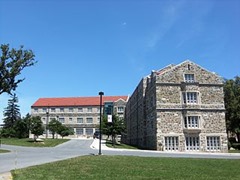
St__Paul's_College_(Washington,_D_C_)A few days ago, Michael Hennessy, made a very public commitment to the Paulists.  Michael was the entire novice class in the fall of 2012.  Evan had a chance to get to know him last summer at the 2012 Paulist Plunge.  At a July 27, 2013 Mass at St. Paul’s College in Washington, DC, Michael made his first promise to the Paulists.

The idea of a “first promise” might sound a little strange — particularly to those who are more familiar with the idea of religious vows.  The Wikipedia entry on the Paulists explains:

The Paulists are a Society of Apostolic Life, meaning they do not take the traditional vows of consecrated life; rather, by means of promises they are supposed to pursue their mission through living in community and developing holiness in their lives.

A better explanation shows up on the St. Paul the Apostle Catholic Community (Los Angeles) web page:

As a fully approved congregation in the Catholic Church, the Church looks on the Paulist Community in a very particular way. We belong to a group of congregations called societies of the apostolic life. Only 15 religious congregations have that status today. These communities do not take the three traditional vows that characterize consecrated life, but instead concentrate on their mission. The Church sees three dimensions to a society of the apostolic life.

  • Our primary purpose is our mission
  • We accomplish our mission through living in community
  • We seek holiness through living our mission and common life

The Paulists, therefore, are not like Benedictines or Dominicans or other great Orders whose lives are grounded in the three vows. Rather than taking vows, we take a promise to obey our Paulist Constitution that lays out our mission, our pursuit of holiness, and our living simply, obediently and chastely. Fr. Hecker and the other early Paulist founders felt that taking a promise reflected more directly the way things are done in North American society.

Like a vow, the promises are an important step in the formation of a Paulist.  By making the first promises, Michael Hennessy has stepped away from the title of Novice and is officially a member of the Paulist community and a seminarian.  At various stages of their formation, the seminarians make additional promises until they reach the final promise which is the penultimate step before ordination.

Each of these promises — as momentous as they are — is but a milestone on the journey toward God.  All of us are on that same journey and we each have our own milestones.  For me, one of those milestones was Evan’s revelation that he felt called to the priesthood.  Certainly it was an important part of his journey, but more than that, it caused me to reflect on my own faith — on the promises that I had made at my Confirmation.  Had I lived up to them?  Could I do better?  What role was God expecting me to play in my son’s lives now that they had become adults?

Honestly, I don’t have all of the answers to those questions; I’m not certain I even have complete answers to any of them.  What I can say is that the very act of seriously asking those questions has deepened my faith and brought me closer to God.  I expect that the promises the Paulists make do much the same for them.

–Dad

The Outside Perspective

Good day all,

This is Sparky, the occasionally referenced elder brother of the Novitiate. My brother leaves town on a largely permanent basis in less than a month so I figured it was high time I put out some words about it.

I think it’s just now hitting me. I mean he and I haven’t spent that much time in each other’s company in years, scheduling trouble and my own reclusive tendencies saw to that. But there is something different in this. I think part of it is geographic. No longer would a trip to see him be just a few hours on the road. But a larger part perhaps is in the nature of his move. Priesthood is a demanding calling, and yes I’m sure he isn’t abandoning his family, and Paulists are rather big on being in the community rather than separated from it, but still. They do refer to it as giving oneself entirely to God. I seem to recall something about a hand on a plowshare,

Now about the title of this post: I am not part of the Church anymore. I often find myself in a position to defend Catholic beliefs and practices but ultimately I struggle with faith on a personal level. I sometimes joke that there was a cosmic mix up and he got all the belief.

So while my parents are watching their younger son go forth in the Service of God I’m watching my brother pursue what he feels is his calling. I’ll not speak a word against it mind you, he does as he feels is right. And there are far far worse things to dedicate one’s life to. But on some level it remains a mystery to me that I can’t quite grasp. Still it is my wish to support him, though probably with less in the way of chaplet crafting.

Another time I shall have to tell the tale of his informing me of his calling, and I’m sure I can come up with a few other posts. But for now I bid you farewell.

–Older Brother

Retreat!

Ignatius_LoyolaEvan is at Lake George, New York this week, participating in the second Paulist Plunge.  The Plunge is a week-long discernment retreat for “men 18-35 who are interested in exploring the possibility of a religious vocation, and who want to get to know the Paulists better.”  He will be attending with another of this year’s novices and other men who are exploring whether or not they are called to a religious life.

Given that tomorrow (July 31) is the Feast of St. Ignatius, it’s fitting to take a moment and talk about retreats and to point you to a couple that you can take right where you’re sitting.

Several websites define a retreat as “A retreat is a withdrawal from ordinary activities for a period of time to commune with God in prayer and reflection.”  That’s a good place to start.  It is worth noting that there are many different kinds of retreats which serve many different purposes.  Cathy and I participated in a Engaged Encounter retreat as part of our marriage preparation.  Prayer and contemplation were an important part of the experience, but so were periods of reflection (both individually and as a couple) regarding our future.  We cannot recommend the Engaged Encounter enough and have even encouraged many non-Catholic friends to send their children when they were contemplating marriage.

Years later we attended a Marriage Encounter weekend, which was another kind of retreat.  Again, there was prayer and scripture and reflection.

The idea of a retreat, a time away for prayer and reflection is ancient.  We can point to Jesus’ sojourn in the desert as a New Testament example of a retreat. The early religious who withdrew to the desert or to monasteries are examples of individuals called to permanent retreats.

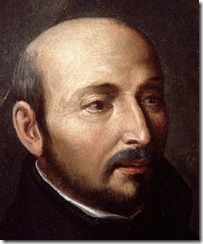
It took St. Ignatius of Loyola (that handsome fellow at the top right of this post) to formalize the idea of retreats in the 1500s.  As the Catholic Encyclopedia notes:

The Society of Jesus was the first active religious order in which the practice of the retreat became obligatory by rule.

It goes on to point out:

The Society of Jesus did not reserve these exercises for its own exclusive use, but gave them to communities and individuals. Blessed Peter Faber in his “Memoriale” testifies to having given them to the grandees of Spain, Italy, and Germany, and used them in restoring hundreds of convents to their first fervour. A letter of St. Ignatius (3 Feb., 1554) recommends giving the exercises publicly in the churches. In addition, the houses of the Society often contained rooms for priests or laymen desirous of performing the exercises privately. Ignatius, having sanctioned this custom during his lifetime, one of his successors, Aquaviva, exhorted the provincials to its maintenance in 1599. In studying the spread of this practice we must not neglect the influence of St. Charles Borromeo. The cardinal and the Jesuits co-operated in order to promote this sort of apostolate. A fervent admirer and disciple of the “Spiritual Exercises”, St. Charles introduced them as a regular practice among the secular clergy by retreats for seminarians and candidates for ordination. He built at Milan an asceterium, or house solely destined to receive those making retreats, whose direction he confided to the Oblates. The zeal of St. Charles was effectual in encouraging the sons of St. Ignatius to adopt definitively the annual retreat, and to organize outside collective retreats of priests and laymen.

All of which brings us back to the Paulist Retreat House in Lake George, New York.  As part of their mission, the Paulists operate a number of retreats on their Lake George property.  Some are related to the arts (the Singer/Songwriter Residency Program and the Artists’ Residency Program), some are more contemplative (Restful Waters/Couples’ Retreat and Praying Your Life) and some are very focused like the Paulist Plunge.  This will be Evan’s second year at the plunge.  He attended the retreat last year and came back energized and renewed.

It’s pretty amazing what a few days of prayer and contemplation can accomplish.

If the idea of a retreat appeals to you, but you can’t possibly get away due to various life commitments, there are plenty of opportunities to take retreats — small and large — just where you are.

At the beginning of July, The Busted Halo published a Virtual Outdoor Retreat.  This handy, printable guide gives you a chance to get back to nature in prayer and contemplation.  The perfect thing for a summer Sunday afternoon.

If you don’t live anywhere near nature (you poor person!) and want a more technological retreat, you can take advantage of Fr. James Martin’s e-book Together on Retreat: Meeting Jesus in Prayer.

If you’re really pressed for time, but want a few moments of peace each day, consider the 3 Minute Retreats from Loyola Press.  You can access them via the web, in your e-mail or through an inexpensive app.  A few minutes of prayer can set a great tone for your whole day and each of these brief reflections will give you something to contemplate.

Whatever you choose, a retreat is a great way to reconnect with God and to strengthen your spiritual life.

–Dad