
A brief note.
As I mentioned in my last post, Saturday night was the Signing-In Mass for the four new novices.
Pictures and text were posted on the Paulist website. I haven’t much to add except…don’t they all look handsome?
— Dad
A brief note.
As I mentioned in my last post, Saturday night was the Signing-In Mass for the four new novices.
Pictures and text were posted on the Paulist website. I haven’t much to add except…don’t they all look handsome?
— Dad
 This past Wednesday we took Evan to the Salt Lake airport at an early hour. (Did you know there’s a five in the morning now?) As I’ve been talking with my colleagues and telling them that he’s gone to the seminary, one question keeps coming up over and over:
Can you talk to him?
Ummmm….yeah.
In fact, on Friday he took a few moments out of his day to call and wish my mother a happy birthday. On Saturday, he gave us a call to update us on his first three days at St. Paul’s College.
All along, he’s been swapping texts with his older brother and we’ve been able to send him e-mails.
I think the reason the question keeps coming up is that many of my colleagues are members of the Church of Jesus Christ of Latter Day Saints — Mormons — and they speak out of their experience of sending children off on religious missions. Although it is not required, young Mormons are encouraged to serve a voluntary mission. During the time that these young people are away from home (two years for men, eighteen months for women) they are not permitted to call home except on Christmas and Mother’s Day. Beyond that, Missionaries are encouraged to write a letter home once a week. In recent years, these letters have come in the form of weekly e-mails.
Since many of these missionaries are young and serving in distant lands, parents are understandably concerned and eager to hear that their children are safe and well.
And, perhaps, some of my colleagues are confusing seminary with a cloistered order in which all communications are strictly controlled. To be fair, there are seminaries which are more strict and seminaries which are less so. The Paulists seem to be interested in having their seminarians engaged with the world and so Evan is readily available to communicate with us. When he was away at college, he called us once a week to chat. I expect that will continue so long as he’s available.
While we’re on the topic, let me share a few highlights of Evan’s week.
I asked Evan how he was doing and he admitted that it was a lot to absorb in just three days. He was looking forward to this week’s opening retreat at Lake George.
–Dad
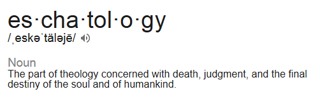 Today’s vocabulary word is eschatology. That’s the theological study of “last things” like death, the afterlife, eternity and the end of time. Hang on to that tidbit, you’ll need it in a minute.
A little over a year ago, Evan’s Vocations Director, Fr. Dave, came out to visit Evan and to meet with us. We fell to talking about the coursework Evan would have to complete in order to graduate in the spring of ’13. By dint of hard work (including a summer semester after he changed majors and an insanely challenging semester with 18 credits) he was very, very close. There was still a chance that he might not graduate. In order to earn his degree, he choose one of two mandatory classes — and it wasn’t clear that either of them was going to be offered during the year.
“That’s metaphysics and eschatology, right?” I asked.
“No dad,” he said. “It’s metaphysics and epistemology.”
“Oh. Right. Epistemology. Eschatology will be one of the last things you’ll study.”
Theology puns. Does it get any better than that? (Yeah, probably, but thank you for indulging me by reading that. The rest of this will be more serious, I promise.)
I’ve been thinking a lot about endings lately. Evan is leaving. As Cathy noted, she’s left her career in medicine and moved on to new challenges. A good friend just lost her adult son to cancer. It seems to be a season of endings for us.
We’ve been preparing with lots of “lasts” and last minute preparations. (Which is, in part, why we’ve been so scarce in this space the last couple of weeks.)
When it opened, the boys and I went to see Elysium. (Capsule review; don’t bother.) Since the boys have moved out, the three of us have met from time-to-time for dinner and a movie. I’ve always enjoyed those as I’ve learned how to relate to my sons as adults. I suspect I’ve not always done a good job of working out this new relationship, but it’s been good getting to know them in a new and different context.
I’m going to miss having those “guys nights”.
A week ago Tuesday, we had Fr. Clarence over for a last dinner with Evan. Ian, our oldest, was able to join us as well so we had the whole family together for a meal with our parish priest. He told us about his vocational discernment, his years with the Peace Corps in Lesotho, the importance of myth and storytelling and his advice on entering the seminary. (Make sure you have a good spiritual director.)
On Wednesday last week we attended the vigil for the Feast of the Assumption and Evan went with us. That’s the last Mass we’ll share with him for a while. When the Mass was done he spent a few minutes visiting with people in the parish whom he has known for years and who have been encouraging during this phase of his discernment.
Tuesday evening we had a family dinner together with both boys and my mother.
And, of course, on Wednesday morning (at an abysmally early hour) we said good-bye and sent him off on the plane to D.C.
We’re hardly the first family bid a child farewell. Every day families send their sons and daughters off to college, to the military, to various kinds of service and education and employment in distant places. Yet, this is a first for us. Even though they moved out, both boys have been relatively close to home. And, as Fr. Clarence pointed out, Evan’s community will become his family now in a profound and important way.
It’s surprisingly tough to see him go. I’ve passed the last couple of weeks in a sort of anticipatory melancholy which balances my hopes for his on-going discernment process against the reality of his departure. As they say on the internet, I’m feeling all the feels.
I’m proud of him, of course, and wouldn’t want him not to go. At the same time I’ll miss having him close by. I take comfort in the fact that this ending is also a new beginning. It is not so much a season of endings, but rather a season of change in our lives. And I look forward to seeing what other changes God has in store for us.
— Dad
.jpg "GrilledSalmon") The Paulist.org website has a nice article about the “Paulist Plunge” retreat for this year. The article does a gives a peek into the experience, but it doesn’t mention the amazing dinner that Fr. Larry cooked for the men participating in the retreat.
The Paulist.org website has a nice article about the “Paulist Plunge” retreat for this year. The article does a gives a peek into the experience, but it doesn’t mention the amazing dinner that Fr. Larry cooked for the men participating in the retreat.
Evan reported that it was an amazing meal featuring grilled salmon and some sort of risotto and (to be honest) I sort of lost track after that as I was very hungry at the time and Evan’s description of the entrée briefly sidelined my ability to process new information.
Fr. Steven Bell, who also participated in the retreat, is a cohost on the Busted Halo podcast and a foodie as well. At various times on the podcast he’s reported on meals he cooked and I had the same mouth-watering-brain-derailing reaction. He has also been heard to say that Jesus was a foodie.
The whole idea of foodie priests might seem strange. A lot of people think of priests as severe ascetics who go out of their way to avoid worldly joys. These same people tend perceive Catholics as dour, pinch-faced individuals. I think they’re confusing us with Puritans.
One of the fundamental teachings of Catholicism (and, as a convert it took me a long time to understand this) is that the world is good. Fallen and corrupt, but good in its very creation. If God — who is all good and loving — created the world, how could it be otherwise?
The Catechism of the Catholic Church asserts this truth in the very beginning.
339 Each creature possesses its own particular goodness and perfection. For each one of the works of the “six days” it is said: “And God saw that it was good.” “By the very nature of creation, material being is endowed with its own stability, truth and excellence, its own order and laws.” Each of the various creatures, willed in its own being, reflects in its own way a ray of God’s infinite wisdom and goodness. Man must therefore respect the particular goodness of every creature, to avoid any disordered use of things which would be in contempt of the Creator and would bring disastrous consequences for human beings and their environment.
…
341 The beauty of the universe: The order and harmony of the created world results from the diversity of beings and from the relationships which exist among them. Man discovers them progressively as the laws of nature. They call forth the admiration of scholars. The beauty of creation reflects the infinite beauty of the Creator and ought to inspire the respect and submission of man’s intellect and will.
In a similar vein, the Bishops of Mississippi and Alabama wrote a pastoral letter to their congregations in 1989 asserting:
For Catholics, Biblical teaching has always maintained that our world is good and has been entrusted to our care by God. We do not see it as something evil to escape, rather we embrace our world without embracing the sin within it.
In practical terms, this means that the we are not only free to enjoy the world — we are actively encouraged to engage with God’s creation. The world is ours to enjoy. Beauty, good food, and and all the delights of the senses reveal parts of God’s love for his creation to us. Our God is an awesome God and it’s okay to acknowledge that and embrace his creation.
And that includes good food.
The link between food and faith is particularly strong. Jesus practiced what is known as “open table fellowship” and is often shown dining with people from a variety of social classes. The Last Supper is one of the pivotal moments in the New Testament — so important that we reenact it at every Mass and given it special prominence during Holy Week at the Mass of the Lord’s Supper.
The folks at CatholicFoodie.com know this. Their website and podcast explore the relationship of food and faith. Plus they have some great recipes.
So, strange as it might seem to some, the idea of a “foodie priest” makes perfect sense. Enjoying good food (but not to excess) is an act of embracing the gifts that God has given us.
Over the years, Evan has shown himself to be an outstanding cook. This past summer he and his roommate make a massive batch of incredible pork tamales. As an undergraduate, he regularly hosted dinners for his friends — calling home to ask advice on food pairings and preparation.
He comes by his talent naturally. His mother is an awesome cook who learned the craft by working in the kitchen at her parent’s restaurant. And I think he might get a bit of his talent from my side of the family too. And, given what I know about the Paulist community and its relationship to food, I think Evan is going to fit right in.
–Dad
Evan is back from his week long retreat in New York. He had a wonderful time of prayer, liturgy, contemplation and relaxation. This retreat — like the others he’s been on — energized him and further confirmed his commitment to the Paulist Community.
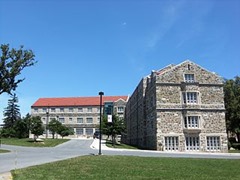 A few days ago, Michael Hennessy, made a very public commitment to the Paulists. Michael was the entire novice class in the fall of 2012. Evan had a chance to get to know him last summer at the 2012 Paulist Plunge. At a July 27, 2013 Mass at St. Paul’s College in Washington, DC, Michael made his first promise to the Paulists.
The idea of a “first promise” might sound a little strange — particularly to those who are more familiar with the idea of religious vows. The Wikipedia entry on the Paulists explains:
The Paulists are a Society of Apostolic Life, meaning they do not take the traditional vows of consecrated life; rather, by means of promises they are supposed to pursue their mission through living in community and developing holiness in their lives.
A better explanation shows up on the St. Paul the Apostle Catholic Community (Los Angeles) web page:
As a fully approved congregation in the Catholic Church, the Church looks on the Paulist Community in a very particular way. We belong to a group of congregations called societies of the apostolic life. Only 15 religious congregations have that status today. These communities do not take the three traditional vows that characterize consecrated life, but instead concentrate on their mission. The Church sees three dimensions to a society of the apostolic life.
- Our primary purpose is our mission
- We accomplish our mission through living in community
- We seek holiness through living our mission and common life
The Paulists, therefore, are not like Benedictines or Dominicans or other great Orders whose lives are grounded in the three vows. Rather than taking vows, we take a promise to obey our Paulist Constitution that lays out our mission, our pursuit of holiness, and our living simply, obediently and chastely. Fr. Hecker and the other early Paulist founders felt that taking a promise reflected more directly the way things are done in North American society.
Like a vow, the promises are an important step in the formation of a Paulist. By making the first promises, Michael Hennessy has stepped away from the title of Novice and is officially a member of the Paulist community and a seminarian. At various stages of their formation, the seminarians make additional promises until they reach the final promise which is the penultimate step before ordination.
Each of these promises — as momentous as they are — is but a milestone on the journey toward God. All of us are on that same journey and we each have our own milestones. For me, one of those milestones was Evan’s revelation that he felt called to the priesthood. Certainly it was an important part of his journey, but more than that, it caused me to reflect on my own faith — on the promises that I had made at my Confirmation. Had I lived up to them? Could I do better? What role was God expecting me to play in my son’s lives now that they had become adults?
Honestly, I don’t have all of the answers to those questions; I’m not certain I even have complete answers to any of them. What I can say is that the very act of seriously asking those questions has deepened my faith and brought me closer to God. I expect that the promises the Paulists make do much the same for them.
–Dad
 Evan is at Lake George, New York this week, participating in the second Paulist Plunge. The Plunge is a week-long discernment retreat for “men 18-35 who are interested in exploring the possibility of a religious vocation, and who want to get to know the Paulists better.” He will be attending with another of this year’s novices and other men who are exploring whether or not they are called to a religious life.
Given that tomorrow (July 31) is the Feast of St. Ignatius, it’s fitting to take a moment and talk about retreats and to point you to a couple that you can take right where you’re sitting.
Several websites define a retreat as “A retreat is a withdrawal from ordinary activities for a period of time to commune with God in prayer and reflection.” That’s a good place to start. It is worth noting that there are many different kinds of retreats which serve many different purposes. Cathy and I participated in a Engaged Encounter retreat as part of our marriage preparation. Prayer and contemplation were an important part of the experience, but so were periods of reflection (both individually and as a couple) regarding our future. We cannot recommend the Engaged Encounter enough and have even encouraged many non-Catholic friends to send their children when they were contemplating marriage.
Years later we attended a Marriage Encounter weekend, which was another kind of retreat. Again, there was prayer and scripture and reflection.
The idea of a retreat, a time away for prayer and reflection is ancient. We can point to Jesus’ sojourn in the desert as a New Testament example of a retreat. The early religious who withdrew to the desert or to monasteries are examples of individuals called to permanent retreats.
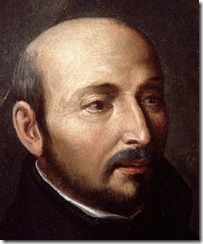
It took St. Ignatius of Loyola (that handsome fellow at the top right of this post) to formalize the idea of retreats in the 1500s. As the Catholic Encyclopedia notes:
The Society of Jesus was the first active religious order in which the practice of the retreat became obligatory by rule.
It goes on to point out:
The Society of Jesus did not reserve these exercises for its own exclusive use, but gave them to communities and individuals. Blessed Peter Faber in his “Memoriale” testifies to having given them to the grandees of Spain, Italy, and Germany, and used them in restoring hundreds of convents to their first fervour. A letter of St. Ignatius (3 Feb., 1554) recommends giving the exercises publicly in the churches. In addition, the houses of the Society often contained rooms for priests or laymen desirous of performing the exercises privately. Ignatius, having sanctioned this custom during his lifetime, one of his successors, Aquaviva, exhorted the provincials to its maintenance in 1599. In studying the spread of this practice we must not neglect the influence of St. Charles Borromeo. The cardinal and the Jesuits co-operated in order to promote this sort of apostolate. A fervent admirer and disciple of the “Spiritual Exercises”, St. Charles introduced them as a regular practice among the secular clergy by retreats for seminarians and candidates for ordination. He built at Milan an asceterium, or house solely destined to receive those making retreats, whose direction he confided to the Oblates. The zeal of St. Charles was effectual in encouraging the sons of St. Ignatius to adopt definitively the annual retreat, and to organize outside collective retreats of priests and laymen.
All of which brings us back to the Paulist Retreat House in Lake George, New York. As part of their mission, the Paulists operate a number of retreats on their Lake George property. Some are related to the arts (the Singer/Songwriter Residency Program and the Artists’ Residency Program), some are more contemplative (Restful Waters/Couples’ Retreat and Praying Your Life) and some are very focused like the Paulist Plunge. This will be Evan’s second year at the plunge. He attended the retreat last year and came back energized and renewed.
It’s pretty amazing what a few days of prayer and contemplation can accomplish.
If the idea of a retreat appeals to you, but you can’t possibly get away due to various life commitments, there are plenty of opportunities to take retreats — small and large — just where you are.
At the beginning of July, The Busted Halo published a Virtual Outdoor Retreat. This handy, printable guide gives you a chance to get back to nature in prayer and contemplation. The perfect thing for a summer Sunday afternoon.
If you don’t live anywhere near nature (you poor person!) and want a more technological retreat, you can take advantage of Fr. James Martin’s e-book Together on Retreat: Meeting Jesus in Prayer.
If you’re really pressed for time, but want a few moments of peace each day, consider the 3 Minute Retreats from Loyola Press. You can access them via the web, in your e-mail or through an inexpensive app. A few minutes of prayer can set a great tone for your whole day and each of these brief reflections will give you something to contemplate.
Whatever you choose, a retreat is a great way to reconnect with God and to strengthen your spiritual life.
–Dad
 One of the things that’s impressed me the most about Evan’s journey is the level of support that he’s had.
See that smiling fellow on the left of the page? His name is Fr. Larry Rice and he’s the current Vocations Director for the Paulists. His job is to guide men in the process of discernment. He talks to them, prays for them and with them, and assists them on their journey.
The Vocation Network website puts it this way:
A vocation director is designated by a religious institute to promote vowed membership, to help others discern their vocation, and to oversee the application process of new members entering the community as a postulant. They assist those who are considering the possibility of religious life by providing support, discernment counseling, and information.The Vocation director for a religious congregation answers to the elected superiors of their congregation. The National Religious Vocation Conference is the professional organization for vocation directors of religious communities.
Vocation Directors who work on behalf of a diocese answer to the bishop.They have their own professional organization, the National Conference of Diocesan Vocation Directors.)
It might sound (a little) like Vocations Directors are recruiters, looking to grow the ranks. This isn’t the case. In fact, anyone who has been pressured is not (by canon law) permitted to take vows. The ordained life — like marriage — is only legitimately available to those who choose it freely.
It might interest you to know that there are Vocations Directors for nuns as well. Sister M. Consolata is the Vocations Director for the Sisters of St. Francis of Alton, Illinois. She describes her role in working with young women in the process of discernment.
My role is to help you. Do you feel a tug on your heart to give everything to Jesus? Do you desire to live only for Him? Or maybe you are just wondering what religious life is all about.
I am here to help answer your questions and walk with you during your time of discernment. Remember, the Lord takes the first initiative. He loves you. Yes, YOU! Then He invites you to make a response to His love. Be not afraid! I would love to hear from you and about your journey with of faith.
Whether you’re a woman considering a vocation as a nun or a man considering the priesthood, your first contact should be with a Vocations Director. There will likely be one in your diocese and there are plenty of links on the web that you can use to contact them. Communicating with a Vocations Director will be an important step in the vocation journey — not just for the discerner, but also for that person’s family.
We haven’t yet had the opportunity to meet Evan’s current Vocations Director, Fr. Rice. We did get to meet Fr. Rice’s predecessor, Fr. Dave Farnum when he came through Utah to meet with Evan a year ago last spring. Fr. Dave is a wonderful man who told us about his own call to the priesthood. He reassured us about the process of discernment and gave us insight into what the ordained life would be like. We thoroughly enjoyed spending time with him and are grateful for everything that he — and Fr. Rice — have done for Evan.
–Dad

Here’s a little game I’ve enjoyed playing for the past couple of years. Whenever talk turned to children and someone asked about my kids, I’d point out that one was a Starbucks CoffeeMaster and the other was a university student.
“Oh? What’s he studying.”
“Philosophy,” I’d deadpan back.
The usual response was a furrowed brow and a hitch in the other person’s voice. I could almost see them thinking, Crud! What am I supposed to say now?
I understood their confusion. After all, isn’t the formal study of philosophy something of a joke? Never mind that some very successful people have degrees in philosophy. Never mind that it can be the gateway to many careers. Philosophy seems to be the sophisticated equivalent of underwater basket weaving.
It wouldn’t be fair to leave the other person hanging, so I always said, “Go ahead. You can ask.”
No one — ever — replied “Ask what?”
They all knew “what.”
And they all asked.
And I always told them of his intent to enter the seminary. It turns out that philosophy is a great background for a priest.
Evan explains it this way:
“Philosophy served as a ground work for theology and it was a good way for me to see if the priesthood was what I wanted to do,” said Cummings, adding that two of his professors at Utah State were Catholic.
You can find that quote (and some other interesting information including a mention of St. Wikipedia) in an article in this week’s Intermountain Catholic. If you have a minute, click over there and read it.
–Dad
So, now we have a date. A letter of instructions arrived for our son yesterday and, among other things, it gave August 21, 2013 as the start date for his Novitiate.
(I’m tempted to call that a “report date”, but that seems a little too militaristic for someone entering a religious vocation.)
It’s a little odd to think about him moving across the country in less than two months. I’m excited for him and proud, but it will be something of an adjustment for all of us. I imagine that any parent with a child moving far away would feel the same.
He is part of a class of four new novices and the Paulist Vocations office has asked for prayers for all of them.
Almighty and ever faithful God, you spoke your Word to the world in your Son Jesus Christ, and commissioned Saint Paul to bring your word to all nations and to the ends of the earth. Your Spirit led Servant of God Isaac Hecker to proclaim your word in North America using tools of the modern age.
We ask you to call new missionaries in the line of Saint Paul and Father Hecker.
May they burn with passion to give the Gospel a voice so that all may know the mystery of your love. May they follow the Lord Jesus with the zeal of Saint Paul and Father Hecker as they carry on the mission of the Paulist Community.
In the power of your Holy Spirit, we ask this through Christ our Lord.
Amen.
You can learn more about Paulist vocations on their website or by following them on Facebook.
–Dad
In my last post, I mentioned the Pope’s admonition regarding joy and it’s place in the Christian life. I certainly believe that, but I wanted to take a moment to address the other side of the equation.
Fr. James Martin is a Jesuit and author of Between Heaven and Mirth: Why Joy, Humor and Laughter are at the Heart of the Spiritual Life. On his blog this week, he posted an excerpt from the book addressing the difference between mindless happiness and true joy.
So the believer must navigate between a grinning, idiotic, false happiness and carping, caterwauling, complaining mopiness. (Notice again that I’m also not speaking of clinical depression here, which more of a psychological issue.) Overall, the believer will be happy and sad at different points of his life; but joy is possible in the midst of tragedy, since joy depends on one’s faith and confidence in God.
He goes on to note that:
Likewise, a person in a difficult situation can still find humor in his or her life and still laugh. Moreover, he can choose to be cheerful around others, not in a masochistic way but rather as a way of not unduly burdening everyone with your latest complaint. This is not to say that one should never talk about one’s struggles or burdens with anyone. As St. Paul would say, “By no means!” It’s important during times of struggle to speak to a close friend, family member, a priest or minister, or a therapist, things are very difficult. And it’s important to share those struggles with God in prayer.
This has certainly been true in my life. Even in the most difficult circumstances, there are moments of joy and grace and even laughter.
In my father’s last days, before the cancer finally beat him, there were many, many dark moments. Times when we despaired as we watched him spiraling down. Yet, there were also moments of joy and humor. Sometimes as a result of something we remembered about him from better days or because of some seemingly small event that set us to laughing.
Humor became a relief valve and provided us with moments that I truly believe were God-sent as grace to get us through.
Much of this came back to me this week when I read Thomas McDonald’s account of his father’s last days. Thomas is a talented blogger who perfectly captured the experience of a slow death in all of its essence. He, too, experienced those moments of grace and joy.
There were brief “rallies” and flickers here and there. One day, he was muttering something, and when my mother asked him who he was talking to, he said, “All of them” with a smile. He would regain tiny slivers of consciousness and his eyes would focus on blank places in the room, one after another, and smile beatifically.
Thomas sums up the experience at the end of the essay.
The bodies we have are noble and God-created: enfleshed spirit. They are wombs for the soul to be born into heaven, and one day we will return to these bodies, only to find them perfected. And after this our exile, we will come face to face with the first fruit of that womb, and there will be neither tears, nor death, nor mourning, nor crying, nor pain.
In my mind, these two essays complement one another. If you have a few moments, please read them both. They point to the middle path which we should walk as believers and give an example of the journey. And, both of them point to the fact that even in dark times, there is still joy to be found.
–Dad
This past week, about 6,000 novices and seminarians visited Rome as part of a Vocations Pilgrimage arranged by the Pontifical Council on the New Evangelization. I’ve enjoyed reading what the Pope has to say to these young people.
In his homily for July 7, he pulled three strands out of the readings and wove them into a compelling picture of ordained religious life. The whole homily is worth reading, but for the moment I’d like to concentrate on his first point — the need for joy in the Christian life.
From the first reading (Isaiah 66:10-14) Pope Francis talks about the joy of the consolation of the Lord.
Every Christian, especially you and I, is called to be a bearer of this message of hope that gives serenity and joy: God’s consolation, his tenderness towards all. But if we first experience the joy of being consoled by him, of being loved by him, then we can bring that joy to others. This is important if our mission is to be fruitful: to feel God’s consolation and to pass it on to others!
I think this joy is something that is too often lacking in the lives of Christians. We shuffle across the Earth with long faces and sour expressions and its little wonder that no one wants to join us. Somewhere along the line we’ve forgotten the essential nature of God.
God is love.
Stop and re-read that sentence. It’s become a sort of Christian meme that we toss around carelessly without really contemplating what it means. If you really consider it, the implications become awesome and a little frightening.
In his review of the film of the musical Les Miserables, Fr. Robert Barron says:
[Speaking of the Bishop’s gift of silver candlesticks.] In this simple and deeply affecting episode, one of the most fundamental principles of the spiritual life is displayed. God is love. God is nothing but gracious self-gift. And what God wants, first and last, is that his human creatures participate in the love that he is, thereby becoming conduits of the divine grace to the world. What Jean Valjean received through the bishop was precisely this divine life and the mission that accompanies and flows from it. If the bishop’s gesture had been, in any sense, self-interested, it would not have conveyed God’s manner of being. But in its utter gratuity, it became a sacrament and instrument of uncreated grace.
Earlier this year, our parish hosted a weekly class built around Fr. Barron’s Seven Deadly Sins/Seven Lively Virtues study course. That hardly sounds like the sort of topic that would lend itself to a discussion of God’s love. Dialogue about sin inevitably conjures visions of punishment. Yet, Fr. Barron constantly drew out the fact that we owe our very existence to God’s love. He used the phrase “continually loved into being” over-and-over.
If we believed that — really believed that — it would change the way we act; it would change who we are.
I think Pope Francis believes that as well, in an earlier address to the seminarians in Rome, he said that there is “no holiness in sadness“.
Pope Francis took seminarians and novices to task for being “too serious, too sad”. “Something’s not right here,” Francis told them pointing out that `’There is no sadness in holiness,” and adding that such clergy lack “the joy of the Lord.”
“To become a priest or a religious is not primarily our choice; it is our answer to a calling, a calling of love”.
“If you find a seminarian, priest, nun, with a long, sad face, if it seems as if in their life someone threw a wet blanket over them,” then one should conclude “it’s a psychiatric problem, they can leave – `buenos dias’”.
He’s right. How can we not have joy and confidence when we know God loves us?
–Dad
In an earlier post, we mentioned that our son will be attending the Paulist seminary. That invites the question, “What is a Paulist?”
Before we can get to the answer to that, it might be helpful to explain the difference between diocesan priests and order priests — sometimes referred to as secular and religious priests.
The word “priest” often conjures up the image of a kindly fellow in a roman collar who works at the local parish. Sort of a latter day version of Bing Crosby’s character in Going My Way. There’s a bit of Hollywood hyperbole going on with Bing Crosby, but the image of a diocesan priest is essentially correct.
A man who is ordained as a diocesan priest promises to obey and respect the diocesan bishop and his successors and to live a life of chastity. His task is to serve the people of the diocese primarily by administering the sacraments.
In a 2009 article from the Catholic News Service, Father Brian Doerr, vocations director for the Diocese of Lafayette in Indiana says:
From the beginning, you’ve discerned that you’ll be ordained and be in the world living and working
Most diocesan priests serve as pastors or associate pastors at local parishes, but some are assigned to other ministries such as teaching in parochial schools.
Order priests, on the other hand, belong to a particular religious community. Religious communities are formally organized catholic groups working on the particular mission or charism of their founder. For example, Pope Francis is a Jesuit. That means he is a member of a religious community for men that is known as The Society of Jesus was founded by St. Ignatius of Loyla in 1540.
Fr. Warren Sazama (a Jesuit) uses a healthcare metaphor to explain the differences:
One diocesan priest I know referred to diocesan priests as the general practitioners of the clergy and compared religious to specialists. As in medicine, the Church needs both. So, while for the most part diocesan priests serve in parishes, religious can serve in a variety of ways according to the “charism,” or unique vision and mission of their founder. That might be in schools, hospitals, orphanages, missions, retreat houses, social justice centers, or other ministries in accordance with the inspiration, special vision, mission, and spirituality of their founder
Finally, just because I find it amusing, I wanted to share something I found while researching this post. The Occupational Outlook Handbook from the Department of Labor includes Roman Catholic Priest among the many thousands of other job titles it lists. I’m not sure it’s proper to refer to a priestly vocation as a “job”, but I can’t disagree with the government’s assessment that:
Many priests will be needed in the years ahead to provide for the spiritual, educational, and social needs of the increasing number of Catholics.
–Dad
I’m a big fan of humor. Big fan. Sure I love a good drama, but I’ll go out of my way for a mediocre comedy. When it comes to Shakespeare, give me Much Ado About Nothing over Henry V any day. (Which in no way implies that Much Ado is mediocre…just making the point that my preferences run to the funny.)
Which is why I was struck by a comment Pope Francis made in his homily on July 1.
He was preaching about the need for tenacity in prayer; the need to bring our petitions to God over and over; the need to negotiate with God. He cited the example of Abraham asking God to spare the cities of Sodom and Gomorrah.
When we speak of courage we always think of apostolic courage – going out to preach the Gospel, these sort of things…But there’s also (the kind of) courage (demonstrated) before the Lord. That sense of paralysis before the Lord: going courageous before the Lord to request things. It makes you laugh a bit; this is funny because Abraham speaks with the Lord in a special way, with this courage, and one doesn’t know: is this a man who prays or is this a‘phoenician deal’ because he’s bartering the price, down, down…And he’s tenacious: from fifty he’s succeeded in lowering the price down to ten. He knew that it wasn’t possible. Only that it was right…. But with that courage, with that tenacity, he went ahead.
There. Do you see it? Right in the middle of the paragraph Pope Francis acknowledges the humor of the situation.
It makes you laugh a bit.
As a lector, I love being able to proclaim the reading from Genesis 18:16-33. Abraham’s character is so vivid and outright funny. God tells him that Sodom is toast. Most of us would probably nod and say, “Well, they deserve it.”
Abraham doesn’t. He starts to negotiate with God. He starts the bargaining by asking if God really intends to sweep away the righteous with the wicked. Then he asks
Suppose there were fifty righteous people in the city; would you really sweep away and not spare the place for the sake of the fifty righteous people within it?
God agrees to Abraham’s terms and Abraham — good negotiator that he is — presses further. With a hilariously formal humility —
See how I am presuming to speak to my Lord, though I am only dust and ashes!
— he drives the bargain to 45 and then 40 and then 30 and then 20 and finally 10. The whole story has a sort of haggling-in-the-marketplace vibe that makes me chuckle every time.
Yet, as Pope Francis points out, negotiating with God is a perfectly acceptable form of prayer.
Sometimes, the Pope said, one goes to the Lord “to ask something for someone;” one asks for a favor and then goes away. “But that,” he warned, “is not prayer,” because if “you want the Lord to bestow a grace, you have to go with courage and do what Abraham did, with that sort of tenacity.” The Pope recalled that Jesus himself tells us that we must pray as the widow with the judge, like the man who goes in the middle of the night to knock on his friend’s door. With tenacity.
In fact, he observed, Jesus himself praised the woman who tenaciously begged for the healing of her daughter. Tenacity, said the Pope, even though it’s tiring, is really “tiresome.” But this, he added, “is the attitude of prayer.” Saint Teresa, he recalled, “speaks of prayer as negotiating with the Lord” and this “is possible only when there’s familiarity with the Lord.” It is tiring, it’s true, he repeated, but “this is prayer, this is receiving a grace from God.” The Pope stressed here the same sort of reasoning that Abraham uses in his prayer: “take up the arguments, the motivations of Jesus’ own heart.”
Like all good humor, the story of Abraham’s negotiation is funny because it is true. And it tells us something about ourselves and our world.
–Dad
In the two-and-a-half years since my wife and I became aware of our son’s vocation call, it’s been interesting telling people about it.
I remember telling some good Catholic friends about it the December after he told us. Their first response was surprise, followed closely by something that looked almost like sympathy.
We’ve seen that look over-and-over among our Catholic friends. They are all pleased, but they also understand the level of commitment that comes with the vocation.
“Is he old enough?”
That’s an interesting question. When I was his age, I was newly married. I’d made a lifelong commitment of fidelity and obedience and no one seemed to mind overmuch. It would be wonderful to believe that everyone knew how mature I was for my age and that I’d make a wonderful husband. It would be wonderful…and inaccurate. Nobody really knew what lay ahead for me — for us — but I guess we trusted in God’s grace.
As an aside, it is interesting that many people perceive priestly vows as more binding and difficult than those of marriage. Perhaps this is because a priest is taking a vow of service to God. Or, perhaps it is because people don’t fully understand the rewards of the priesthood.
Whatever the case, God has blessed Cathy and I with a long and satisfying marriage.
We approach our son’s vocation with the same faith. (We try to, at least.) His period of discernment has already lasted longer than our engagement and he has quite a bit of time yet to go. If he continues on this path to the point of ordination, he’ll be blessed with the ontological change which occurs in all priests.
Is he young? Yes. But so were we when we got married. So were thousands of priests. All any of us can do is put our trust in God and move ahead.
P.S.
Of course, this isn’t the only question we’ve been asked. There have been lots of others. We’ll be addressing them in future posts. If you’d like to ask us a question, feel free to post in the comments or e-mail us at SeminarianParents@gmail.com
–Dad
 Seminarian Parents