Catechesis

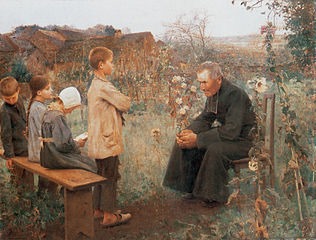
Catechism Lesson - Jules-Alexis MuenierThe Pope says that Cathy and I are special.
Well, not really.  What he said was that catechists are “pillars” for education in the faith.  This came in the context of his remarks to the participants in the International Conference on Catechesis.

This was a neat article for Cathy and I as we are both catechists.  Cathy is in her second year teaching a fifth grade formation class for our parish.  She does sword drills with them (an idea we borrowed from our Protestant friends), has crafts, lets the journal privately and works to help them understand the sacraments.  It’s been a great experience for her.

I’ve been asked to take on a special class for a group of young people who have never had any of the sacraments.  I’ll be meeting them soon to set a schedule and get started.  They range in age (I think) from about eight to about fourteen, so it should be an interesting challenge.  I’m looking forward to it.

Cathy and I have also been invited to take formal catechist training through the Salt Lake Diocese.

So, the article resonated with us.  As is his way, Pope Francis also dropped a challenge in along with the praise.

“This is a beautiful experience, and a bit paradoxical…Why? Because the person who puts Christ at the centre of his life is off-centre. The more you unite with Jesus and make Him the centre of your life, the more He makes you abandon yourself, decentralize yourself, and open yourself to others…In the heart of the catechist, there always lives this ‘systolic- diastolic’ movement: union with Jesus; encounter with the other…If at one of these two movements is no longer beating, then you do not live.”

This reminds me a bit of a story that Fr. Rolheiser shared in a recent column.

A priest friend of mine who teaches at a secular university was once asked by one of his students: “Father, have you met Jesus Christ?” His answer, no doubt, reflected some fatigue: “Yes,” he replied, “I have met Jesus Christ, and it messed-up my whole life! There are days when I wish I hadn’t met him!” What his answer, in its irreverence, correctly highlights is that meeting Jesus implies a lot more than a private, romantic, affective, and safe encounter with him and that meeting Jesus is more than having a private feeling in the soul that we are loved by and secure with God.

Like that tired priest, Pope Francis is reminding us that following Jesus is deeply countercultural and challenging and we cannot expect it to be easy.  As catechists, we have to accept that challenge and expect that we will have moments of doubt and difficulty.  At the same time, Pope Francis reminds us in his gentle, pastoral tone:

This is our beauty and our strength: If we go, if we go out to bring his Gospel with love, with true apostolic spirit , with frankness , He walks with us , before us always [preceding] us.

— Dad

Question: What is the Paulist Mission?

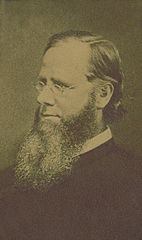
Hecker1This past week the novices spent some time with Fr. Colgan learning more about the Paulist mission.  Seemed a good excuse to post a few words about what make the Paulists unique.

In short, the Paulists are a missionary order who work primarily in North America.

Their three-fold mission is:

— Evangelization, by giving the Word of God a voice “using tools of the modern age”

— Reconciliation with Catholics who have left the church

— Ecumenical outreach to build bridges with other faiths

All of this relates back to Fr. Isaac Hecker, a Redemptorist priest who was called by the Holy Spirit as a missionary to the people of North America.  This puts the Paulist priests out into the community as much as possible, finding ways to build bridges and understanding.

A couple of notable examples of this ministry include The Busted Halo and Fr. James DiLuzio’s Luke Live.

Busted Halo is a far reaching ministry designed to reach out to the young who have questions of faith.  (Although those of us who are “older” can learn a lot there as well.)  Among the tools of Busted Halo you’ll find a comprehensive and frequently-updated website, a daily radio program on Sirius XM, and a variety of podcasts which include homilies and a more-or-less-weekly Q&A show with Fr. Dave Dwyer and Fr. Steven Bell.

Luke Live is a parish mission in which Fr. James brings his considerable vocal and theatrical talents into play to illuminate and instruct around the Gospel of Luke.  We’ve been privileged to have him bring the mission to our parish twice now and both visits were remarkable and uplifting.

And, of course, I’d be remiss if I didn’t mention two of their more well-known ministries; Paulist Press and Paulist Productions.  The first of these is a publishing house and the second a film production company.

One last note, this week Evan will be meeting with a Sulpician priest.  I had never heard of the Sulpicians and was surprised to discover that they are an order which is dedicated to the formation of priests.  Kind of neat that such and order exists.  I look forward to hearing more about them in the future.

— Dad

Question: What Does A Novice Do?

The first few weeks of Evan’s Novitiate have been somewhat busy, but things are beginning to settle down.

In addition to the initial retreat, his unexpected trip back to Utah, and his brief stay in New York City, he’s had the privilege of attending Jimmy Hsu’s Final Promise Mass and Mass of Ordination as a Transitional Deacon.  The participation of the entire Paulist Community in DC in these events underscores the deep commitment these men have to the order and their connectedness and it was — by all accounts — a joyous celebration.

With that past, the novices are beginning to settle into the routine that will serve them in their discernment during the coming months.  I’m going to share (as best I can) a snapshot of that life.  If I miss something, I’ll ask that the novices be generous and gentle in correcting my errors.

7:45 a.m. — Morning prayer from the Liturgy of the Hours.  (If you’re interested in sharing that experience, you can find out more at Universalis.com and DivineOffice.org)

Breakfast after prayer

9:30 a.m. — Conference with other novices.  This may be discussions of the texts the novices have been reading, current issues facing the Church or the order, events of the day, explorations of different forms of prayer and spirituality, and theology discussions.  From what I gather, this is sort of an updated version of the old academic notion of a colloquy or seminar.

Noon — Lunch, like all meals, taken in common with the community.

The afternoon is free time during which the novices engage in personal prayer and study as they seek to enter into a deeper relationship with God.  They have all been given a number of books — some of which are mandatory reading and some of which they selected themselves.  The mandatory reading includes 101 Questions and Answers on Paul and the biography of Isaac Hecker (founder of the order), among other books.  For the self-selected reading, Evan just finished a book on Native Meso-American Spirituality and Dan (another novice whom I have gotten to know through Facebook) is reading Where the Hell is God?

4:50 p.m.  — Prayer in front of the Blessed Sacrament in the Blessed Sacrament chapel.

5:15 p.m. — Mass in the adjacent St. Paul chapel.

5:45 p.m. — Pre-Dinner Social.

6:15 p.m. — Dinner, again taken with the community.

7:30 p.m. — Communal prayer, led by the novices.  Each day (in rotation) one of the novices selects the prayer.  Sometimes they pray the Liturgy of the Hours for the evening, sometimes other prayers.  Evan chose the Chaplet of St. Michael last week when it was his turn.

In addition to the daily routine, there are certain special days during the week.

On Wednesday, the schedule is altered to accommodate Mass at noon in the Holy Spirit Chapel and the evening prayer at 5:15 is led by the students.  (Once a candidate complete the novice year and make his first promise, he is considered a student.)

On Friday, Mass and prayer are at 7:30 a.m. and the novices have the rest of the day free.  Evan has been using his time to explore DC a bit and spent last Friday visiting the Air and Space Museum at the Smithsonian.

Saturday is the work period for the novices when they are assigned chores such as cleaning and mopping.

Evan also tells me that a Paulist Father (Tom Ryan, I believe) has generously allowed the novices to participate in his class “Body, Mind and Heart” which connects Christian prayer to the meditative practices of yoga.

They novices are also being trained for their apostolates.  These involve the novices working the local community and parishes to help out.  I don’t have a clear idea of what Evan will be assigned yet, but once I do I’ll be back with another post.

As always, questions are welcome.

— Dad

So, Where’ve You Been?

Our boots, showing the red dust from Zion's National ParkIt’s been a little quiet around here this past week.

In celebration of 28 years of marriage, Cathy and I took off on Southwestern vacation; revisiting two of our favorite parks and making our first visit to another.

We hiked the familiar Rim Trail at Bryce Canyon, took in the Emerald Pools and explored Watchman in Zions, and visited the North Rim of the Grand Canyon.  We love the rugged, surreal scenery of the southwest and relished the opportunity to get out in it again.

Along  the way, God watched out for us — despite the fact that it rained every day, it never rained on us.  When our Jeep’s battery died, we were stopped at an actual gas station which actually did service.  So, we had a crisis-free vacation which gave us a chance to relax.

We’ll leave you with a few of our favorite pictures from the trip.

— Dad

The view from Rim Trail in Bryce

Cathy resting at the top of Watchman

A view from a bridge near the Zion Park Lodge

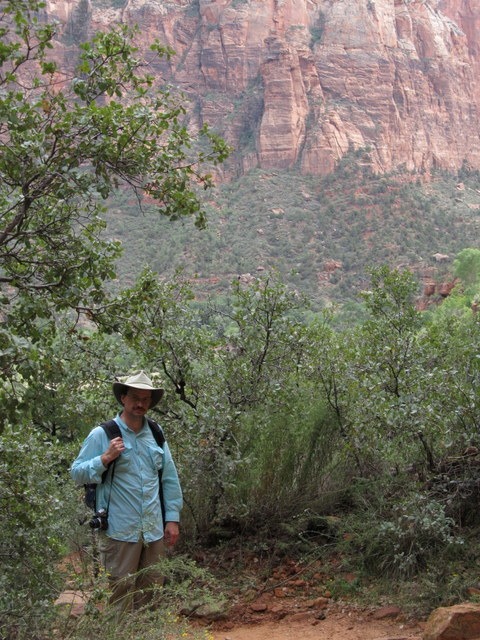
Kevin on the Emerald Pools Trail

Sunset at the North Rim

A Panoramic View of the North Rim Lodge

Question: What is a Vocation?

imageWhen I set out to write this particular post, I thought it would be easy.  You hear about “vocations” all the time.  Except, when I started researching, it seemed to be more subtle and complex than I expected.

I’m going to take my best shot and hope that if I stray, someone will be kind enough to correct me.

I’ll start with a quote from St. John Paul II.

What is a vocation? It is an interior call of grace, which falls into the soul like a seed, to mature within it. (Angelus message, December 14, 1980)

The Lumen Gentium, (one of the principle documents to come out of the Second Vatican Council) explains that there is a sort of universal vocation:

Thus it is evident to everyone, that all the faithful of Christ of whatever rank or status, are called to the fullness of the Christian life and to the perfection of charity; by this holiness as such a more human manner of living is promoted in this earthly society. In order that the faithful may reach this perfection, they must use their strength accordingly as they have received it, as a gift from Christ. They must follow in His footsteps and conform themselves to His image seeking the will of the Father in all things. They must devote themselves with all their being to the glory of God and the service of their neighbor. In this way, the holiness of the People of God will grow into an abundant harvest of good, as is admirably shown by the life of so many saints in Church history. (40)

My first thought was, “Oh.  Is that all?”  The “perfection of charity” and “holiness” seems like something of a tall order.  But it’s right there in black-and-white and (just in case you missed it) there’s a reference to this in paragraph 2013 of the Catechism.

Both those quotes contain within them the notion of a “call” from God; an invitation to live a life of holiness.  What’s interesting is that the Lumen Gentium acknowledges that there are many different ways that this life of holiness can be lived.  Section 41 speaks eloquently about bishops and priests, other consecrated clerics, lay ministers, married couples, widows, single people, “those who engage in labor”, the poor, the infirm, and the sick.  It concludes by sweeping them all up into a final paragraph:

Finally all Christ’s faithful, whatever be the conditions, duties and circumstances of their lives—and indeed through all these, will daily increase in holiness, if they receive all things with faith from the hand of their heavenly Father and if they cooperate with the divine will. In this temporal service, they will manifest to all men the love with which God loved the world. (41)

This is often referred to as the “universal vocation” and I’m taken with this notion that we are all encouraged to pursue holiness as our primary vocation, by acting out our calling.  It’s the word “calling” that most Catholics think of when they hear the word “vocation”.

Traditionally, Catholic thought turns to three different vocations as “primary” vocations or callings; holy orders, consecrated life, or marriage.  Holy orders refers to those who are ordained as deacons, priests and bishops.  Consecrated life refers to those who have taken vows to live “the evangelical councils of poverty, chastity and obedience“; the most common of which are those who live in religious communities such as monks or nuns.  Marriage is also a vocation, although one that is often held in too little regard in the common culture.

All of these primary vocations — these paths to holiness — are a response to God’s call and all of them involve a total gift of self.  For married couples, we are called to give ourselves wholly and unreservedly to our spouse.  For those taking vows, they are giving themselves totally to God.

I found a wonderful article on OSV.COM that explains it very eloquently:

In the case of each primary vocation, that gift of self is not a transitory or temporary thing. It’s not given one day and taken back the next. Rather, the central relationship of each is spousal. It’s exclusive, total and enduring. When the gift of self is made to God, enduring is a “for all eternity” kind of enduring. When the gift of self is made to another person, it’s just an “until death to us part” kind of enduring. Nevertheless, the idea is the same: You fully and freely give yourself to another, and through that giving you pursue your universal vocation, holiness.

One of the keys — if not the key — to working toward holiness is surrender.  It’s that wonderful paradox that comes up again and again in Christ’s teachings — the idea that to attain the most that God has for us, we have to give up our self.

Then he said to all, “If anyone wishes to come after me, he must deny himself and take up his cross daily* and follow me. For whoever wishes to save his life will lose it, but whoever loses his life for my sake will save it. (Luke 9:23-24)

Which doesn’t mean that we turn our backs on life.  Most of us have bills to pay and families to raise and (yes!) parishes to support and that means taking up some form of worldly labor.  You’ll sometimes see this referred to as a “secondary vocation”. Having a job (or even a career) facilitates our survival and it can also be part of our journey toward holiness  The Lumen Gentium recognizes this when it says:

Finally, those who engage in labor—and frequently it is of a heavy nature—should better themselves by their human labors. They should be of aid to their fellow citizens. They should raise all of society, and even creation itself, to a better mode of existence. Indeed, they should imitate by their lively charity, in their joyous hope and by their voluntary sharing of each others’ burdens, the very Christ who plied His hands with carpenter’s tools and Who in union with His Father, is continually working for the salvation of all men. In this, then, their daily work they should climb to the heights of holiness and apostolic activity. (41)

There is — as I discovered in writing this — a lot more territory to cover when it comes to vocations including the question of discerning God’s will for our lives.  I’ll end this now, though, with an encouraging quote from Thomas Merton.

Discovering vocation does not mean scrambling toward some prize just beyond my reach but accepting the treasure of true self I already possess. Vocation does not come from a voice out there calling me to be something I am not. It comes from a voice in here calling me to be the person I was born to be, to fulfill the original selfhood given me at birth by God.

Thomas Merton

–Dad